itstargetnews

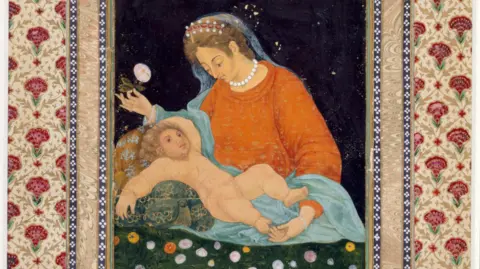 From the British Library archives
The birth of Jesus Christ – a seminal biblical event – has been the subject of many paintings by Western artists, who often drew on the ideas of beauty and creativity that prevailed there when depicting this event on canvas.
These works are among the most widespread representations of Christian art, shaping how the world viewed this biblical event and subconsciously removing its influence from those outside the West.
But for centuries, Indian artists have tried to express their views on the event by depicting the Nativity and other Christian themes in their own style.
Some do this consciously, some unconsciously, but the end result is a body of work that breathes new life and meaning into the event of Christ’s birth and Christianity itself.
Here are some paintings from Indian art history that show the birth of Jesus from a unique local perspective.
The Mughal emperor Muhammad Jalaluddin Akbar introduced Christianity to northern India by inviting Jesuit missionaries to his court.
Missionaries brought artwork with biblical and European Christian themes, which influenced court painters. Akbar and his successors also commissioned many murals with Christian themes, and some court painters began to infuse these paintings with elements of Islamic art.
South Asia historian Neha Vermani talks about a painting created by a Mughal court artist that depicts Emperor Jahangir in a nativity scene that traditionally features Mary , Joseph and baby Jesus.
“The Mughal rulers saw themselves as ‘just’ rulers, able to maintain harmony and balance in their kingdom; they were ‘universal rulers.’ Allowing different religions to coexist was an important part of how they viewed themselves and wanted themselves to be remembered Partly,” Ms. Vermani said.
The 18th-century painting below has typical stylistic elements of Mughal art, including highly stylized figures, bright colors, naturalism, and decoration.
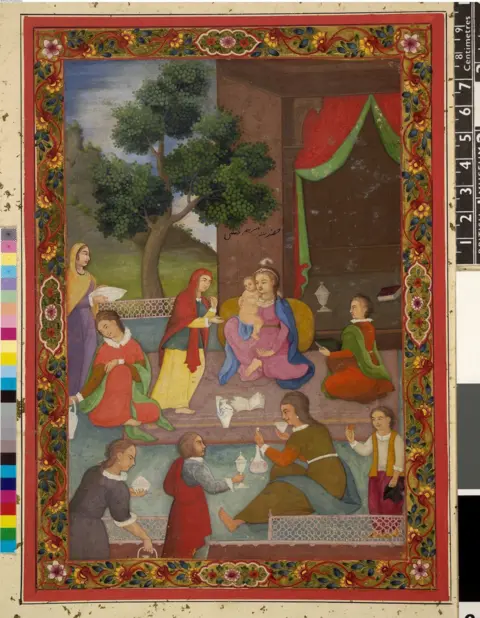 Trustees of the British Museum
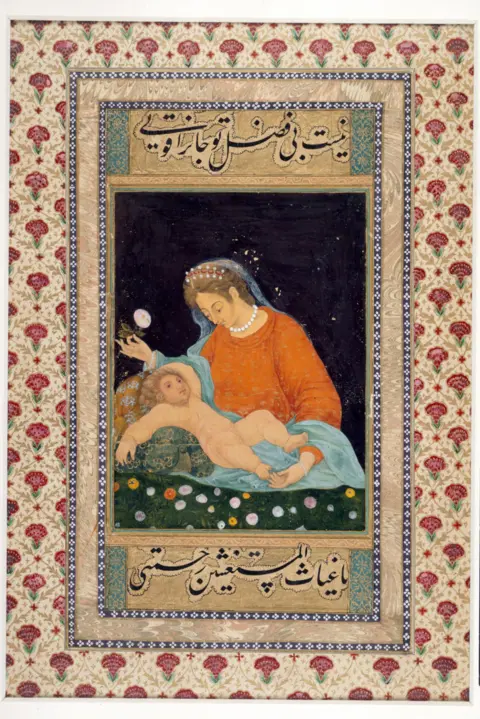 From the British Library archives
Born in 1887 in what is now the Indian state of West Bengal, Jamini Roy is known for creating a unique visual language by fusing elements of Bengali folk art and Kaliyat painting, a A unique art form that originated near a famous temple in the city of Kolkata.
Ashish Anand, CEO and Managing Director of art company DAG, said art critic WG Archer once observed that Christ represented the Santal figures of Jamini Roy ( Santals are an Indian tribal group).
“The simplicity of Christ’s life and his sacrifice attracted Roy, making his paintings of Christian themes at least as important as his paintings of Hindu mythology, all rendered in his distinctive modernist folk style,” he said.
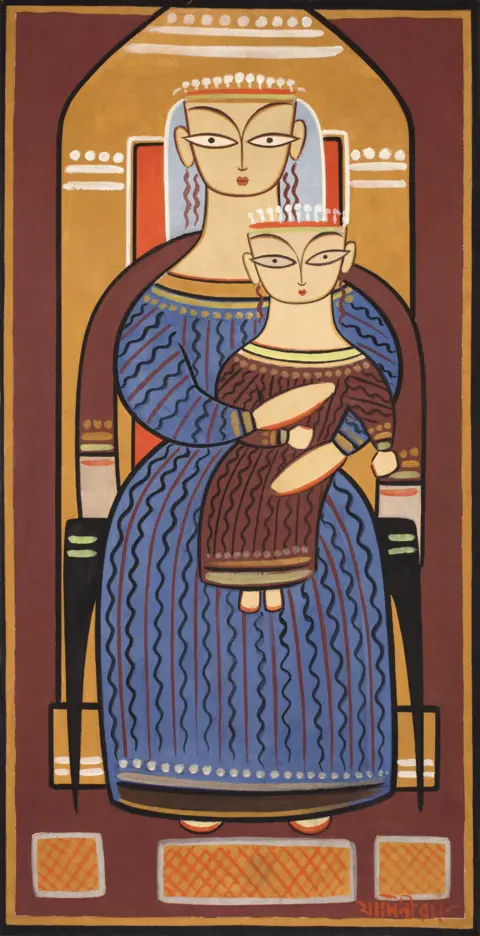 Photo courtesy: DAG
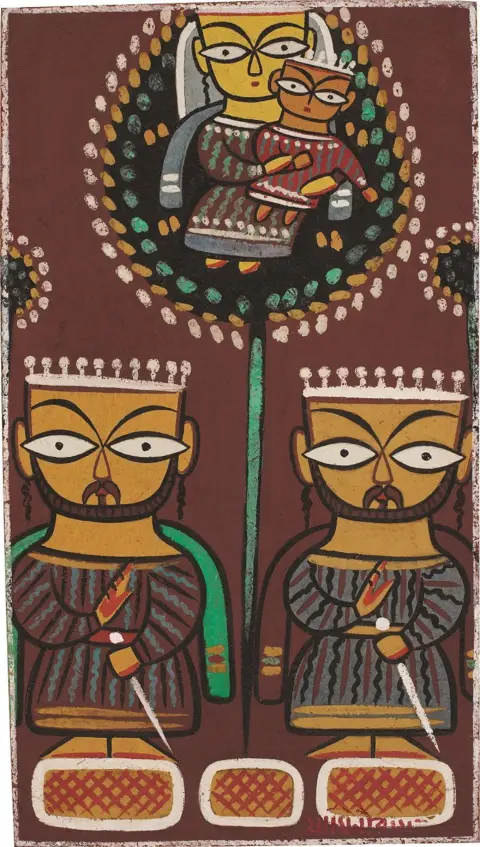 Photo courtesy: DAG
Born in 1902 in the western state of Goa, Angelo de Fonseca is credited with creating unique Christian iconography, blending Eastern and Western influences with his Goan sensibility.
In his paintings, Mary is not depicted as a beautiful maiden in a blue robe, but looks very much like a brown-skinned Indian woman wearing a sari and a mangalsutra (a Hindu Traditional Indian jewelry worn by married women)).
The biblical scenes unfold in a local setting and have themes and elements that speak to Indian audiences.
Through his art, he sought to disprove the notion that the West was the cradle of beauty and artistic creativity.
“Fonseca wanted to situate Christianity – largely seen as a Western religious tradition – in the Indian subcontinent. It was out of this anxiety that his watercolors re-portrayed Christianity,” said Ri Li, director of the Xavier Center for Historical Research. Rinald D’Souza, Goa, told the BBC.
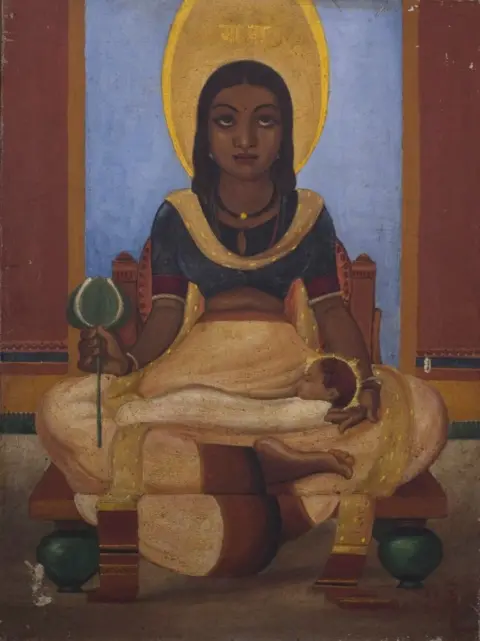 Xavier Center for Historical Research, Goa
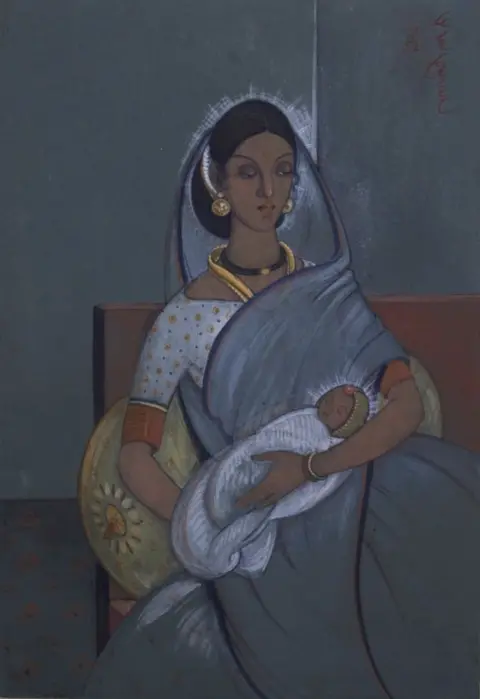 Xavier Center for Historical Research, Goa