itstargetnews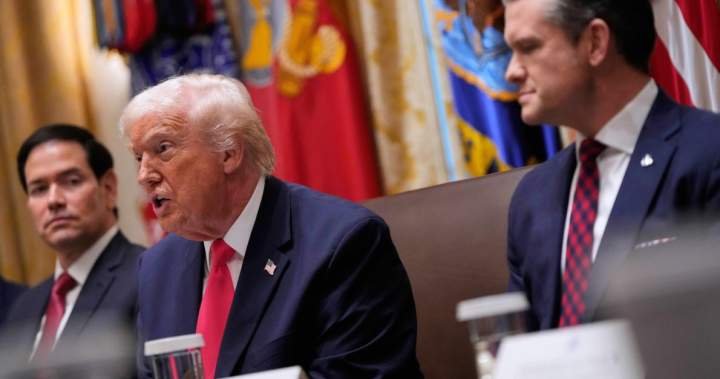
Since the United States and Israel went on strike Iran on Saturday, the US president Donald Trump and his administration have offered shifting explanations for why war is necessary—and what the endgame is.

On Tuesday, Trump offered a new rationale, suggesting Iran was preparing to attack Israel and potentially other Gulf countries, requiring the US – which has thousands of military and diplomatic troops in the Middle East – to strike first.
This appeared to contradict suggestions a day earlier that Israel was planning a pre-emptive strike against Iran, requiring the US to act and avoid a deadly Iranian retaliation.
Officials cited the “imminent” threat posed by Iran’s nuclear and ballistic missile programs, despite claims that strikes last June had “wiped out” Iran’s nuclear facilities. Officials claimed that efforts are underway to rebuild these facilities.

Although the stated goals of the war so far appear to be exclusively military and security, Trump has openly called for regime change.
He also wavered between setting a clear four-week timeline for US operations and saying operations could last “as long as we want”, and did not rule out the possibility of US troops on the ground in Iran.
“I certainly hope that the endgame is well defined by the president and the administration so that Congress can do what Congress is supposed to do: hold the president accountable, which hasn’t happened so far,” said retired U.S. Maj. Gen. Randy Manner, who served as deputy commander of the U.S. 3rd Army in Kuwait.
Here’s how the message has evolved since Saturday.
Trump to Iranians: ‘America supports you’
In a video address released early Saturday morning after the first US and Israeli strikes on Iran, Trump said his goal was to “defend the American people by eliminating the immediate threat of the Iranian regime.”
“His threatening activities directly threaten the United States, our troops, our bases abroad and our allies around the world,” he said.
Trump cited decades of attacks by Iran and its terrorist proxies in the region that have killed American civilians, as well as failed negotiations to end their pursuit of nuclear weapons, along with Iran’s ability to hit Europe and American bases abroad with long-range ballistic missiles that “could soon reach the American homeland.”

He said the US would “destroy their missiles and raze their missile industry” as well as “destroy their navy” and end Iran’s ability to finance and arm militant groups such as Hamas and Hezbollah.
“When we are done, take over your government,” he said to the Iranian people.
“Now you have a president who gives you what you want. So let’s see how you respond. America supports you with overwhelming power and destructive force. Now is the time to take control of your own destiny and unleash the prosperous and glorious future that lies ahead.”
Trump and Israeli officials later confirmed that Iran’s Supreme Leader Ayatollah Ali Khamenei had been killed in an attack on his compound in Tehran, along with dozens of other senior Iranian officials.
“All I want is freedom for the people,” Trump he told the Washington Post in an interview early Saturday after his announcement but before Khamenei’s death was confirmed.
‘A terrible threat to every American’
In a video update on Sunday, Trump said that US operations in Iran would continue “until all of our objectives are met”, and that the regime posed a threat to both the US and Israel.

Get daily national news
Get the day’s top news, political, economic and current affairs headlines delivered to your inbox once a day.
He did not say whether the threat was imminent.
“An Iranian regime armed with long-range missiles and nuclear weapons would be a terrible threat to every American,” he said. “We cannot allow a nation that amasses terrorist armies to possess such weapons – it would allow them to force the world to their evil will. I will not allow that to happen.
“These actions are right and necessary to ensure that Americans will never have to face a radical, bloodthirsty terrorist regime armed with nuclear weapons and numerous threats.”
He again called on the Iranian people to “take back their country” and said the US “will be there to help”.

‘I got him before he got me’
In a series of one-on-one phone interviews with reporters on Sunday, Trump offered shifting rationales and timelines for war.
In an interview with ABC Newsthe president said of Khamenei, “I got him before he got me,” referring to U.S. accusations of Iran-backed plots to kill Trump. He added that “most of the candidates” identified by the US to succeed the supreme leader have been killed, and that the operation will last “as long as we want it.”
He said NBC news The “number one” outcome that the US is looking for “is beheading, get rid of their whole group of murderers and thugs. And there are many, many outcomes. We could do a short version or a long version.”
Trump said the US envisioned a “four to five week” deadline. interview for the New York Times.
He suggested the “perfect scenario” would be similar to what happened in Venezuela, where much of the regime remained in place and pledged to work with the US after the capture of President Nicolas Maduro.
‘It is not a so-called war for regime change’
In his first public event since the start of the warOn Monday, Trump reiterated many of the goals he outlined in his Saturday video, but stopped short of repeating his call for regime change.
“Our goals are clear,” he said. “First, we destroy Iran’s missile capabilities… Second, we destroy their navy… Third, we ensure that the world’s number one sponsor of terrorism can never obtain a nuclear weapon… And finally, we ensure that the Iranian regime cannot continue to arm, finance and direct terrorist armies outside its borders.”
Trump said the administration had anticipated a deadline of four to five weeks, “but we have the ability to go much longer than that.”


At a separate briefing in the Pentagon with General Dan Caine, chairman of the Joint Chiefs of Staff, US Defense Secretary Pete Hegseth said the military’s “clear, devastating, decisive mission” is to “destroy the missile threat, destroy the Navy, without nuclear weapons.”
“This is not a so-called regime change war, but the regime has certainly changed and the world is better for it,” he said.

Caine said that achieving the military’s goals “will take some time, and in some cases it will be difficult and painstaking work.”
“Our mission is to protect and defend ourselves and, together with our regional partners, to prevent Iran from projecting power beyond its borders and to be ready for further actions as necessary,” he said.

‘We were aware of Israel’s intentions’
Speaking to reporters on Monday after a briefing with congressional leaders on Capitol Hill, US Secretary of State Marco Rubio said the US must act now because Israel will attack Iran, which would retaliate by attacking US bases in the region.
“There was absolutely an immediate threat, and the immediate threat was that we knew that if Iran was attacked — and we believe they would be — that they would come after us immediately,” he said. “We went proactively in a defensive manner to prevent them from doing more damage.
“Obviously we were aware of Israel’s intentions and we understood what that would mean for us, and we had to be prepared to act as a result. But this had to happen no matter what.”
He denied, however, that the US was forced to attack because of the upcoming Israeli action, and that the ultimate goal of the US was regime change.
“Still, we wouldn’t mind, we wouldn’t be heartbroken and we hope that the Iranian people can overthrow this government and establish a new future for that country,” he said.
“We wish it was possible. But the goal of this mission is to destroy their ballistic missile capabilities and their naval capabilities.”

‘They wanted to attack first’
During a meeting in the Oval Office with German Chancellor Friedrich Merz on Tuesday, Trump was asked if Israel coerced him and dragged the US into war with Iran.
“No, I may have forced them,” Trump replied.
“You see, we were negotiating with those lunatics, and it was my opinion that they would attack first. They would attack if we didn’t. They would attack first, I strongly felt that.”
He added: “Based on the way the negotiations went, I think they will attack first, and I didn’t want that to happen. So, if anything, I may have forced Israel’s hand. But Israel was ready and we were ready.”
He later said that Iran “was getting ready to attack Israel, they were getting ready to attack others.”
Asked what the worst possible scenario for war could be, Trump suggested it would be if “we do this and then we get taken over by someone who is just as bad as the last person. That could happen.”