itstargetnews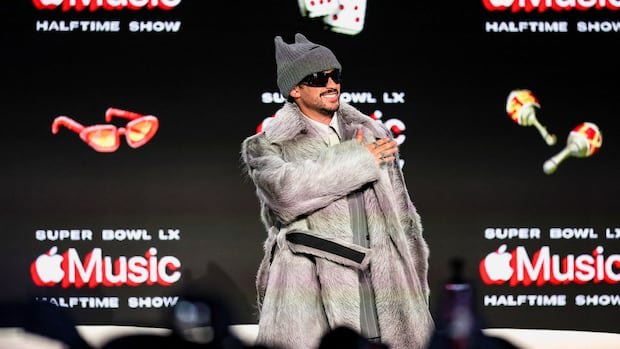
It’s four days until Puerto Rican superstar Bad Bunny hits one of the biggest stages in music — the NFL Super Bowl halftime show.
Bad Bunny, the “King of Latin Trap” and one of the biggest music artists in the world, remained tight-lipped on Thursday about what fans can expect during the upcoming show, avoiding the question of whether or not he might bring out musical guests.
But he promised a good time.
“I know the world will be happy this Sunday. And they will have fun, and they will dance,” said the 31-year-old singer, born Benito Antonio Martínez Ocasio.
He urged viewers at a pre-Super Bowl press conference not to worry about anything but practicing their dance moves ahead of the big day.
“I don’t want to give away any spoilers. It’s going to be fun,” he said.
But beyond the music and dance, culture war commentary has swirled around the decision to make Bad Bunny the halftime act since the September announcement.
That rhetoric has intensified since last weekend’s Grammy Awards, where the singer used the platform to criticize the Trump administration’s crackdown on immigration in the US, led in part by Immigration and Customs Enforcement (ICE).

Puerto Rican musician Bad Bunny was the big winner of this year’s Grammy Awards and used the opportunity to speak out against the immigration policy of US President Donald Trump.
After receiving the Grammy for best música urbana album on Sunday for YOU SHOULD TAKE MORE PHOTOS — which later made history as the first Spanish-language album to win Album of the Year — Bad Bunny began his speech by saying, “Before I say thank God, I’m going to say ICE out.”
After drawing a standing ovation, the singer added: “We are not savages, we are not animals, we are not aliens. We are human and we are Americans.”
Increased immigration measures in the USA resulted in the death of two American citizens — Renee Good and Alex Pretty — in Minnesota last month.
While other stars, including Billie Eilish and Olivia Dean, have also used their time on stage to criticize immigration crackdowns or defend immigrants, Bad Bunny’s comments were some of the most direct.
When asked about the possibility of politics playing a role in Sunday’s halftime, NFL commissioner Roger Goodell said he expects Bad Bunny to use the huge platform to rally the country.
“Bad Bunny … is one of the great artists in the world and that’s one of the reasons we chose him. But the other reason is that he understood the platform he’s on, and that platform is used to bring people together,” Goodell said at a press conference Monday.
“I think Bad Bunny understands that and I think he’s going to have a great performance.”

Benjamin Tausig, a professor at Stony Brook University who studies protest music, says he expects any political statements at the big game to be more subtle than those at the Grammys.
He says the open format of an awards acceptance speech, where celebrities have a few minutes to say whatever they want in front of an audience of their peers, naturally attracts more political statements.
The NFL tightly scripts and manages halftime performances to prevent potentially polarizing comments, Tausig said.
“At the Super Bowl, (artists) can’t be explicit, but they can be implicit,” he said. “And I bet Bad Bunny will find some ways to do that.”
Kendrick Lamar’s performance last year is a perfect examplehe says. A Pulitzer Prize-winning rapper he was “subtle and clever” in his commentary on how the US treats its black citizens, Tausig said, which allowed him to pull it off.

Politics is already in play
Whatever happens this weekend, Bad Bunny’s performance has already taken on a political dimension.
Those from the political right panned the selection for Bad Bunny to perform, and some will follow him lack of English songs. Others said that “big Trump hater” and “anti-ICE activist,” while the American president himself said that the choice “absolutely ridiculous.”
Bad Bunny previously criticized Trump’s response to Hurricane Maria, which devastated Puerto Rico, and seemingly shot at the president in music video for his song NUEVAYoLin which Trump’s voice can be heard on the radio apologizing to immigrants.
This is Bad Bunny.
He was just announced as the 2026 Super Bowl halftime show.
– Big hater of Trump
– Anti-ICE activist
– No songs in English
He even canceled his entire US tour for this reason: “Fucking ICE might be out of my concert. And that’s something we were… pic.twitter.com/11KvuSWnEH
The artist also opted for a 30-show residency in Puerto Rico instead of touring the U.S. mainland, in part out of fear that “ICE may be out” of his concerts attempt to arrest fans.
Since Bad Bunny accepted to perform at the Super Bowl, which takes place at Levi’s Stadium in Santa Clara, California, US Secretary of Homeland Security Kristi Noem said right-wing podcaster Benny Johnson that ICE will be at the game and involved in law enforcement.
NFL officials said as much this week ICE would not actually be one of the federal agencies responsible for security on the day of the match, but the locals supposedly they are not convinced and remain concerned.
The commotion with Elamine Abdelmahmoud24:59What does the end of Bad Bunny’s residency mean for Puerto Rico? And a new graphic novel by Fela Kuta
In protest, the right-wing advocacy group Turning Point USA is hosting its own “All-American Half-time Show” on Sunday. Headlined by Kid Rock and featuring several country acts, the show is billed as a celebration of “faith, family and freedom.”
“(Bad Bunny) said he’s having a dance party, wearing a dress and singing in Spanish? Cool. We plan to play great songs for people who love America,” Kid Rock said.
‘Everything He Does’ Is Political: Music Critic
Beyond the battle of the culture war, freelance music critic Reanna Cruz says Bad Bunny taking the Super Bowl stage is sending a message because of what the artist means to the Latino community.

The superstar will make history if he performs the show entirely in Spanish, as expected. He’s sung it exclusively in Spanish (save for a few English words or phrases here and there) on all six of his studio albums — a rare feat, Cruz says, since many other Spanish-language artists have switched to English to appeal to a wider, mainstream audience.
(If you want to brush up on your Spanish before Sunday, Duolingo has decoded some of the stars’ hits from “Naughty Bunny 101.”)
Bad Bunny also incorporates sounds from lesser-known Puerto Rican folk genres and sings about the issues plaguing his home island, which has made him a symbol of the Latino community and his music inherently political, according to Cruz.
“All of that — who he is as a person and the ethos he has around celebrities and supporting his community — makes everything he does political,” Cruz said. “The fact that he even has that platform is an extremely important message in itself.”