itstargetnews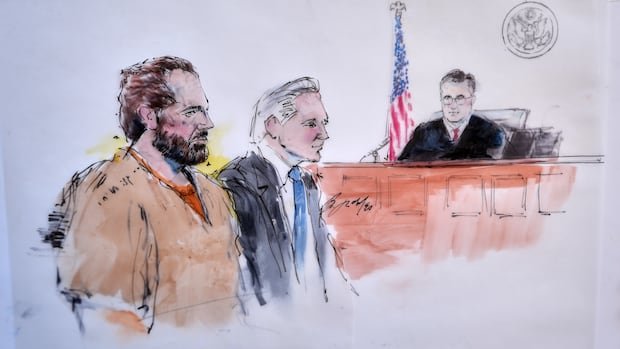

Listen to this article
Estimated 4 minutes
The audio version of this article was generated using artificial intelligence-based technology. Mistakes in pronunciation may occur. We work with our partners to constantly review and improve results.
Ryan Wedding, the former Olympic snowboarder turned alleged drug kingpin, pleaded not guilty Monday in a Santa Ana, California, court to multiple charges related to murder and drug trafficking.
The 44-year-old, who was born in Thunder Bay, Ont., was arrested in Mexico last week after spending nearly 10 years on the run from authorities in the United States, Canada, Mexico, Colombia and the Dominican Republic.
He faces 17 charges, including conspiracy to export cocaine, continuing a criminal enterprise, murder in connection with a continuing criminal enterprise and drug crime, and retaliation against a witness, victim or informant by murder.
The crimes were allegedly committed in multiple countries, prompting cooperation among law enforcement agencies and raising questions about who had jurisdiction to prosecute Wedding.
He was on the FBI’s 10 Most Wanted list, and the US government offered a $15 million reward for information leading to his arrest or conviction.
Here’s what we know about the next steps in the criminal case against Wedding.

Anthony Colombo, the attorney for Ryan Wedding, spoke to reporters outside a courthouse in Santa Ana, Calif., after his client and alleged drug kingpin entered two not guilty pleas. Colombo said that it is still early in the process and that ‘indictments are not evidence, they are only accusations’.
When is the next court appearance?
Wedding is scheduled to return to court on February 11 for a status hearing, where the parties involved in the case will discuss whether a trial date – set for March 24 – is realistic.
His lawyer, Anthony Colombo, told CBC News he expects the parties to agree that March is “too early” given the complexity of the case and the seriousness of the charges.
“I would say we plan to delay this for at least six months, given the number of defendants, the nature and circumstances, the amount of discovery we would have to go through,” he said.
Meanwhile, Wedding is in custody in California.
The judge said Monday that he could not immediately find conditions that would ensure public safety or Wedding’s appearance in court, but that he would consider bail if Wedding requested it at a later date.
What punishments is he facing?
Wedding faces an automatic life sentence if convicted of murder, drug trafficking and witness tampering.
Although Colombo said the case is also eligible for the death penalty, he does not expect the U.S. attorney’s office to pursue that option. He said that a life sentence without parole is also possible.
This is precisely where Canada’s involvement complicates matters, according to Dalhousie University law professor Robert Currie.
“If the death penalty is on the table, Canadian police can no longer cooperate with the U.S. to facilitate the investigation,” because Canada does not have the death penalty, Currie told the CBC’s Thomas Daigle.
“The whole slant of our law would suggest that the death penalty puts really significant barriers on police being able to cooperate, to send evidence, to send officers to testify in the US.”
Currie said Canadian police would also have to stand down if prosecutors seek life without parole, which is considered unconstitutional in Canada.
There was speculation that Wedding might cooperate with investigators and give up some of his associates in exchange for a lighter sentence. Currie says it’s possible the prosecution and defense could agree to bring charges below a slightly lower threshold if Wedding continues down that path.
“It would leave room for a plea bargain, it would leave room for cooperation, if that’s what Mr. Wedding ultimately wants to do,” Currie said.
What about the Canadian charges?
Wedding still faces charges in Canada, stemming from a cocaine-importation plot uncovered by RCMP in 2015 while he was living in Montreal. His drug-trafficking ring was Canada’s largest supplier of cocaine, according to a 2024 indictment.
Currie says that while Canada could legally request Wedding’s extradition to face those charges, it is highly unlikely that they would, given that “a major effort to cooperate with the police” is already underway in the case.
“It appears to me that the decision has been made, fully within the law, that all prosecutions will take place in the US,” Currie said.
He says Wedding could try to challenge the charges on jurisdictional grounds, but would likely be unsuccessful, as cross-border crimes are flexible in terms of which countries can prosecute.