itstargetnews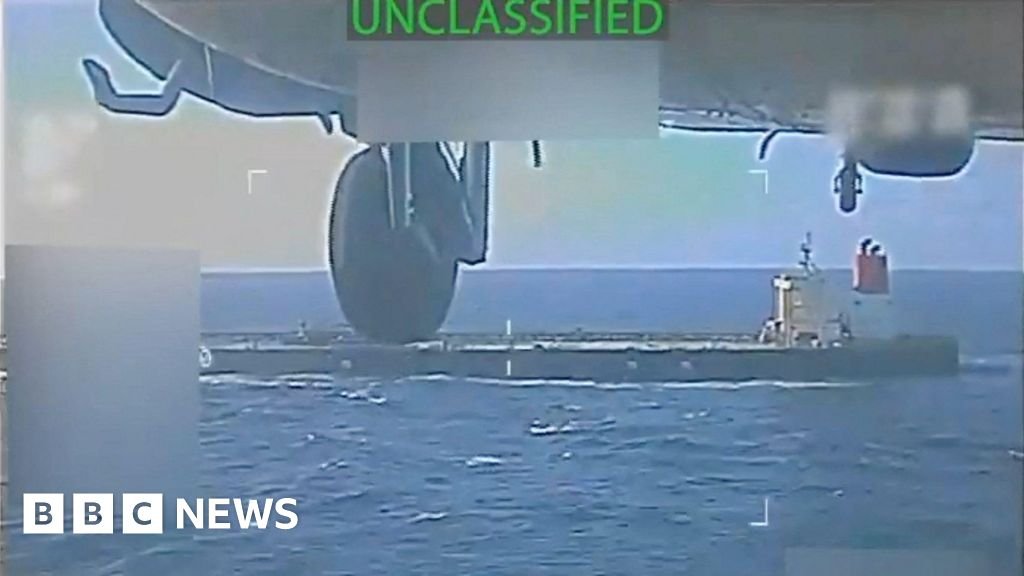
Angel Bermudezbbc news world

 Reuters
Amid further escalation in tensions between the United States and Venezuela, President Donald Trump ordered a naval blockade to prevent sanctioned oil tankers from entering or leaving the South American country.
Venezuela has the world’s largest proven oil reserves and is highly dependent on oil export revenues to fund its government spending.
But U.S. sanctions against Venezuela’s state-run oil company PDVSA have made it difficult for the Venezuelan government to export oil, leading them to resort to a fleet of “ghost ships”.
So what do we know about these ships and how they operate?
“Complete and complete lockdown”
Trump imposed sanctions on Venezuela’s oil industry as early as 2019 during his first term as president.
Venezuelan crude oil exports fell by more than half that year, from about 1.1 million barrels per day in January to about 495,000 barrels per day at the end of 2019, according to the U.S. Energy Information Administration.
Six years later, sanctions remain in place, but Venezuela’s oil exports have grown again to about 920,000 barrels per day as of November, Reuters reported.
While this is well below the country’s 1998 peak of 3 million barrels per day (bpd) of oil exports, this partial recovery suggests sanctions on Venezuela are not working as well as the United States had hoped.
This suggests that Nicolás Maduro’s government has found new ways to sell Venezuelan oil centered on a “ghost fleet.”
Not unique to Venezuela
The phenomenon of ghost fleets is growing and is used not only by Venezuela but also by Russia and Iran, two other oil-producing countries subject to Western sanctions.
Financial intelligence firm S&P Global estimates that one in five tankers worldwide is used to smuggle oil from sanctioned countries.
Of these, 10% transport only Venezuelan oil, 20% transport Iranian oil, and 50% exclusively transport Russian oil. The remaining 20% does not belong to any specific country and can transport oil from multiple countries.
Oil sanctions are designed to prevent countries or companies from purchasing or handling crude oil from sanctioned countries.
Companies and countries that purchase oil from sanctioned countries such as Venezuela face the risk of U.S. sanctions.
Sanctioned countries sell oil at deep discounts so that companies or countries are willing to risk buying the oil, while using tricks to disguise its origin.
False logos and name changes
One of the most common tactics used by ghost tankers is to change their name or flag frequently – sometimes several times a month.
For example, the tanker seized on Wednesday was named “The Captain,” according to BBC America partner CBS News.
The ship has been subject to U.S. Treasury sanctions since 2022 for its alleged involvement in an oil smuggling network that helps fund Iran’s Revolutionary Guards and the Lebanese militia Hezbollah, CBS reported.
At the time, the tanker was named Adisa, but was originally known as Toyo. It is one of the ships linked to Russian oil tycoon Viktor Artemov, who is also subject to sanctions.
The Skipper is a 20-year-old vessel, another common characteristic among Ghost Fleet tankers. Large shipping companies usually dispose of ships after 15 years of use, and they are usually scrapped after 25 years.
“Zombie Ship”
Another trick used by these vessels is to steal the identities of scrapped vessels using unique registration numbers assigned by the International Maritime Organization – similar to how criminals exploit the identities of deceased persons.
These are called “zombie ships.”
Last April, a ship named the Varada arrived in Malaysian waters after a two-month journey from Venezuela.
This aroused suspicion because it was a 32-year-old vessel flying the flag of the East African island nation of Comoros, a common choice for ships wanting to avoid detection.
According to a Bloomberg investigation, this is a zombie ship because the real Varada was scrapped in Bangladesh in 2017.
The news agency compared satellite imagery with historical photos and found four zombie ships carrying Venezuelan crude.
Other common tactics include concealing the origin of crude oil by diverting it in international waters to legitimate tankers flying another flag.
The oil companies then ship the oil to its destination and identify it as coming from a country not subject to sanctions.
This is what happened to Venezuela’s oil exports to China during the tightening of sanctions during Trump’s first term.
Another common trick used by these tankers is to disable automatic identification systems, which transmit data including the vessel’s name, flag, location, speed or route.
This allows the ship to hide its identity and location.
Maritime risk firm Vanguard Tech said it believed the Skipper “has long been spoofing its position” – sending false signals to make it appear to be in a different location.
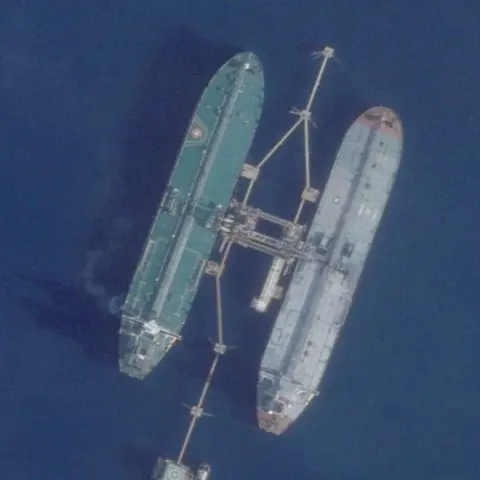 Planet Labs PBC/Reuters
According to an October report by the anti-corruption NGO Transparency Venezuela, there are 71 foreign tankers in the ports of Venezuela’s state oil company PDVSA, 15 of which are subject to sanctions and nine linked to the ghost fleet.
The investigation found that 24 tankers were operating covertly and had their mandatory positioning signals deactivated.
The NGO said it had detected six incidents of ship-to-ship cargo transfers in waters off western Venezuela.
Most of the ships fly the flags of countries such as Panama, Comoros and Malta that are seen as safe havens with lax sanctions regulations.
Many vessels have been stuck at oil terminals for more than 20 days without docking, while Chevron vessels authorized by the United States to operate in Venezuela load and leave within six days.
“The prolonged stay in the port area, without direct access to the oil terminal, raises serious doubts about the type of operations being carried out by these vessels,” Transparency Venezuela said in its report.
Whereas the December 10 seizure of the ship came from the USS Gerald R. Ford – the world’s largest aircraft carrier – now part of the US Navy. The United States deploys large-scale military forces in the CaribbeanMaduro’s ability to rely on the Ghost Fleet is likely to be significantly weakened.