itstargetnews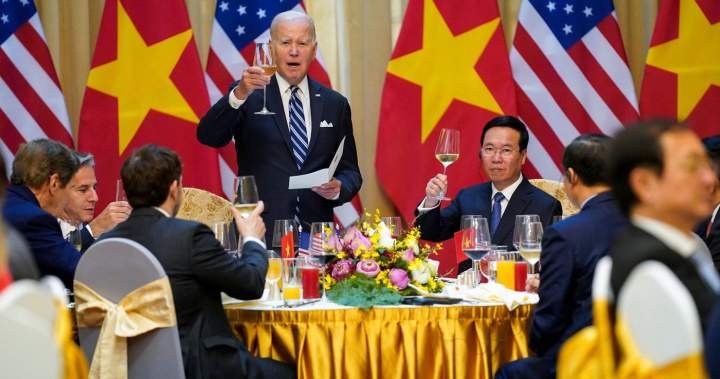
A year later Vietnam raised its relations with Washington to the highest diplomatic level, an internal document showed its military was taking steps to prepare for a possible US “war of aggression” and considered the United States a “belligerent” power, according to a report released Tuesday.

More than just exposing Hanoi’s duality in its approach to the US, the document confirms a deep-rooted fear of outside forces fueling an uprising against the communist leadership in a so-called “color revolution”, such as the Orange Revolution in Ukraine in 2004 or the Yellow Revolution in 1986 in the Philippines.
Other internal documents cited in its analysis by The 88 Project, a human rights organization focused on human rights abuses in Vietnam, point to similar concerns about American motives in Vietnam.
“There is a consensus here across government and in different ministries,” said Ben Swanton, co-leader of Project 88 and author of the report. “This is not just some kind of fringe or paranoid element within the party or within the government.”
“The Second American Invasion Plan”
The original Vietnamese document, titled “Second US Invasion Plan,” was completed by the Department of Defense in August 2024.
He suggests that in pursuit of “its goal of strengthening deterrence against China, the US and its allies are willing to employ unconventional forms of warfare and military intervention, and even carry out large-scale invasions against countries and territories that ‘diverge from its orbit’.”
FILE – A member of the U.S. Marine Corps Honor Guard holds a Vietnamese flag during a cordon of honor at the Pentagon to welcome Vietnamese Defense Minister Gen. Phan Van Giang, Sept. 9, 2024, in Washington. (AP Photo/Kevin Wolf, file).
Noting that “currently there is little risk of war against Vietnam,” Vietnamese planners write that “due to the bellicose nature of the US, we must be careful to prevent the US and its allies from ‘creating a pretext’ to launch an invasion of our country.”
Vietnamese military analysts outline what they see as progress through three US administrations – from Barack Obama, through Donald Trump’s first term and to Joe Biden’s presidency – with Washington increasingly pursuing military and other ties with Asian states to “form a front against China”.
Vietnam balances diplomatic outreach with internal fears
In his tenure, Biden signed a “Comprehensive Strategic Partnership” with Vietnam in 2023, elevating relations between the nations to the highest diplomatic level on par with Russia and China as “trusted partners with friendship based on mutual respect.”

Get daily national news
Get the day’s top news, political, economic and current affairs headlines delivered to your inbox once a day.
However, in a 2024 military document, Vietnamese planners said that while the US views Vietnam as a “partner and important link”, it also wants to “expand and impose its values of freedom, democracy, human rights, ethnicity and religion” to gradually change the country’s socialist government.
“The Second American Invasion Plan provides one of the clearest insights into Vietnam’s foreign policy,” Swanton wrote in his analysis. “It shows that far from viewing the US as a strategic partner, Hanoi sees Washington as an existential threat and has no intention of joining its anti-China alliance.”

Vietnam’s Ministry of Foreign Affairs did not respond to emails seeking comment on the Project 88 report or the highlighted document.
The U.S. State Department declined to comment directly on “America’s Second Invasion Plan,” but emphasized the new partnership agreement, saying it “promotes prosperity and security for the United States and Vietnam.”
“A strong, progressive, independent and resilient Vietnam benefits our two countries and helps ensure that the Indo-Pacific remains stable, secure, free and open,” the State Department said.
Documents offer a window into inner thinking
Nguyen Khac Giang, of Singapore’s ISEAS-Yusof Ishak Institute think tank, said the plans underscore tensions within Vietnam’s political leadership, where a conservative, military-oriented Communist Party faction has long been preoccupied with external threats to the regime.
“The military has never been too comfortable moving forward with the Comprehensive Strategic Partnership with the United States,” Giang said.
Tensions within the government spilled into the public sphere in June 2024, when the US-affiliated Fulbright University was accused of inciting a “color revolution” in a military TV broadcast. The State Department defended the university, a point that US and Vietnamese officials pointed out as the two countries upgraded ties.
Zachary Abuza, a professor at the National War College in Washington, said the Vietnamese military still has a “very long memory” of the war with the U.S. that ended in 1975. While Western diplomats have tended to see Hanoi as the most worried about possible Chinese aggression, the document confirms other policy documents that suggest the leader’s biggest fear is a “color revolution,” he said.


Further undermining trust between the US and Vietnam are cuts to the US Agency for International Development by President Donald Trump’s administration, which have disrupted projects such as efforts to clean up tons of soil contaminated with deadly dioxin from the military defoliant Agent Orange and unexploded US munitions and landmines.
“This pervasive uncertainty about color revolutions is very frustrating, because I don’t see why the Communist Party is so uncertain,” said Abuza, whose book, “Vietnamese People’s Army: From People’s Warfare to Military Modernization?” it was published last year.
“They have so much to be proud of – they have lifted so many people out of poverty, the economy is growing, they are the darlings of foreign investors.”

While China and Vietnam have clashed over territorial claims in the South China Sea, the documents portray China more as a regional rival than a threat like the US
“China does not pose an existential threat to the Communist Party (of Vietnam),” Abuza said. “Indeed, the Chinese know that they can only push the Vietnamese so far, because they fear that the Communist Party cannot respond strongly to China (and will) look weak and cause a mass uprising.”
China is Vietnam’s largest two-way trading partner, while the US is its largest export market, meaning Hanoi must strike a balance between maintaining diplomatic and economic ties while protecting itself from its stakes.
“Even some of the more progressive leaders are looking at the United States, saying, ‘Yes, they like us, they work with us, they are good partners for us so far, but if given the opportunity to have a color revolution, the Americans would support it,'” Abuza said.
Trump’s second administration eases some concerns but raises others
Under Vietnamese leader To Lam, who became general secretary of the Communist Party around the same time the document was written, the country has moved to strengthen ties with the US, especially under Trump, Giang said.
Lam was reappointed secretary-general last month and is expected to assume the presidency, which would make him the country’s most powerful figure in decades.
With Lam at the helm, the Trump family business began a $1.5 billion golf resort and luxury real estate project under the Trump name in the northern province of Hung Yen. The Vietnamese leader almost immediately accepted Trump’s invitation to join the Peace Committee, which Giang said was an unusually quick decision given that foreign policy moves are usually calibrated with close attention to Beijing’s possible reaction.
But Trump’s military operation to capture former Venezuelan President Nicolás Maduro has given Vietnamese conservatives new justification for their discomfort with closer ties to Washington. Any US military action involving Hanoi’s ally Cuba could upset Vietnam’s strategic balance, Giang added.
“Cuba is very sensitive,” he said. “If something happens in Cuba, it will send shock waves among the Vietnamese political elites. Many of them have very strong, intimate ties to Cuba.”
Overall, the first year of Trump’s second term likely left Vietnamese happy about his focus on the Western Hemisphere, but wondering about other developments, Abuza said.
“Vietnamese people will be confused by the Trump administration, which has downplayed human rights and the promotion of democracy, but at the same time has been willing to undermine the sovereignty of states and remove leaders they don’t like,” he said.