itstargetnews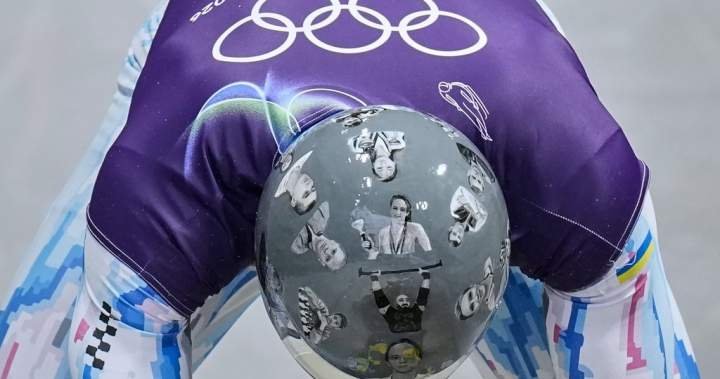
Ukrainian skeletonist Vladyslav Heraskevycha likely medal contender at the Winter Olympics, was banned from racing on Thursday after refusing a last-minute request from the International Olympic Committee not to wear a helmet that honors more than 20 athletes and coaches killed in his country’s war with Russia.

The decision came about 45 minutes before the start of competition and ended a three-day saga in which Heraskevych knew he risked being pulled from the Games by wearing the helmet, which the IOC says violates rules against making statements on the field of play.
The International Bobsled and Skeleton Federation said his decision to wear a helmet was “contrary to the Olympic Charter and the Guidelines on Athlete Expression”.
He wore a helmet in training, but the IOC asked him to wear a different helmet in races. He offered concessions, such as wearing a black armband or allowing him to show off his helmet after leaving the ice.
“I deeply believe that the IBSF and the IOC understand that I am not breaking any rules,” Heraskevych said.
“Also, I would say (that) it’s painful that it really looks like discrimination because a lot of athletes have already spoken out. … They haven’t faced the same things. So all of a sudden only a Ukrainian athlete at these Olympics is going to be disqualified because of a helmet.”
IOC president Kirsty Coventry, who was supposed to be in Cortina d’Ampezzo to see the alpine skiing, went to the ski center instead of meeting Heraskevych.
She was waiting at the top of the trail when he arrived around 8:15 a.m., and they found themselves alone. After about 10 minutes, Coventry failed to change Heraskevych’s mind.
“We haven’t found common ground on this issue,” Heraskevych said.

Coventry had tears streaming down his face after the meeting. The Olympic swimming champion made it clear she wanted a different outcome, and the IOC said the decision was made with regret.
Ukrainian skeletonist Vladyslav Heraskevych speaks to the media at the start house of the skating center at the 2026 Winter Olympics in Cortina d’Ampezzo, Italy, Thursday, Feb. 12, 2026.
(AP Photo/Fatima Shbair)
“As you’ve all seen over the last few days, we’ve allowed Vladyslav to use his helmet in practice,” Coventry said.

Get the latest national news
For news that affects Canada and the world, sign up for breaking news alerts delivered directly to you as they happen.
“No one, no one — especially me — disagrees with the messages. The messages are powerful messages. It’s a message of remembrance. It’s a message of remembrance and nobody disagrees with that. The challenge we face is we wanted to ask or come up with a solution just for the field of play.”
Coventry and Heraskevych agreed that the helmet is not clearly visible during the races anyway, given that the skaters are hurtling down the ice chute at about 120 km/h (75 mph). This, the IOC hoped, was a window for compromise. Heraskevych did not give in.
“Unfortunately, we haven’t been able to come to that resolution,” Coventry said. “I really wanted to see him race today. It was an emotional morning.”
Heraskevych said he would appeal to the Court of Arbitration for Sport, but the race continued without him. The first two runs were on Thursday, the last two on Friday.

Regardless of what CAS says, his chance to race at these Games is gone. The IOC allows him to keep his accreditation, which means he can stay in the Olympics as an athlete – just not as a competitor.
About a dozen Russian athletes are allowed to compete in the Olympics as neutrals along with seven Belarusians. They are not allowed to compete under their national flag or anthem.
Heraskevych has spoken several times about why he believes they should not be at the Olympics and said the IOC’s decision “plays into Russian propaganda.”
The decision immediately drew condemnation from officials in Ukraine and some athletes.


“Sports should not mean amnesia, and the Olympic movement should help stop wars, not play into the hands of aggressors,” Ukrainian President Volodymyr Zelenskyy wrote on social media.
“Unfortunately, the International Olympic Committee’s decision to disqualify Ukrainian skeletonist Vladyslav Heraskevich says otherwise.”
“Disqualified. I think that’s enough to understand what the modern IOC really is and how it disgraces the idea of the Olympic movement,” Ukrainian skier Kateryna Kotsar added on Instagram. “Vladyslav Heraskevych, for us and for the whole world, you are the champion. Even without a start.”
The IOC was previously on the side of Ukraine’s first candidate.
When he displayed a “No war in Ukraine” sign after his fourth and final run at the 2022 Beijing Olympics, the IOC said he was simply calling for peace and did not reveal that he had violated the Olympic Charter.
In this video still, Vladyslav Heraskevych, of Ukraine, holds a sign that reads “No war in Ukraine” after finishing his race in the men’s skeleton competition at the 2022 Winter Olympics, Friday, Feb. 11, 2022, in Yanqing District, Beijing.
(NBC via AP)
This time, Heraskevych said he believes there are inconsistencies in the way the IOC decides what statements are allowed.
Among those he cited: American figure skater Maxim Naumov bringing a photo of his late parents — former world doubles champions Evgenia Shishkova and Vadim Naumov, who were among the 67 people who died in a plane crash on Jan. 29, 2025 — into the kiss-and-cry area after his skate in Milan this week, and Israeli skeleton skater Jared Firestone’s decision to appear at the opening ceremony carrying a statue inscribed with their names 11 Israeli athletes and coaches killed in an attack in 1972 during the Munich Games.
“The contestant literally put the memory of the dead on his head to pay tribute to them,” Heraskevych wrote on Instagram. “Honestly, I don’t understand how these two cases are fundamentally different.”
Firestone said he admired Heraskevych. “I think he’s a man with strong values,” he said.

In Milan, IOC spokesman Mark Adams said if athletes were allowed to display messages without restrictions on the field of play “it would lead to a chaotic situation”.
“Sports without rules can’t work… If we don’t have rules, we don’t have sports,” Adams said.
Heraskevych was fourth at the world championships last year and was among the fastest in the training sessions leading up to the Olympic races. The medal was certainly within reach, but the helmet was more important to Heraskevych.
“The International Olympic Committee destroyed our dreams,” said Mykhailo Heraskevych, the skater’s coach and father. “It’s not fair.”