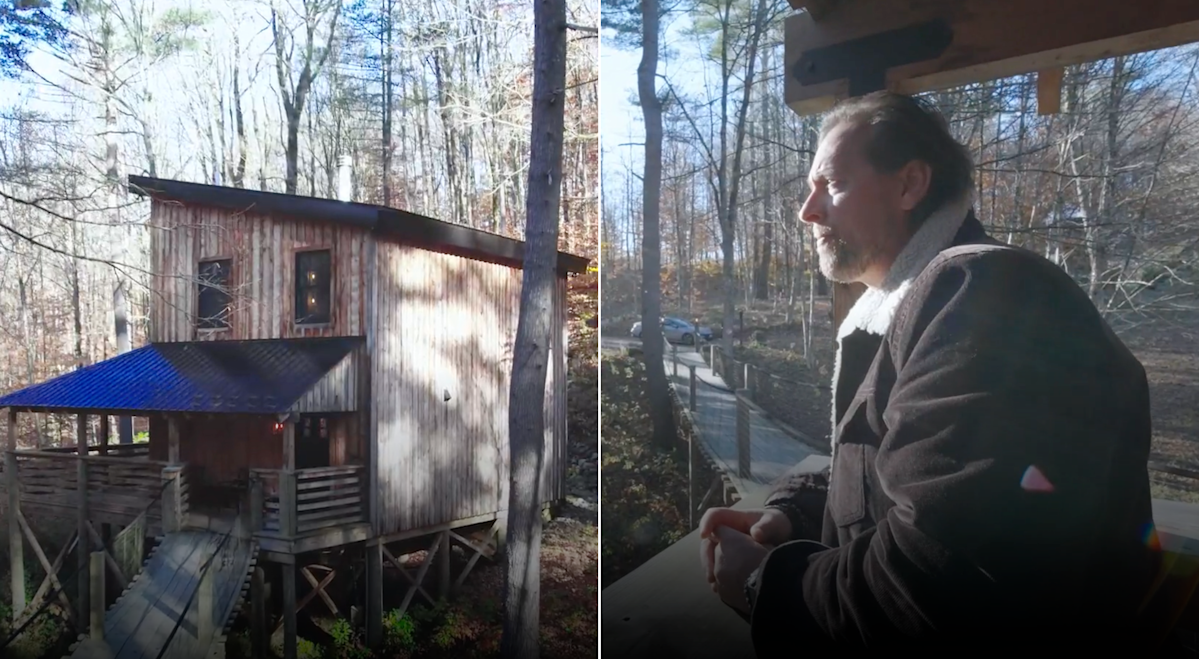
When Chris Broomfield bought the five-acre property in 2015, he already had plans to build several cabins. What he didn’t know was how successful his new venture would be.
“I always knew it was going to be an Airbnb property. I knew I was going to put several cabins on it,” he told CNBC Make It (1). “I chose this property because it was close to the lake. It was heavily wooded and had rolling hills. I saw its potential with multiple cabins.”
Broomfield owns several rental properties in Remsen, New York, which he built himself, including a treehouse.
Suspended 14 feet in the air, the treehouse features two bedrooms, a private pond, and breathtaking views of a waterfall. To access the house, guests must cross an 80-foot suspension bridge (2). This unique rental property is one of New York’s highest rated properties for its breathtaking views and unique setting.
Despite the effort required to build the cabins, Broomfield is making a tidy profit. As of 2018, his business, Evergreen Cabins, has generated over $2.1 million. Using dynamic pricing, Broomfield’s rate for each of the cabins ranges from $380 to $700 per night.
While Broomfield’s success is impressive, it may not be very easy to replicate. As rental properties become popular side hustleinvestors interested in this company may want to consider whether Broomfield’s path is repeatable before taking the leap.
Stories like Broomfield’s help explain why short-term rentals continue to attract potential investors. Platforms like Airbnb have made it easier than ever to market unique properties, and coverage of these stories in the news and on social media often makes something like buying property and building cabins look easy.
But high nightly rates don’t always translate into consistent profits, as occupancy rates can vary greatly by location, season and competition. According to AirDNA, the average US Airbnb host earns approximately $14,000 per year, although actual earnings can vary greatly by market (3). Many hosts see strong demand during peak travel months, followed by long seasons.
Higher borrowing costs have also changed the equation. Mortgage rates remain well above pre-pandemic levels, pushing up monthly payments for investors who rely on financing. At the same time, housing prices remain historically high. According to Redfin, median home prices are still significantly above 2019 levels, even in regions where prices have cooled (4).
The regulations are another wild card. Many cities and counties in the United States have introduced stricter regulations on short-term rentals, including permit requirements, limits on non-owner-occupied properties, and higher taxes or fees (5). New investors could spend thousands (or hundreds of thousands) only to be forced out of the short-term rental industry by new regulations.
In Broomfield’s case, several factors worked in his favor: he bought land at a relatively low price ($27,000 for five acres), had decades of construction experience, and created unique properties that stood out in search results and on social media. For many investors, replicating this combination of factors can be difficult.
Read more: The average net worth of Americans is a staggering $620,654. But it hardly means anything. Here’s the number that counts (and how to make it pop)
The takeaway here is not that rental properties are a bad investment; is that success in this industry is rarely predictable or guaranteed. Anyone considering a similar path should take time to run the numbers and understand the risks before starting.
Here are some things to keep in mind:
-
Local demand and seasonality: Look beyond peak rates and examine employment trends throughout the year. A property that rents for $500 a night but is vacant for half the year may underperform compared to a lower-priced rental that is consistently booked.
-
Total costs: Beyond the purchase price, be sure to budget for costs such as insurance, property taxes, utilities, maintenance, cleaning, rig fees, and management or labor costs.
-
Regulatory environment: Before you buy, check local short-term rental laws, zoning regulations and licensing requirements. Some municipalities can change rules with little notice, which can affect whether a property can legally function as a vacation rental
-
Financing risk: Higher interest rates increase the pressure on cash flow. Consider whether the property can break even, or at least cover expenses, during slower periods. If not, make sure you have the cash flow to cover the costs
-
Financial guarantees: Keep a dedicated emergency fund and avoid excessive leverage to protect against slow seasons or regulatory changes
Broomfield’s success serves as a reminder that experience, cash and hands-on effort matter. For those inspired by high-income rentals, the smartest next step isn’t to buy quickly, but to do your research, run conservative numbers, and make sure your financial footing is secure before taking the leap.
Join over 200,000 readers and be the first to get the best stories and exclusive interviews from Moneywise – clear information curated and delivered weekly. Subscribe now.
We only rely on verified sources and credible third-party reports. For more information, see our ethics and editorial guidelines.
CNBC Make It (1); Airbnb (2); AirDNA (3); Redfin (4); Business Insider (5).
This article provides information only and should not be construed as advice. It is provided without any warranty.
 itstargetnews