itstargetnews
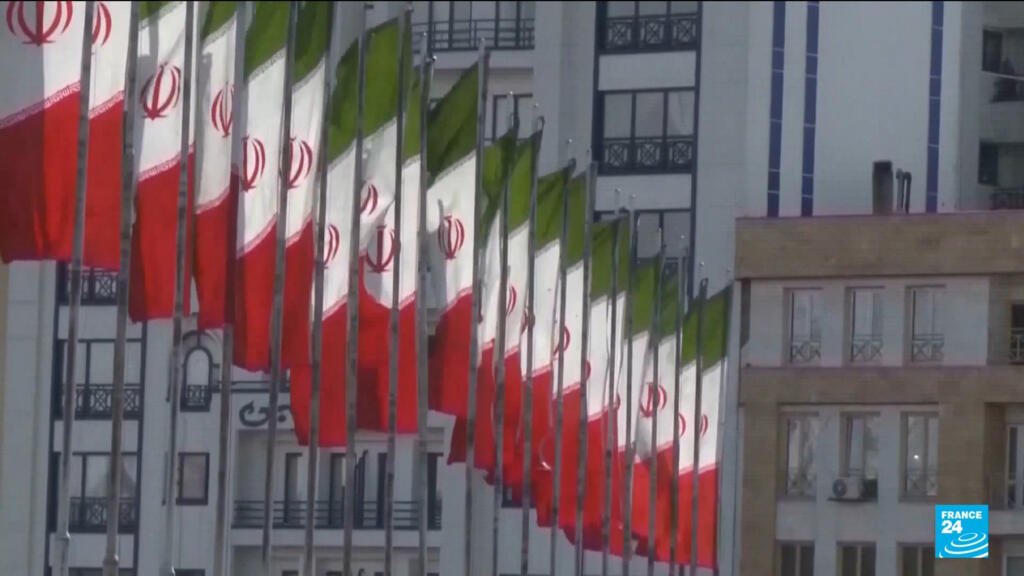
Iranian officials addressed the wider Middle East on Wednesday over the threat of a possible US military strike against the country, as the value of Iran’s currency hit a new low a month after protests spread across the country and sparked a bloody crackdown.
Two countries, Saudi Arabia and the United Arab Emirates, have made it clear that they will not allow their airspace to be used for any attack. But America has moved the USS Abraham Lincoln and several guided-missile destroyers to the region, which can be used to launch attacks from the sea.
It remains unclear what US President Donald Trump will decide on the use of force, although he has set two red lines – the killing of peaceful protesters and the possible mass execution of detainees. At least 6,221 people have been killed in protests as Iran begins a bloody crackdown on protests, with many more feared dead, activists said on Wednesday.
“Let’s hope Iran quickly ‘comes to the table’ and negotiates a fair and just deal – NO NUCLEAR WEAPONS – that is good for all parties,” Trump wrote on his Truth Social platform on Wednesday. “Time is running out, that really matters!”
Referring to the June strikes on Iran as the US intervened in Israel’s 12-day war against the Islamic Republic, Trump wrote: “The next attack will be far worse!”
Iran’s mission to the United Nations quickly responded to Trump, announcing on X that “Iran is ready for dialogue based on mutual respect and interests – BUT IF PUSHED, IT WILL DEFEND AND RESPOND LIKE NEVER BEFORE!”
Iran’s state media, which now refers to the protesters only as “terrorists”, remains the only source of news for many since Tehran cut off access to the global internet three weeks ago. But Iranians have grown angry and worried, watching footage of protesters being gunned down, as they worry about what might happen next as the economy – the original focus of the protests – sinks further.
“I feel that my generation failed to teach a better lesson to the younger ones,” said Mohammad Heidari, a 59-year-old teacher in Tehran. “The result of decades of teaching by my colleagues and myself has resulted in the deaths of thousands and possibly more injured and imprisoned.”
Diplomacy between Iran, Arab nations
Egypt’s foreign ministry said its top diplomat, Badr Abdelatty, had spoken separately with Iranian Foreign Minister Abbas Araghchi and US Middle East envoy Steve Witkoff to “work to achieve calm, to avoid the region slipping into new cycles of instability”.
The statement did not provide details, although Iranian state media quoted Araghchi as saying that third-party intermediaries had been in contact. Witkoff, a billionaire real estate tycoon and friend of Trump, previously negotiated Iran’s nuclear program. The White House did not immediately confirm the call.
The Turkish Foreign Minister also had a phone conversation with Araghchi about reducing regional tensions. Turkish officials have expressed concern that intervention in Iran could cause instability or spur an influx of refugees.
Meanwhile, Saudi Arabia’s Crown Prince Mohammed bin Salman spoke to Iranian President Masoud Pezeshkian, saying the kingdom “will not allow its airspace or territory to be used for any military actions against Iran or for any attacks by any party, regardless of their origin.” This follows a similar pledge by the UAE.

Iran’s Supreme Leader, Ayatollah Ali Khamenei, has acknowledged that thousands of people have been killed during anti-government protests in the past two weeks, but blamed the number of casualties on the US. He also called President Donald Trump a criminal for supporting the protests, which were opposed by tens of thousands of pro-government protesters. The US Press Agency for Human Rights said it had confirmed 3,090 deaths, including 2,885 protesters, and more than 22,000 arrests. CBC News talks to Iranian journalist and activist in exile Masih Alinejad about the protests.
The largest U.S. base in the region is Qatar’s vast Al Udeid Air Base, which serves as the forward operating headquarters for the U.S. Army’s Central Command. Both Araghchi and Ali Larijani, a senior Iranian security official, spoke with Qatari Prime Minister Mohammed bin Abdulrahman Al Thani. Qatar confirmed the calls but offered few details of what was discussed.
Iran attacked Al Udeid in June in response to Trump sending US warplanes to bomb Iran’s nuclear facilities during the war last year.
“Our position is exactly this: the application of diplomacy through military threats cannot be effective or constructive,” Araghchi told reporters on the sidelines of a cabinet meeting on Wednesday. “If they want negotiations to take shape, they must give up threats, excessive demands and asking illogical questions. Negotiations have their own principles: they must be conducted on an equal basis, on the basis of mutual respect and for mutual benefit.”
Activists offer a new death toll
As protests have stalled for weeks after the crackdown, information leaking out of Iran via Starlink satellite dishes reaches activists trying to calculate the carnage.
On Wednesday, the US Human Rights Watch, which has been accurate in multiple rounds of unrest in Iran, said the 6,221 dead it counted included at least 5,858 protesters, 214 government forces, 100 children and 49 non-protesting civilians. More than 42,300 were arrested, it added.
The group verifies each death and arrest with a network of activists on the ground in Iran. The Associated Press could not independently estimate the death toll as authorities shut down the Internet and cut off calls to the Islamic Republic.
Iran’s government put the death toll at a far lower figure of 3,117, saying 2,427 were civilians and members of the security forces and labeling the rest as “terrorists”. In the past, the Iranian theocracy undercounted or underreported casualties in the unrest.
The death toll exceeds any other round of protests or unrest in Iran in recent decades and is reminiscent of the chaos that surrounded the 1979 Islamic Revolution.
The protests began on December 28, fueled by the fall of Iran’s currency, the rial, and quickly spread. The country faced more than two weeks of internet outages, the most extensive in its history.
On Wednesday, Iran also announced the execution of Hamidreza Sabet, a man it convicted of spying for Israel. Sabet’s execution is the 13th execution Iran has carried out against alleged spies for Israel since the June war.