itstargetnews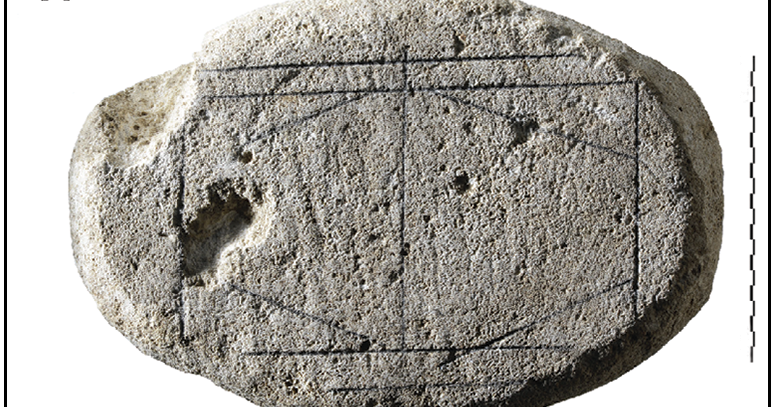
A smooth, white stone dating back to Roman times and excavated in the Netherlands has long puzzled researchers. Now, with the help of artificial intelligence, scientists believe they have solved the mystery: the stone is an ancient board game and they even guessed the rules.
A circular piece of limestone has incised diagonal and straight lines.
Using 3D images created by restoration studio Restaura, the scientists found that some lines are deeper than others, suggesting that parts have moved along them, some more than others.
“We can see wear along the lines on the stone, right where you would push the piece,” said Walter Crist, an archaeologist at Leiden University in the Netherlands who specializes in ancient games, in statement. “The appearance of the stone combined with this outfit strongly suggests that it is a game.”
Other researchers from Maastricht University then used an artificial intelligence program that can deduce the rules of the ancient games.
They trained this artificial intelligence, christened Ludii, with the rules of about 100 ancient games from the same area as the Roman stone.
The computer “produced dozens of possible rule sets. It then played the game against itself and identified a few variants that people are comfortable playing,” said Dennis Soemers of Maastricht University. statement.
They then cross-checked the possible rules with wear on the stone to discover the most likely set of moves in the game.
However, Soemers also sounded a note of caution.
“If you present Ludius with a line pattern like the one on the stone, he will always find the rules of the game. So we can’t be sure that the Romans played exactly that way,” he said.
The goal of the “deceptively simple but exciting strategy game” was to hunt down and capture opposing pieces in as few moves as possible, the researchers said. The researchers said they believe glass, bone or earthenware were used as game pieces.
Research and possible rules were published in the journal Antiquitywho posted the video on social media explaining the game.
“We know that the rules we found explain the wear marks on the stone and are consistent with games from comparable cultural periods,” said Karen Jeneson, curator of the Roman Museum in Heerlen. statement. “Of course we considered other possible uses for the stone, such as an architectural decorative feature, but we didn’t find an alternative explanation. So the stone is really a board game.”
In 2015, scientists said they discovered board game piecesincluding dice, in an ancient Roman settlement in a German city located on the Rhine River.