itstargetnews

Federal regulators and prediction-market exchange Kalshi drew attention to a pair of insider-trading cases, stating that actions appear in event-based markets are subject to the same rules as traditional derivatives platforms. The rollout, however, was quickly met with pushback from a journalist who argued that at least one of the headline examples had already been reported months earlier.
On Wednesday (February 25), the Commodity Futures Trading Commission (CFTC) released a COUNSEL outlines two enforcement matters disclosed by Kalshi involving the misuse of non-public information. The agency clearly states that “the Commission has full authority to police illegal trading practices occurring in any DCM, including those described above in relation to prediction markets.”
Kalshi used himself advertisement to emphasize that “we prohibit insider trading” and said it launched about 200 investigations in the past year. More than a dozen of those inquiries have led to formal enforcement actions, according to the company. Kalshi also said that the money collected through fines in these cases is donated to a nonprofit that supports derivatives education.
Growing political and regulatory pressure on Kalshi amid insider trading cases
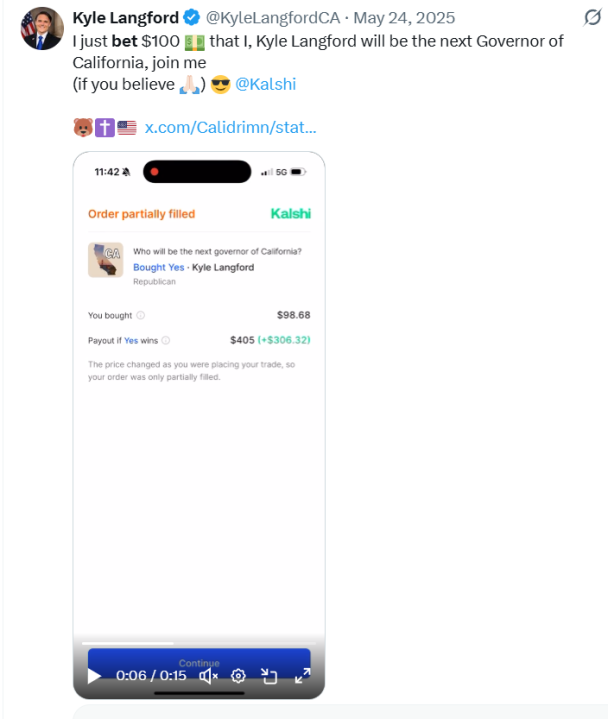
One case centered on a political candidate who bet on his own gubernatorial race. Kalshi said the candidate placed nearly $200 in contracts tied to his campaign and later promoted the bet online. Since the rules of the exchange prohibit traders from betting on outcomes that they can directly influence, the company issued a five-year ban and fined him ten times the value of the trade.
The CFTC said the trader “acknowledged that he knew these trades were improper and violated the Kalshi rules” and added that the conduct may have violated the anti-fraud provisions of the Commodity Exchange Act.
Journalist Dustin Gouker countered that the episode was not new. Posting on X, he wrote that Kalshi was “bullying to suppress a politician who bet on themselves when I was the one who literally broke the news like 10 months ago.” He also said that the company spread the news of the implementation to other reporters but not to him, adding, “And you wonder why I don’t take this company seriously.”
An image attached to Gouker’s post shows his May 26, 2025 Event Horizon article, “California Candidate For Governor Bets On Himself To Win.” In that piece, he identified Republican candidate Kyle Langford as the businessman and described a video the candidate shared on social media showing the bet.
The second enforcement item involved a video editor on MrBeast’s popular online channel. Kalshi said the trader’s positions appeared “statistically anomalous” and concluded that he “likely had access to material non-public information connected to his trading.” The account was suspended for two years, and the trader was fined five times the size of the positions. The CFTC similarly stated that the individual “likely had advanced knowledge of the contents of the channel’s videos before they were posted publicly” and suggested that the conduct could amount to insider trading based on misuse.
The lawsuits come as prediction markets face increased scrutiny in Washington. Legislators introduce legislation aimed at blocking members of Congress from negotiating contracts tied to political outcomes, and some senators urged the CFTC to crack down on controversial contracts, including those related to death. Kalshi’s CEO has the public supports stronger restrictions on insider-tradingincluding restrictions on government officials participating in certain markets.
At the same time, opposite platform Polymarket faces its own insider-trading questions, including disputes about large bets and cash-outs tied to political events abroad.
Featured image: Kalshi / Canva
The post Regulators highlighted Kalshi’s insider trading cases amid criticism first appeared in ReadWrite.