itstargetnews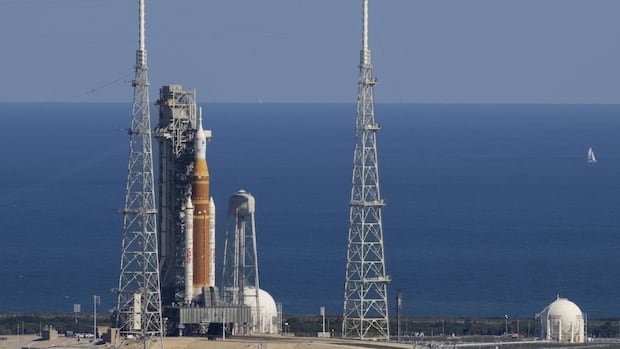

Listen to this article
Estimated 3 minutes
The audio version of this article was generated using artificial intelligence-based technology. Mistakes in pronunciation may occur. We work with our partners to constantly review and improve results.
NASA encountered a leak while fueling its new moon rocket on Monday in one final test that will determine when astronauts can launch on a lunar flyby.
The launch team began filling the 98-meter rocket with supercooled hydrogen and oxygen at the Kennedy Space Center in Florida at noon. More than 2.6 million liters had to flow into tanks and remain on board for several hours, mimicking the final stages of a real countdown.
But just hours into the day-long operation, an excess of hydrogen was discovered near the bottom of the rocket. Hydrogen filling was temporarily stopped, and only half of the core stage was filled.
Uploading resumed after about an hour, but was briefly halted once again until resuming shortly after 4:00 PM ET.
The launch team scrambled to fix the problem using techniques developed during the only other launch of the Space Launch System (SLS) rocket three years ago. That first test flight was plagued by hydrogen leaks before it finally took off.
The crew – Jeremy Hansen of the Canadian Space Agency and NASA astronauts Reid Wiseman, Victor Glover and Christina Koch – watched the crucial dress rehearsal from nearly 1,000 miles away in Houston, home of the Johnson Space Center. They were in quarantine for a week and a half, waiting for the outcome of the training countdown.
The day-long operation will determine when they can take off on the first crewed lunar trip in more than half a century.

If Canadian astronaut Jeremy Hansen suddenly can’t go on NASA’s Artemis II mission, Jenni Gibbons is ready to take his place. She tells The National’s Ian Hanomansing about her role as an assistant astronaut and what inspired her to pursue a career in space exploration.
Time delay
Two days behind schedule due to the bitter cold, NASA set its countdown clocks to stop half a minute before they hit zero, just before the engines fire.
The clock started ticking Saturday night, giving launch controllers a chance to go through the motions and address any lingering problems with the rocket. A hydrogen leak kept the first SLS rocket on the platform for months in 2022.
If the refueling demonstration is successfully completed on time, NASA could launch Commander Wiseman and his crew to the moon as early as Sunday.
The rocket must lift off by February 11 or the mission will be aborted until March. The space agency has only a few days in any given month to launch a rocket, and the extreme cold has already shortened the February launch window by two days.
The nearly 10-day mission will send astronauts past the Moon, around the mysterious far side and then straight back to Earth, with the goal of testing the life support capsule and other vital systems. The crew will not go into lunar orbit or attempt to land.
NASA last sent astronauts to the moon during the Apollo program in the 1960s and 1970s. The new Artemis program aims for a more permanent presence on the Moon, with Wiseman’s crew setting the stage for future lunar landings of other astronauts.