itstargetnews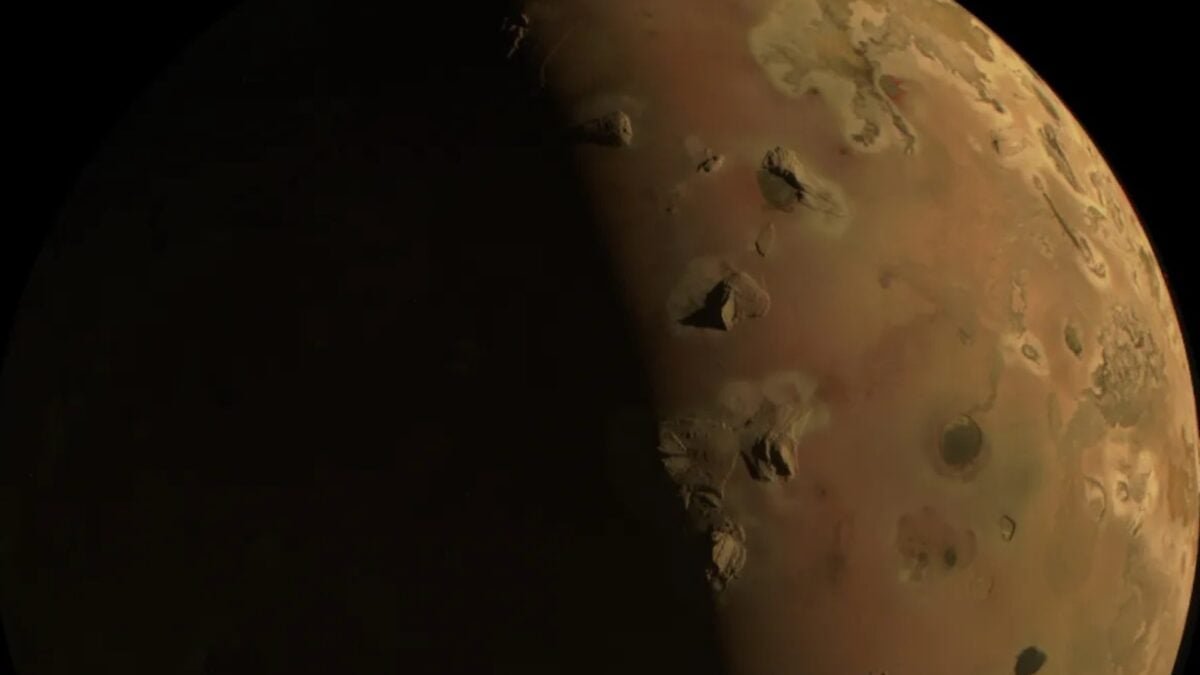
Jupiter’s moon Io is covered in hundreds of volcanoes, spewing fountains of lava that often fill the craters on its surface with scorching molten lakes. A recent discovery of intense volcanic activity on the Jovian moon predates any eruptions previously detected on Io, proving that this chaotic world is infinite.
NASA’s Juno mission detected a volcanic hot spot on the southern side of Jupiter’s moon, marking the most powerful explosion ever detected on Io or anywhere else in the solar system beyond Earth.
“This is the most powerful volcanic event ever recorded on the largest volcanic world in our solar system—that’s for sure,” Scott Bolton, a researcher at the Southwest Research Institute in San Antonio and principal investigator of the Juno mission, said in a statement.
The details of the discovery are recent PUBLISHED in Journal of Geophysical Research: Planets.

Credit: NASA/JPL-Caltech/SwRI/ASI/INAF/JIRAM
Lava fountain
Juno has been orbiting Jupiter for almost a decade. The spacecraft’s extended mission, which begins in 2021, will allow scientists to study Jupiter’s moons Io, Europa, Ganymede, and Callisto.
Juno flies through the same region as Io once every two orbits. During its latest flyby on December 27, 2024, the spacecraft flew within about 46,200 miles (74,400 kilometers) of the moon and aimed its infrared instrument at the southern hemisphere.
Using Juno’s Jovian Infrared Auroral Mapper (JIRAM) instrument, contributed by the Italian Space Agency, scientists detected an event of intense infrared light. The total amount of electricity in the new hot spot light measured more than 80 trillion watts.
“What makes the event even more extraordinary is that it does not involve a single volcano, but several active sources that glow simultaneously, increasing their brightness by more than a thousand times compared to the average level,” Alessandro Mura, a researcher at the Italian National Institute for Astrophysics (INAF), and lead author of the paper, said in an emailed statement. “This perfect synchrony suggests it was a massive explosive event, spreading underground for hundreds of kilometers.”

The data not only suggest that this is the worst volcanic eruption ever recorded on Io, it also shows that there is a large chamber system of interconnected magma reservoirs beneath the moon’s surface. These interwoven systems can be simultaneously activated to produce a planetary-wide energy release. “We have evidence of what we found to be actually a few closely spaced hot spots emitting at the same time,” Mura said.
JunoCam, the spacecraft’s visible light camera, also captured the event. The team compared images obtained by JunoCam from the mission’s last two flybys of Io in April and October of 2024 with the most recent one obtained in December 2024, discovering significant changes in surface coloration around the area where the hot spot was seen.
Tormented world
Io’s volcanic activity is the result of a gravitational tug-of-war between Jupiter’s gravitational pull on the moon and a precisely timed pull from neighboring moons Ganymede and Europa. The tortured moon is subject to intense tidal forces, causing its surface to swell up and down 330 feet (100 meters) at a time, according to in.
Tidal forces create a lot of heat inside Io, thus causing its liquid subsurface to seek relief from the pressure by escaping to the surface. Io’s surface is constantly being reshaped, as molten lava refills the moon’s impact craters, smoothing the moon with fresh liquid rock.
The recently detected explosion will likely leave a long-lasting impact on Io. The team behind Juno will use the mission’s upcoming flyby of the moon on March 3 to look again at the hot spot and note any changes in the landscape surrounding it.
“While it’s always great to witness events that rewrite the record books, this new hot spot could be so much more,” Bolton said. “The interesting feature will improve our understanding of volcanism not only on Io but on other worlds as well.”