itstargetnews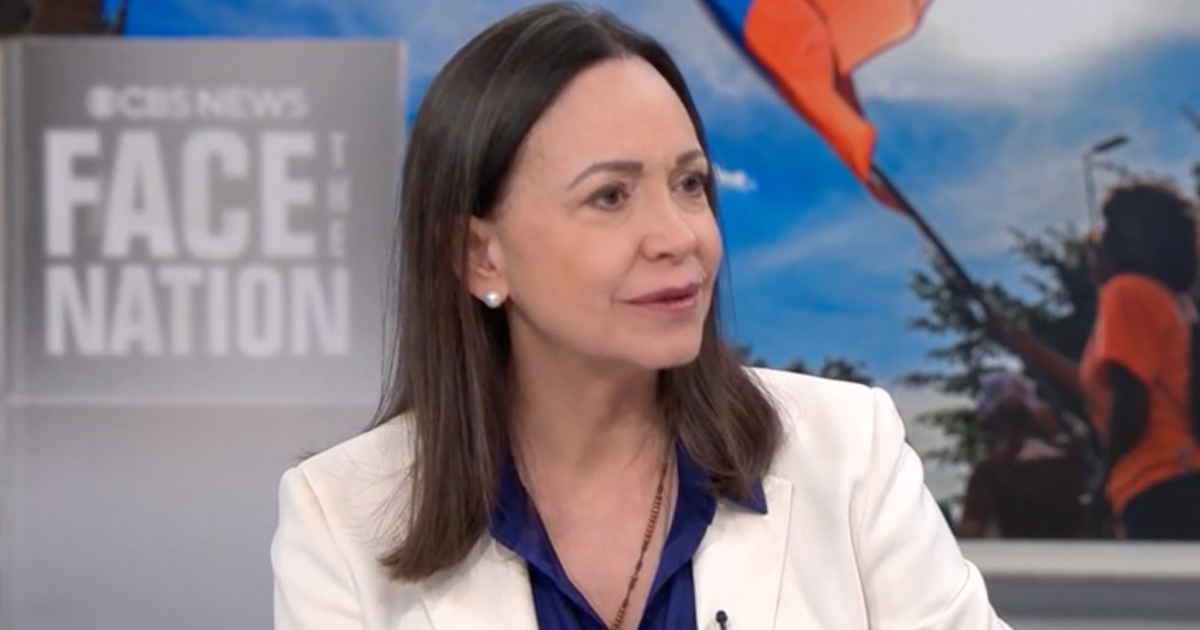
leader of the Venezuelan opposition Maria Corina Machadowhose party won the 2024 elections. said “Face the nation” that the political transition from the remnants of the Maduro regime is “unstoppable” and argued that any positive changes made by the interim government are the result of pressure from the Trump administration, but may not carry legal weight.
In an interview Friday with “Face the Nation” host Margaret Brennan, Nobel Peace Prize winner Machado said US military capture operation Former Venezuelan President Nicolás Maduro “sent a clear message” to members of his regime who still run the South American country, “and they are beginning to understand that things have changed forever.”
“So they might end up realizing, and very quickly, that it’s in their best interest to accept that the transition is unstoppable,” Machado continued. She told CBS that neither she nor her opposition movement was in contact with Rodriguez’s government, which she said was due to the regime’s past and repeated rejection of transition talks.
Since it is the morning of Maduro’s captureVenezuela was governed by interim president Delcy Rodriguez, who previously served as Maduro’s vice president and was later sworn in by the National Assembly as president. Instead of ousting the remnants of the Maduro regime, including officials indicted and sanctioned by the US, the Trump administration has sought to work with them, using strong US restrictions on Venezuelan oil exports as a source of leverage.
US Secretary of State Marco Rubio told senators on Wednesday that the Trump administration does not plan to take any further military action in Venezuela. He said “the only military presence you will see in Venezuela is our Marines in the embassy,” referring to the possibility of reestablishing a US diplomatic presence in the Venezuelan capital, Caracas.
While the Trump administration is cooperating with Rodriguez’s government, the US has not diplomatically or legally recognized their legitimacy. On Saturday, American diplomat Laura Dogu arrived in Caracas to work as chargé d’affaires of the Unit for Venezuelan Affairs. She holds the title of ambassador due to her previous roles in Honduras and Nicaragua. The State Department said it would work with the opposition, civil society and the interim government in Caracas. The US retained approximately 70 locally employed personnel there.
When asked if Rubio’s comments removed the necessary power for lawmakers to influence Venezuela’s interim government, Machado said she did not believe that was the case.
“Actually, everything Delcy Rodriguez is doing right now is because she’s following the instructions she’s getting from the United States,” Machado said. “Therefore, I think the message has been delivered and so far we are seeing results in the actions taken by the regime, as well as in the mood and energy that is growing among the Venezuelan population.”
Rodriguez’s government has made some significant changes in recent weeks, including signing a law that loosens state control over Venezuela’s oil industry – moving away from the country’s socialist Chavista foundations. This shift towards privatization is
in line with President Trump’s push for US oil companies to reinvest in Venezuela after they largely fled the country due to the nationalization of their assets.
Asked if she supports changes in the oil industry, Machado said: “these so-called reforms introduce positive signs in terms of what we, the Venezuelan people, want in the future.”
“We don’t want socialism. We don’t want the state to own every single plant or production center. We want private ownership,” she said. “But that requires the rule of law (and) long-term guarantees for foreign investment, for local investment.”
Machado told CBS that she met with energy executives while in exile. She emphasized that many have told her that a move toward a stable, democratic system would help strengthen faith and new investment in Venezuela.
Machado argued that the changes promised by Rodriguez were based on a false legal premise because the US government did not recognize the National Assembly as a legitimate authority. Without free and fair elections, she asserted, the existing government remains an “illegitimate government” and whatever comes from it “has no legality.”
Rodriguez said Friday that lawmakers would consider a bill granting amnesty to hundreds of political prisoners, while Machado pressed for the prisoners’ release. The follow-up to that announcement may test how tolerant the interim authorities can be of dissent and human rights.
Maria Corina Machado indicated that while she shares the Trump administration’s vision of the endgame, they have not provided an exact timeline for when the interim government would agree to hold elections. She argues that securing that transition is key to building trust among refugees and political exiles who may want to return to Venezuela but fear persecution and instability.
“So if we want those hundreds of thousands and millions of Venezuelans to come back, we need to have a secure and precise timeline for this transition to progress,” she said.
Rubio said Wednesday that the Trump administration eventually wants Venezuela to have democratic elections, but that the transition to democracy “will take some time.”
The WSJ reported that the energy minister told the business community that the election could be in a year and a half to two years. He previously said “Face the Nation” that the US may have to stay directly involved in Venezuela for a while. “It’s not about weeks, it’s about months. It could be a year or two, it could be more,” Wright said.
Machado, who met with Rubio on Wednesday, said toppling the Maduro regime would likely be a “very complex process,” calling it a “criminal structure” with ties to US adversaries such as Cuba, Iran and China.
Speaking about her own political future, Machado told CBS, “I will be president when the time is right.”
But she added that “the people of Venezuela should decide on this in the elections”.
Maduro has banned Machado from running against him in Venezuela’s 2024 elections, but she has galvanized her party and thrown her support behind former diplomat Edmundo González Urrutia. The US and much of the international community recognized González Urrutia as the legitimate winner of the election, but Maduro remained in power amid widespread accusations that the results were rigged.
She lived in hiding in Venezuela for 16 months after that and moved locations frequently, fourteen times she said, to avoid persecution by Maduro’s government. In December, she fled the country in a daring and secret water operation with the help of an American security company and local supporters. She flew to Norway to collect her Nobel Peace Prize.
Next month, Machado presented her with the Nobel medal to Mr. Trump, who openly campaigned for the award. She told CBS News that she gave the award to the US president because she was “truly grateful for what he did,” referring to the operation to oust Maduro.
Aboard Air Force One Saturday night, reporters asked Trump if Machado should be allowed to return to Venezuela.
The president said she was a “very good person” and generally mentioned the potential for the opposition and the regime to work together.
“But I think I have to say, at the same time, the current leadership is doing a very good job,” Trump said of Delcy Rodriguez.
Asked if she believed she would be imprisoned if she returned to her home country now, Machado told Brennan that “things are changing very quickly in Venezuela.”
“If they had caught me before I left, I probably would have disappeared or worse,” Machado said. “At this point I don’t think they would dare to kill me because of the presence, pressure and actions of the United States.”