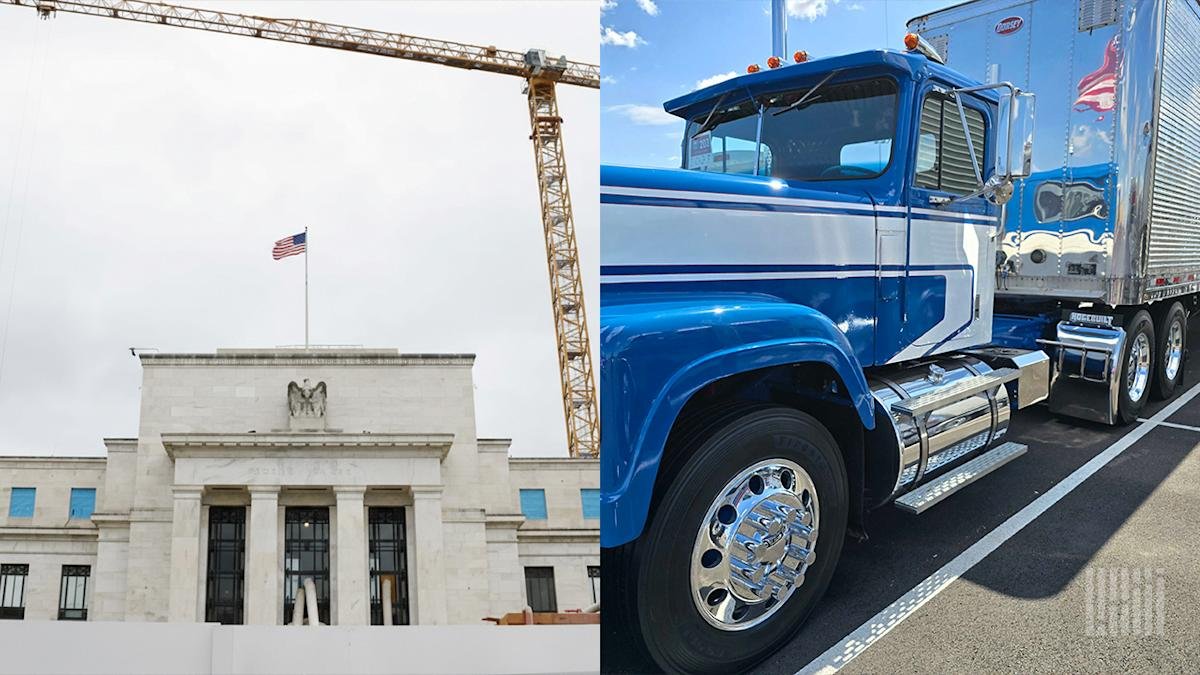
Kevin Warsh doesn’t think the Federal Reserve should sacrifice Main Street to save Wall Street.
This distinction matters more than most truckers realize. Because for the past three years, the opposite philosophy, that cooling the labor market by keeping credit expensive would somehow fix inflation, has been the guiding principle of Fed policy. And the trucks absorbed every bit of that pain.
In a Wall Street Journal op-ed published just weeks before his nomination, Warsh made his case against the Fed’s current approach. “Money on Wall Street is too easy and credit on Main Street is too tight,” he wrote. The Fed’s “bloated balance sheet” had created conditions where large institutional players could access cheap money while small businesses and American workers faced pressure.
If you’ve been watching freight rates sink, carrier exits grow, and driver wages fall behind inflation, you knew something was wrong. Now you know what to call it.
The Federal Reserve raised interest rates 11 times between March 2022 and July 2023, taking the federal funds rate from near zero to 5.25-5.50%, the highest level since 2001. The rate stayed at that high for 14 months before the first cut came in September 2024.
The stated aim was to “cool down” the labor market. Fed officials repeatedly cited “elevated wage pressures” as justification for keeping rates tight. The theory, based on something economists call the Phillips curve, holds that low unemployment causes inflation because workers demand raises that businesses pass on as higher prices.
There’s just one problem with this theory when applied to trucks: driver wages weren’t keeping up with inflation in the first place.
According to the American Transportation Research Institute’s 2025 Operating Costs Report, driver wages increased just 2.4% in 2024. The Bureau of Labor Statistics reported inflation of 2.9% during the same period. This is not wage-driven inflation. That is, workers are left behind while they are blamed for economic conditions they did not create.
The Fed was fighting a ghost.
This is how many consecutive months the ISM Manufacturing PMI spent in contraction territory, from November 2022 to December 2024. It was the longest manufacturing contraction streak on record. Through December 2025, the index remained in contraction for nine more months, bringing the total to 35 of the 38 months in negative territory since the Fed began its tightening cycle.
The December 2025 ISM reading was 47.9, the lowest of the year. New orders were taken for the fourth consecutive month. The employment sub-index showed that manufacturing jobs declined for 11 consecutive months.
Manufacturing leads to trucks. When factories are operating, trucks bring in raw materials and finished products. When factories are idle, trucks sit.
The Fed saw this happening. They kept rates high anyway.
According to ISM President Susan Spence, “For every positive panelist comment on new orders, 1.3 comments indicated concern about near-term demand, driven by tariff costs and other uncertainties.”
Tariffs weren’t the only factor crushing demand. Fed policy deliberately suppressed the economic activity that creates goods in the first place.
Want to understand why flat carriers got crushed? Track mortgage rates.
In January 2022, the average 30-year fixed mortgage rate was 3.22%. By October 2022, it had risen to 7.08%. It peaked above 8% in October 2023, the highest level since 2000.
The Consumer Financial Protection Bureau documented the impact: Monthly payments for a median-priced home rose $1,532, a 113 percent increase, between 2021 and 2023 when rate increases were combined with rising home prices. Although the rates fell back slightly, the increase remained at $1,040, or 77%, until the end of 2024.
Census Bureau data confirmed the carnage. Total housing starts fell from 1.56 million units in June 2022 to 1.36 million in 2024, a 3.9% year-over-year decline. Multifamily starts dropped 25% in 2024 alone.
Every house that is not built is wood that does not move. Drywall not shipped. Appliances that do not leave the warehouse. Furniture sitting in a distribution center waiting for buyers who can’t pay their mortgages.
The Congressional Budget Office acknowledged that “high mortgage rates are holding back construction activity.” That’s a polite way of saying that Fed policy deliberately suppressed one of the most freight-intensive sectors.
According to analysis by FTR Transportation Intelligence, carrier departures have been ongoing since the fourth quarter of 2022. The net decrease in for-hire carriers totaled approximately 40,000 in 2023, before slowing to approximately 19,000 in 2024, still a 50% year-over-year reduction and a continued decline.
The market still has nearly 86,000 more for-hire trucking companies than before the pandemic, a 33 percent increase in the carrier population, according to FTR Vice President of Trucking Avery Vise. But that increase came in 2020-2022, when stimulus money flowed in and rates rose. The correction that followed was not a natural part of the market cycle. It was the Fed-induced destruction of demand that forced carriers to choose between operating at a loss and shutting down.
Morgan Stanley’s analysis noted that many carriers were “operating every mile at a loss.” This is not a market correction. This is policy-driven economic harm.
Data from the American Transportation Research Institute paints a complete picture of an industry pulled from all directions.
Non-fuel operating costs reached $1,779 per mile in 2024, the highest figure ATRI has ever recorded. Driver wages and benefits combined reached 90.7 cents per mile by 2023. Insurance premiums continued their relentless climb. Equipment costs remained high.
Meanwhile, ATRI documented $108.8 billion in annual congestion costs for the trucking industry. This is the productivity loss from infrastructure failures that Washington refuses to address as it focuses on “chilling” the labor market.
Add in the detention time, 135.9 million hours annually, representing $11 billion in lost revenue, and you begin to understand why the trucking economy has become so brutal. Drivers sitting on docks do not charge. Carriers lose productivity. And the Fed’s solution was to raise interest rates, making credit more expensive so businesses couldn’t invest in efficiency improvements.
The freight recession was political.
Kevin Warsh served as Federal Reserve governor from 2006 to 2011, including during the financial crisis of 2008. At 35, he was the youngest appointment in Fed history. He has worked with billionaire investor Stanley Druckenmiller and taught at Stanford Business School.
His recent statements suggest a fundamental break with the Powell Fed’s approach.
In his Wall Street Journal article, Warsh called the Fed’s path under Powell “one of unwise choices” and argued that “inflation occurs when the government spends too much and prints too much.” He called on the Fed to shrink its balance sheet and lower interest rates “to support households and small and medium-sized businesses.”
This is a direct challenge to the political apparatus that created the freight recession.
Treasury Secretary Scott Bessent shares Warsh’s perspective. Both have argued that the Fed has effectively been “implementing fiscal policy” by picking winners and losers in the economy, with Wall Street consistently winning and Main Street consistently losing.
President Trump made the connection explicit. “If you announce good news,” he said at a recent cabinet meeting, “that means they’re going to raise interest rates because they want to kill them.”
The economic establishment dismisses this as populist rhetoric. The data supports it.
The truck recovery depends less on the output of capacity than on the return of demand, demand returning when monetary policy stops deliberately suppressing it.
There are positive signs. The Fed has cut rates six times since September 2024, bringing the federal funds rate down to 3.5-3.75% in January 2026. The Reshoring Initiative documented $1.7 trillion in relocation and foreign direct investment announcements through 2024, up from $933 billion in 2023.
John Deere is building excavators in North Carolina for the first time in 50 years. The Treasury Department noted that for the first time in 26 years, the United States produced more steel than Japan. First Solar is bringing domestic production to Alabama. Graphite processing returns to New York for the first time in 70 years.
Each relocated factory creates freight lanes. Every new manufacturing plant needs trucks, but the industry has burned out before.
Carriers look back on 2021 and 2022, when demand increased and new entrants flooded the market. They remember the crash that followed. The “scarring,” as analysts call it, will make fleet executives cautious about adding capacity even as the market tightens.
Craig Fuller noted that capacity recovery will be slow: “This scar from the last few years will prevent banks and entrepreneurs and fleet executives from expanding.”
This precaution might help. Slow and sustainable growth overcomes boom and bust cycles that destroy careers and businesses.
Kevin Warsh’s nomination is a sign that the economic framework that created three years of trucking devastation may finally be changing.
The myth of wage inflation crushed this industry. Driver wages fell behind inflation as the Fed said it was fighting wage-driven price increases. Manufacturing contracted for a record 26 consecutive months. Home starts collapsed under the weight of Washington-designed mortgage rates.
None of this was necessary. None of this was based on sound economics. All of this fell more heavily on American workers who move goods for a living.
Warsh’s Fed may not fix everything. Senate confirmation is not guaranteed, and Republican Sen. Thom Tillis has indicated he may oppose the nomination until an independent federal investigation is resolved.
Recognizing that “money on Wall Street is too easy and credit on Main Street is too tight” is a start. For trucks, this recognition is long overdue.
The publication Kevin Warsh’s Fed will end the war on high street and trucks appeared first FreightWaves.
 itstargetnews