itstargetnews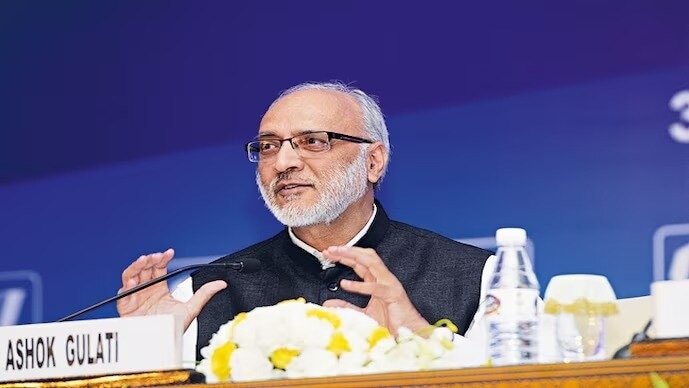
India’s negotiators have taken a balanced approach provisional trade agreement with the United States, especially in agriculture and dairy, Ashok Gulati, distinguished professor at ICRIER, said on Saturday. “Indian negotiators have played it pretty safe. And it’s a very balanced deal,” Gulati said in a conversation with Business Today Group Editor Siddharth Zarabi.
The United States and India announced on Saturday that they have reached a framework for an interim trade deal. Under the agreement, India will eliminate or reduce tariffs on all US industrial products and a wide range of US food and agricultural products, including dried distillers grains (DDG), red sorghum for animal feed, nuts, fresh and processed fruit, soybean oil, wine and spirits, and additional products.
Gulati said what emerges from the joint statement is a limited and carefully structured opening in agriculture. One of the key items is dried distillers grains, a byproduct of corn and soybean processing, which is expected to be used primarily as poultry feed.
“DDGS (Distillers Dried Grains with Solubles) is likely to be fed to poultry, either corn or soybeans. This could have a marginal impact on corn and soybean farmers. But it will be very useful for the poultry industry and the dairy industry in this regard,” he said.
Crucially, Gulati noted that the most politically sensitive issues have so far been kept out of the deal: direct imports of genetically modified crops and dairy. “We’ve avoided the GMO issue because it’s all crushed into shape. So the import of corn or soybeans, which people were talking about, that’s not on the list so far,” he said. “Dairy was not mentioned at all in the joint statement.”
He added that while future inclusions cannot be ruled out, there is currently no indication that India has opened the door to direct imports of GM crops. “We still do not know that among all the other products there are many other products mentioned, whether they will come later or not, we do not know. But we have not allowed the direct import of GM crops from this angle.”
On tariff cuts, the economist said concessions on nuts are unlikely to hurt Indian farmers because domestic production is limited. “Almost 90 percent of the almonds that we consume domestically come from the United States. And if you take the product-specific tariff and then convert that to ad valorem, it’s an 11 percent tariff,” he said. “In the new ones, we had 120. The finance bill says we will take it to 100. I don’t understand that logic.”
He added that tariffs on walnuts, pistachios, pecans, cranberries and cranberries are likely to be in the range of 10 to 15 percent. “This is not going to affect our farmers very much. There is very little acreage and very little production that we have at home.”
Gulati also addressed a key line in the joint statement referring to India’s commitment to address “long-standing non-tariff barriers” in food and agriculture trade, a phrase that has raised concerns in political and agricultural circles.
“Especially in the dairy sector, for example, we have a big concern that their cows are not vegetarian. A lot of the cows are fed some of the waste from the abattoirs and all that. So whether it’s allowed or not, it’s a very sensitive issue.”
The second, he said, relates to genetically modified crops, a debate that India has repeatedly postponed. “Remember our GM crop, Atal Bihari Vajpayee in 2002 allowed BT cotton and in 10 years we went from 13 million bales to 39 million bales. It was a genetic revolution,” Gulati said. “But then we got some things wrong. We didn’t allow corn.”
“Transgenic corn in the US gives a productivity of 11 tons. Our corn productivity is 3.5 tons,” the economist said. “We must remember that the future of agriculture will be in gene editing.”
Invoking Prime Minister Atal Bihari Vajpayee, Gulati warned against allowing ideology to override science. “It reminds me of Atalji’s famous line that if IT, information technology, is for India, BT biotechnology will be for Bharat. If we ignore this, we will be left behind,” he said. “Our approach should be based more on science than on ideology. That’s what I read from this document.”