itstargetnews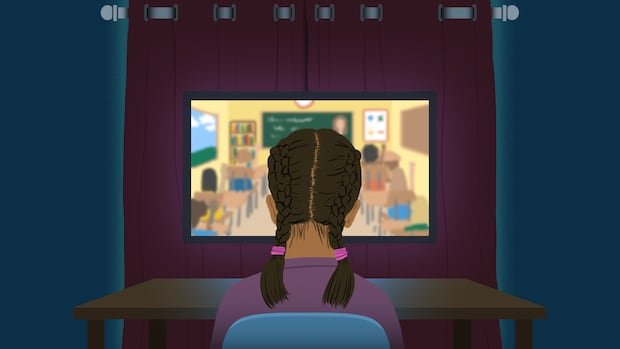
Current21:57How violent ICE actions changed life in Minnesota
In Minneapolis, a nine-year-old girl logs on to her computer in a family friend’s living room, watching her classmates through a screen instead of sitting next to them at school.
She is from Haiti and has been doing virtual learning since her family recently decided to stop dating for fear of being detained by US Immigration and Customs Enforcement (ICE).
“It’s because (ICE) is taking people,” she told the CBC. CBC agreed not to release the girl’s name or the names of her family members because of concerns they could become a target for ICE.
The girl’s mother says that her daughter often cries and asks why she can’t go to school. He tries to explain it in words that the child can understand, in a way that will not create additional fear.
“We’re just trying to navigate it… it’s a situation that’s not under… our control,” says the girl’s mother. “My husband can’t go to work, my kids can’t go to school, I can’t go to the supermarket. We can’t function.”
Theirs is just one of many families in Minnesota whose children face the reality that ICE could be hunting their parents — or them. That fear intensified after the arrest five-year-old Liam Ramos last week when ICE agents allegedly “used him as bait” to arrest his father; just one of four student detentions in the past few weeks, according to school officials.

Five-year-old Liam Ramos was detained by Immigration and Customs Enforcement (ICE) agents on Tuesday during an operation to arrest his father, the US Department of Homeland Security said. The family’s attorney said both are now in custody at the ICE Detention Center in Dilley, Texas.
The children have disappeared
And it’s changing the landscape of Minneapolis and St. Paula. Fewer front yards have children of color playing in them; they are absent from school and extracurricular activities. Hiding in the face of uncertainty.
“The kids are gone, the kids aren’t going back to school,” said Mandi Jung, a high school teacher in St. Paul, Minn.

Usually one of her classes has about 30 children, but recently it has dwindled to a dozen.
Many of her students are immigrants, Jung says. It is a Spanish-speaking “magnet” school, so there is a large student population from Latin America. But many other immigrant communities are represented in her classes.
“What I see in my classroom is white kids come to school and black and brown students are at home.”
The superintendent of public schools StStacie Stanley, says in a video on her website that she has received hundreds of emails requesting online learning for students who don’t feel comfortable in school. Earlier this month, she made virtual learning an option for those families, she recently said 25 percent of students, or 7,000, use this option.
“Just like we did during COVID, (teachers) are being asked to adapt on the fly and create lessons that kids can do at home,” says Jung.

And it is not only schools where children are absent.
Wes Burdine runs a queer football bar called The Black Hart of St. Paul, he also participated in community surveillance, trying to monitor where ICE agents are — and witness when they detain people. He’s also a father, and earlier this month he noticed that one of the kids on his son’s soccer team wasn’t showing up.
He asked the coach where the child was, and the coach told him that “the family doesn’t go out, they don’t feel safe.”
Emotional turmoil
“Students (are) telling us things like, ‘My dad was kidnapped. We don’t know where my dad is,'” Jung says.
The anxiety surrounding these detentions affects Jung’s students, even those who are citizens.
She tells the CBC that she was grabbed by a girl in the school hallway who asked, “‘Ms. Jung, can I deport citizens?’ And I said: ‘No’. And she said: ‘But I have a Mexican last name. Can I be deported?’”
While Jung says she told the child that citizens should not be detained, there were many cases in which citizens were heldand they are often from racial communities.

“They did high school students. They don’t want anyone to know this is happening to them. They don’t want their friends to know. They think it’s embarrassing … because they have a strong accent or because they’re … dark skinned and they’re just trying to figure out what’s going on.”
Jung says he sees his co-workers, many of whom are immigrants with families, filled with fear and anxiety for the safety of their children.
“One of my associates saidI just became a citizen last year,” she said. “I was at her house the other dayy, and every time the siren sounded, she would jump out of her skin.”

Following the death of intensive care nurse Alex Pretti at the hands of federal police in Minneapolis, The National’s Ian Hanomansing talks to local reporter Jason DeRush about how another fatal shooting has affected the city.
Her friend held her child and every timewould “squish the baby in her chest.”
She watched anone of her colleagues walk by with her passport on a lanyard around their neck – a reminder to anyone who might stop that she is a citizen. The woman put photocopies of her son’s passport “in his hockey bag, in his (backpack) — everywhere except to staple it together on the child’s forehead”.

Gathering as a community
Across the Twin Cities, people like Jung are doing what they can to rally support for families affected by ICE’s presence. Groups of citizens are collecting food for families who are too scared to leave their homes. A local union leader tells the CBC she is bringing food to 200 of her fellow union members.
Jung says he knows a student whose father was detained and whose family was in trouble; the mother could not work because her youngest child has autism and needs round-the-clock care.
So the teacher paid the family’s rent.
Her desire to help is echoed by others in the community, including a man who shelters a nine-year-old Haitian girl and her family.
“The worst situation brings out some of our best actions, like people risking their lives (for fear of being killed),” he said. “You experience a glimpse of true humanity.”