itstargetnews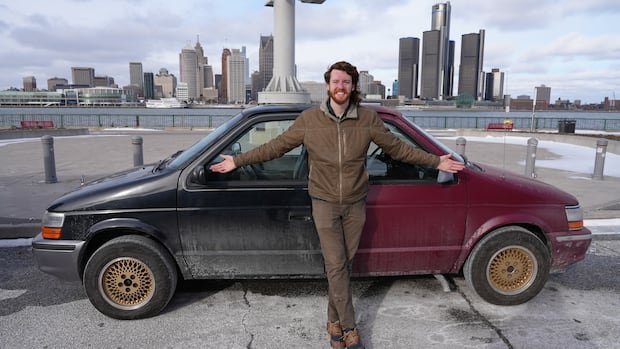

Listen to this article
Estimated 3 minutes
The audio version of this article was generated using artificial intelligence-based technology. Mistakes in pronunciation may occur. We work with our partners to constantly review and improve results.
When Zach Sutton drives down the street in his Chrysler minivan, it’s hard to tell if he’s coming or going.
A Detroit man drives a Bak2Bak, his name for what he created when he welded the front ends of two vehicles together. The front half is an old 1993 Dodge Caravan and the rear is a 1991 Plymouth Voyager. Combined, they look like two vehicles joined together that can go in either direction.
The main thing: the front half of the vehicle is made in Canada, and the latter in the USA
For Sutton, who works in the auto industry in Detroit alongside Windsorites crossing the border, it’s an unexpected bit of automotive diplomacy.

Detroiter Zach Sutton talks to CBC Windsor about his unique vehicle made from two halves of a ’90s minivan.
“It’s a model of what we might want to be, in a way,” Sutton said after driving to Windsor to speak with CBC News.
“We cooperate well as brother and sister countries.”
On Tuesday, Sutton crossed the line for the first time with his franken-car. No stranger to tinkering, the 29-year-old mechanical engineer is part of the Detroit Freakbike Experience, a group that builds bikes using unexpected parts and designs.

In addition to “crazy bicycle creations”, he does sewing, woodworking, metalworking and “anything I can do with my hands”.
Sutton says he envisioned making a vehicle with two front ends because he likes project cars, but they’re “a little isolated, so I wanted something that everyone could appreciate and understand.”
“Love and whimsy are something universally valued.”

He built the vehicle over three days at the i3detroit Community Workshop in Ferndale, a maker space where people with engineering minds build creative projects. There, Sutton used a laser to cut vehicles in half.
When he put the two front pieces together, “they went together almost perfectly,” he said. “It was very satisfying.”
Bob Katovich, a fellow builder in the shared workshop space and member of the Detroit Freakbike Experience, helped Sutton with the split.
“We had to remove everything from the inside and actually take everything apart,” Katovich said. After the vans were cut in half, “we had to figure out what to do with the back halves.” They were loaded onto a pickup truck, which was “kind of a surreal, funny experience to figure out how to do it and watch it.”
Sutton removed everything under Voyager’s hood. His headlights became the vehicle’s taillights. The steering wheel on the rear vehicle is locked, so everything drives like a real vehicle. The fuel tank is in Voyager’s engine compartment.

There are only two seat belts, Sutton says. Four people could fit in an off-road vehicle, but it would be cramped.
At the border, he says, passage was easy. The guards just asked him the “usual questions”.
When people see it, he says, they’re either “super confused” or “laughing and taking pictures.”
“The second day I had it on the road, someone took it and put it on Instagram and it got millions of views,” he said.
“I didn’t really build it for anyone but myself. I just wanted to drive around and have fun with it.“