itstargetnews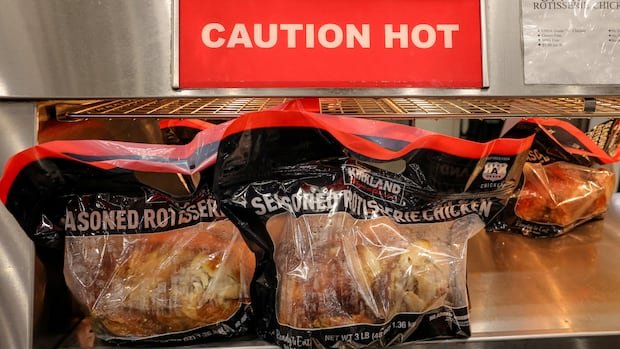

Listen to this article
Estimated 5 minutes
The audio version of this article was generated using artificial intelligence-based technology. Mistakes in pronunciation may occur. We work with our partners to constantly review and improve results.
They are cheap. There are plenty of them. They are sold in greasy plastic bags and are by all accounts delicious.
In a time of skyrocketing food prices and turbulent economic times, Costco’s rotisserie chickens for many, they are a reliable mainstay of meals. But a new lawsuit filed in a California court takes issue with how the retailer advertises its beloved cooked birds.
That proposed class action, filed Jan. 22 in the U.S. District Court for the Southern District of California and seen by CBC News, alleges that the retail giant “systematically defrauded customers out of tens — if not hundreds — of millions of dollars by falsely advertising its Kirkland Signature Seasoned Rotisserie chicken as ‘preservative-free.'”
The lawsuit, which has not yet been certified as a class action, alleges that Costco uses sodium phosphate and carrageenan, which extend shelf life and maintain texture. Costco has confirmed that it does indeed use these common ingredients.
And while those two ingredients are common in prepared foods, i federal regulators including Health Canada listing them as safe, the lawsuit says it’s wrong to claim the chickens don’t use preservatives.
The two California women who filed the lawsuit allege in their complaint that they would not have bought the chicken or would have paid less for it if they had known it contained preservatives.
The lawsuit includes photo examples of in-store and online advertising for chickens that claim to be “preservative-free.” Previous images of Costco’s rotisserie chickens reviewed by CBC News on various photo services appear to bear the same claim.

“Consumers reasonably rely on clear, prominent claims like ‘preservative-free,’ especially when deciding what they and their families will eat,” said Wesley M. Griffith of the Almeida Law Group, which represents the plaintiffs. online statement.
“Costco’s own ingredient list contradicts its marketing. It’s illegal and unfair.”
In a statement to CBC News, Costco said it removed its “preservative-free” references “to maintain consistency” among its labels and signs.
“We use carrageenan and sodium phosphate to support moisture retention, texture and consistency of the product during cooking. Both ingredients are approved by food safety authorities.”
I am looking for a certificate for 2 classes
In his online statement, Griffith said the legal team was “pleased” that Costco dropped its claims that the chickens were preservative-free.
“It’s confirmation of our core legal theory — the ‘preservative-free’ claims were false,” Griffith said.
He did not respond to CBC’s question about whether he would proceed with the class action. The complaint says the plaintiffs are demanding a jury trial and are seeking certification of two classes — one for anyone in the U.S. who bought Costco’s grilled chicken and a subclass for people in California.
The two California women who brought the lawsuit both say in the complaint that they still intend to buy Costco grilled chicken in the future, but that they “cannot rely on Costco’s representations regarding the product’s preservatives.”
The lawsuit alleges that both women prefer to buy food without preservatives.

Canada’s mandatory front-of-pack labeling came into force on January 1st, meaning foods high in saturated fat, sugar and/or sodium now come with a warning. With obesity, diabetes and heart disease rates skyrocketing in Canada, the subtle warning is getting mixed reviews.
California has seen a major push for health-conscious consumer products and labeling, becoming the first US state to ban four potentially harmful additives by 2023. and broke ultra-processed food and food coloring in school meals.
Health Canada monitors the use of additives in Canadian food. Sodium phosphate and carrageenan are both whitelisted “emulsifying, gelling, stabilizing or thickening agents.”
The two are used in everything from dairy products and infant formula to “prepared meat”.
Grocery label shock
Canadians have been dealing with sticker shock for years food prices increased by more than 30 percent since 2020. according to the latest data from Statistics Canada. Especially meat is one of them the main drivers of price increasesand reports indicate that this trend will continue in 2026.

Costco is suing the Trump administration, seeking a full refund of the tariffs it paid. But the wholesale retailer’s lawsuit will depend on the outcome of another case currently before the US Supreme Court.
So, like celebrities A hot dog in the food court for $1.50one of the main advantages of Costco’s cooked chickens is their relatively consistent price. American stores sold chickens for $4.99 for decades. In Canada it’s more like $7.99 to $9.00 which is still way cheaper than comparable cooked chickens sold in other large grocery stores.
Canadian consumers seem to love them, with one Costco Fan on Reddit describing “the faint smell of grilled chicken that carries you forward like incense” when you enter the store. online, people share advice about how to stretch one chick in more meals.
In 2023, Costco sold 137 million grilled chickens, according to Seattle Times.