itstargetnews
By David Brunnstrom, Simon Lewis (JO:), Trevor Hunnicutt and Tim Kelly
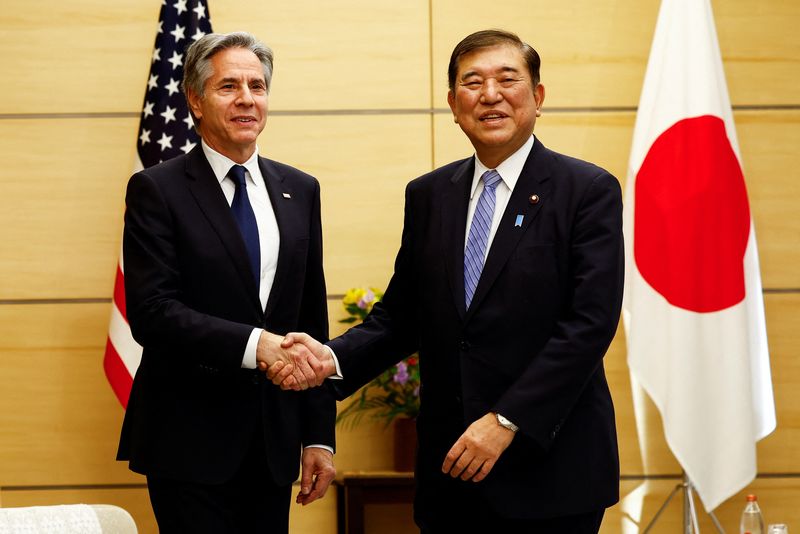
WASHINGTON/TOKYO (Reuters) – US President Joe Biden’s decision to block Nippon Steel’s $14.9 billion bid for US Steel cast a shadow over Secretary of State Antony Blinken’s visit to Japan on Tuesday for farewell meetings with Washington’s most important ally in Asia.
The rejection, announced on Friday, has fueled US efforts to strengthen ties with its Asian allies as the political crisis in South Korea could complicate the strained relationship between Washington, Seoul and Tokyo. The trilateral alliance is a key plank in the countries’ efforts to counter China’s military buildup.
U.S. investment could also cool, but analysts say any damage to broader U.S.-Japan relations is likely to be limited because of shared security concerns about China.
On Monday, Japanese Prime Minister Shigeru Ishiba described Biden’s decision to block the sale of US Steel to Nippon Steel as “puzzling”.
Along with White House National Security Adviser Jake Sullivan, Blinken met with Japanese Foreign Minister Takeshi Iwaya in Tokyo and will hold talks later in the day with Ishiba and other senior Japanese officials.
Several trips to Japan in the last four years “are evidence not only of the importance, but of the centrality that the United States attaches to our partnership.
“We have, between our two countries, a partnership that began to focus on bilateral issues, that worked on regional issues and that is now truly global,” he added.
Ahead of his trip, the State Department said Blinken wanted to build on the momentum of US-Japan-South Korea trilateral cooperation.
In Seoul on Monday, Blinken reaffirmed confidence in South Korea’s handling of its political turmoil as investigators there sought an extension of an arrest warrant for impeached President Yoon Suk Yeol.
US President-elect Donald Trump’s allies have also assured Seoul and Tokyo that they will support continuing to improve ties and advance military, economic and diplomatic cooperation to counter China and North Korea, Reuters reported on Monday. the Nov. 5 re-election of Trump.
TENSION, LIMITED DAMAGES FROM NIPPON STEEL DECISION
Nippon Steel and US Steel filed a lawsuit on Monday alleging that Biden violated the US Constitution by blocking their $14.9 billion merger through what they called a national security review. They called on the US federal court to overturn the decision.
Nicholas Szechenyi, a Japan expert at Washington’s Center for Strategic and International Studies, said Biden’s decision would make Blinken’s visit to Tokyo “awkward.”
However, “Japan will not allow the Nippon Steel decision to poison US-Japan relations; it is very important for Japan’s national security,” he said.
A Japanese diplomat told Reuters that Biden’s decision would chill foreign direct investment, but hoped that close US-Japan relations would continue, with a strong emphasis on rebuilding strong- on relationship with Trump seen in his previous administration, and took advantage of the increasingly hawkish situation. in Washington in China.
Japanese and US business lobbies have pushed hard for unification, backing their arguments with warnings about the impact on vital US-Japan relations.
But the merger has faced opposition from Biden and Trump, who took office on January 20 and is earnestly courting Japan in the run-up to his re-election bid.
Trump reiterated after his re-election that he was “absolutely opposed” to the merger and vowed to block it as president and support US Steel with tax breaks and tariffs.
A former senior official in Trump’s first administration told Reuters he believed Trump would take the same approach as Biden.
Marc Busch, a fellow at Georgetown University’s McDonough School of Business, predicted “significant setbacks” for US efforts to work with allies to create strong supply chains in the face of dominance. in China or competition in key areas.
“Japan and other allies have reservations about investing in or aligning with politically sensitive US supply chains.