itstargetnews
Carlos Alcaraz, Jannik Sinner and Aryna Sabalenka are among several players banned from using wearable fitness trackers. But why are they banned from Grand Slam tournaments?
Why are players unhappy?
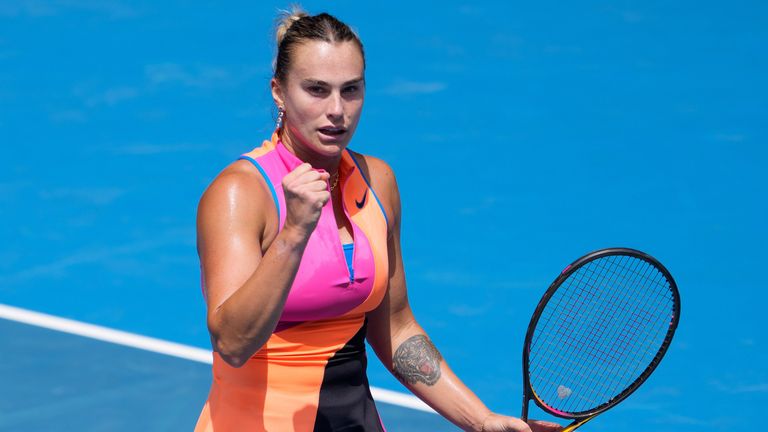
Sabalenka uses the technology to aid her recovery during her 2024 U.S. Open win
Sabalenka and several top players have been seen wearing fitness trackers on their wrists, with the device approved by the International Tennis Federation (ITF).
While wearable trackers can be worn at most matches on the men’s and women’s tours, Grand Slam organizers have not yet approved their use.
In other elite high-intensity sports, such as football and rugby league, data and fitness tracking are used to identify when players are in the “red zone” and more susceptible to injury without adequate recovery.
“The reason I wore it in court was because we received an email saying we had approval from the ITF to wear the device,” Sabalenka said.
“We wear it all year long – WTA Championships, all the tournaments I play. It’s just to keep track of my fitness,” she added.
“I don’t understand why the Grand Slams don’t allow us to wear it. I really hope they reconsider this decision and have their players track their health monitors.”
Why can players wear fitness trackers on the ATP and WTA tours, but not in Grand Slam tournaments?
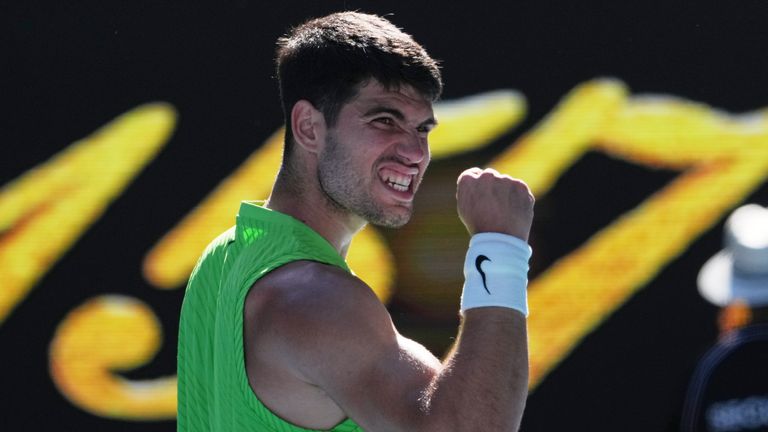
Carlos Alcaraz was spotted wearing the technology under his wristband
The ATP, which governs the men’s tour but not the Grand Slams, approved players’ use of the technology in tournaments through 2024.
Then-chief sporting officer Ross Hutchins said in a statement that the technology was “a huge step forward in our efforts to optimize player performance and prevent injuries.”
As of 2021, the WTA allows female athletes to use them.
But health analysis devices, known as wearables, are currently not allowed at Grand Slam tournaments.
Tennis Australia said organizers were discussing the issue, although the event already uses high-tech cameras to provide players with data such as distance, changes of direction and sprints to measure load.
“Wearable devices are currently not permitted at Grand Slam events,” the governing body said. “The Australian Open is engaged in ongoing discussions on how to change this situation.”
Top-seeded Alcaraz was asked to remove the tracker he was wearing under his sweatband before his fourth-round victory over Tommy Paul.

Jannik Sinner says trackers will help improve training sessions
Defending champion Sinner, who battled sweltering heat in his third-round victory, said his team hopes to collect performance data through the trackers to improve training sessions.
“There’s some specific data that we want to pursue in court,” Sinner said.
“It’s not for live broadcasts. It’s more about what you can see after the game. That’s data we want to use in practice as well, because from it you can practice heart rate, how many calories you burned, all that stuff.”
The former world number one has been asked to remove his equipment ahead of his fourth-round clash with Luciano Dadri.
“The referee immediately asked me if it was a tracker,” said the Italian. “I said, ‘Yes.’ He said, ‘Delete.’
“It’s OK. There are other things we could use (like) a vest, but it’s a little uncomfortable for me. You feel like there’s something on your shoulder.
“But rules are rules. I understand. I won’t use it again.”
What is a wearable fitness tracker?

Several top players, including Carlos Alcaraz and Jannik Sinner, have Whoop fitness trackers on their wrists
Whoop’s fitness tracker is waterproof and designed to be worn 24/7, making it a must-have for professional athletes and their teams, who use it to track everything from heart rate variability to sleep stages, skin temperature, blood oxygen, and even detect disease.
This data can then be synced via Bluetooth and read by the coach using a paired mobile device.
It has been worn by top athletes such as Cristiano Ronaldo, LeBron James and Rory McIlroy.
Whoop CEO Will Ahmed said the devices did not pose a security risk and that stripping athletes of their health data was “crazy.”
“We will fight this so athletes can get the data they need,” he wrote on X.
Watch ATP and WTA Tour matches live on Sky Sports or Live with NOW and Sky Sports Appthis year Sky Sports customers can watch more than 50% of live sports events for free. Learn more here.