itstargetnews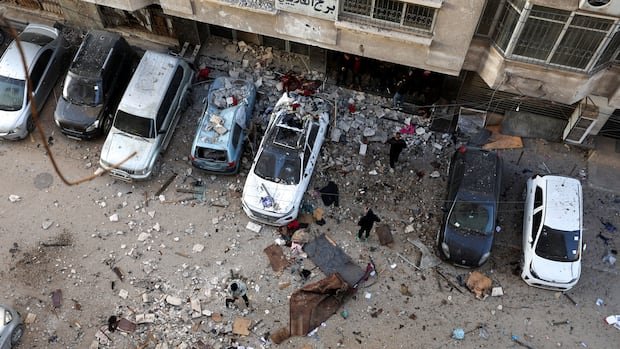

Listen to this article
Estimated 4 minutes
The audio version of this article was generated using artificial intelligence-based technology. Mistakes in pronunciation may occur. We work with our partners to constantly review and improve results.
Hospitals in Gaza said Israeli strikes killed at least 30 Palestinians on Saturday – one of the highest casualties since a ceasefire aimed at ending the fighting took effect in October.
A day after Israel accused Hamas of fresh ceasefire violations, strikes hit locations across Gaza, including deadly strikes on an apartment building in Gaza City and a tent camp in Khan Younis, officials at the hospitals that received the bodies said.
Among the victims are two women and six children from two different families. The airstrike also hit a police station in Gaza City, killing at least 14 and wounding others, Al-Shifa Hospital director Dr. Mohamed Abu Salmiya said.
Israel’s military said it was studying the report, but did not immediately say whether it had carried out airstrikes on the enclave.
The video shows charred, blackened and destroyed walls in a multi-storey apartment, and debris scattered inside and outside on the street of Gaza City.

“We found my three little nieces in the street, they say cease fire and everything, what were those kids doing, what were we doing?” said Samer al-Atbash, a relative.
Saturday’s strikes are a reminder that the death toll in Gaza continues to rise even as a ceasefire agreement moves forward.
Nasser Hospital said the strike on the tent settlement caused a fire that killed seven people, including a father, his three children and three grandchildren.
Meanwhile, Al-Shifa Hospital said an attack on a residential building in Gaza City on Saturday morning killed three children, their aunt and grandmother, while an attack on a police station killed at least 14 policemen, including four policewomen and prisoners held at the station. The Hamas-run Interior Ministry said Palestinian civilians were also killed in the attack.

The series of attacks took place a day before the Rafah crossing along the border with Egypt is to be opened in the southernmost city of Gaza. All border crossings in the area were closed during almost the entire war. Palestinians see Rafah as a lifeline for the tens of thousands who need treatment outside the territory, where most of the medical infrastructure has been destroyed.
The opening of the crossing, limited at first, marks the first major step in the second phase of the US-brokered ceasefire. Reopening the borders is one of the challenging issues on the agenda of the ongoing phase, which also includes demilitarizing the Strip after nearly two decades of Hamas rule and installing a new government to oversee reconstruction.
Israeli fire has killed more than 500 people, most of them civilians, according to Gaza health officials, since a US-brokered truce between the Palestinian militant group Hamas and Israel took effect in October after two years of war.
Palestinian militants have killed four Israeli soldiers since the ceasefire, according to Israeli authorities.
On Friday, Israel’s military said its forces had identified eight gunmen who emerged from a tunnel in Rafah, southern Gaza. Three were killed and a fourth, whom he described as a key Hamas commander in the area, was arrested.
The two sides have traded blame for truce violations, even as Washington presses them to proceed with the next stages of a cease-fire agreement meant to end the war for good.

The next phase of US President Donald Trump’s plan includes complex issues such as the disarmament of Hamas, which the group has long denied, further Israeli withdrawal from Gaza and the deployment of international peacekeeping forces.
Meanwhile, Israeli Prime Minister Benjamin Netanyahu insisted he would never agree to Palestinian statehood, despite growing international support for it. (Canada joined Great Britain, France and Portugal in recognizing Palestine as a state in September.)