itstargetnews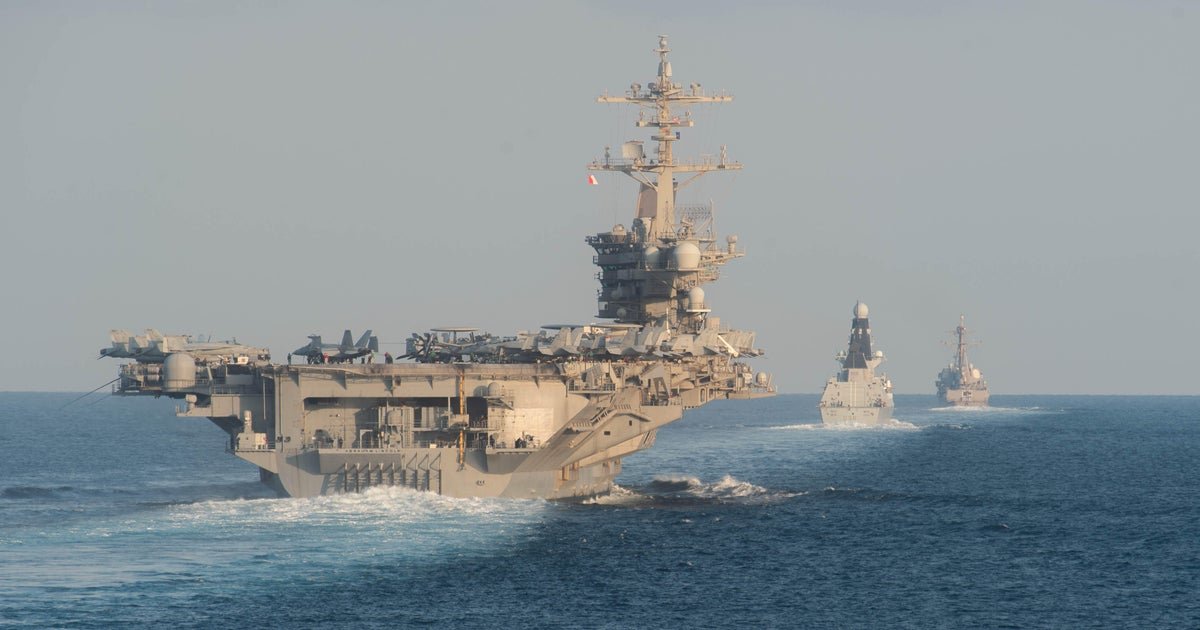
As the Trump administration continues to prepare military options for attacks in Iran, U.S. allies in the Middle East, including Turkey, Oman and Qatar, are trying to forestall that possibility by brokering diplomatic talks, multiple regional officials told CBS News.
But at this point, the opportunity for direct diplomacy between the US and Iran to discuss the regime nuclear program and ballistic missile capability has not gained traction, according to three regional officials who spoke to CBS News on condition of anonymity to speak freely.
Israeli military intelligence chief Gen. Shlomi Binder was in Washington earlier this week for meetings at the Pentagon, the CIA and the White House, a source familiar with his plans told CBS News. Axios was the first to confirm the Israeli visit – which was not announced by the Trump administration. In addition, the Saudi defense minister is scheduled to be in Washington, DC, this week for meetings, according to a source familiar with his schedule.
In Iran, thousands of protesters are believed to have been killed and many more detained as Iranian authorities waged a brutal crackdown recent demonstrations caused by economic difficulties and political repression. Almost complete shutting down the internet and communications it has now been going on for more than two weeks, and only a small number of Iranians have been able to connect recently.
In a social media post on Wednesday, President Trump said “a massive armada” moved toward Iran, calling on its government to “come to the table.” Iranian Foreign Minister Seyed Abbas Araghchi said in a statement shortly afterward that Iran’s security forces are “ready—with their fingers on the trigger—to respond immediately and forcefully to ANY aggression against our beloved land, air, and sea.”
But some of the regional allies like Saudi Arabia and the UAE have made it clear that their airspace and territory cannot be used to launch an attack on the Islamic Republic. According to a readout of Wednesday’s conversation between Saudi Crown Prince Mohammed bin Salman and Iranian President Masoud Pezeshkian, the Saudi leader said he specifically prohibited “any party” from using the Kingdom to attack Iran. Similarly, the UAE vowed not to allow the use of its waters, airspace or territory, and said it would not provide logistical support for an attack on Iran.
Recent US intelligence assessments show that the Iranian government is in its weakest position in decades – the most vulnerable since the 1979 revolution that returned the previously exiled Ayatollah Khomeini to Iran on February 1.
Iran’s foreign minister is scheduled to be in Turkey on Friday for diplomatic meetings. Iran is skeptical of diplomatic gestures and doubts that the US offers are sincere to several diplomatic officials in the region. That skepticism is based in part on what happened last June when the Trump administration decided to join Israel’s bombing campaign Iran’s nuclear infrastructurealthough diplomatic talks were scheduled.
Over the past few weeks, Mr. Trump has ordered a military buildup in the Middle East. An additional destroyer and Lincoln Carrier Strike Group arrived in the region this week. The carrier strike group brings the aircraft carrier USS Abraham Lincoln, with its fighter squadrons and three accompanying destroyers. The deployment joins two destroyers and three littoral combat ships already in the area, which is under US Central Command.
Mr Trump has repeatedly talked about the potential for a US strike on Iran, but it currently seems unclear what the targets would be or whether the focus would be on the type of beheading attacks used to help bring about regime change.
Although the president initially publicly threatened military action to deter the regime from continuing its brutal crackdown, the protests have dwindled dramatically without that action. The Trump administration is seeking a diplomatic deal that would instead address Iran’s nuclear program and ballistic missile capability.
saying to CBS News on Thursday night on the red carpet for the premiere of “Melania” — a documentary that provides an inside look at first lady Melania Trump’s life in the days after her husband’s 2024 election victory — Mr. Trump said he had “had” talks with Iran in the past few days and “planned” to have more.
Mr. Trump said that in those conversations, he “told them two things. No. 1, no nuclear weapons. And No. 2, stop killing the protesters. They’re killing them by the thousands.”
Mr. Trump also reiterated: “We have a lot of very large, very powerful ships that are sailing toward Iran right now. And it would be great if we didn’t have to use them.”
In testimony Wednesday before the Senate Foreign Relations Committee, Secretary of State Marco Rubio he could not answer questions about who would take over if Iran’s Supreme Leader Ayatollah Ali Khamenei and the regime fall. He said there would be “hope that there would be some possibility that they would have someone within their systems” who could work constructively on the transition.
Rubio described the Iranian regime as “weaker than it’s ever been” with its economy “collapsing.” But he played down the likelihood that the regime could be toppled as a result of the recent wave of popular protests across the country.
He suggested that the Iranian authorities may have brought the country under control with their brutal crackdown on protesters.
“I think regimes, including the one in Iran, have learned that when you start shooting people in the head with snipers, it’s effective,” Rubio said.
Earlier this month, a source inside Iran told CBS News activist groups believed that the death toll reached at least 12,000 and possibly as high as 20,000, based on reports from medical officials across Iran. CBS News could not independently verify these figures.
Rubio told Congress that the US currently has 30,000 to 40,000 US troops stationed at eight or nine facilities in the Middle East. He characterized the U.S. military buildup as defensive in nature, noting that all of those U.S. facilities are at risk from an Iranian attack using a short-range ballistic missile or a one-way drone or drone.