itstargetnews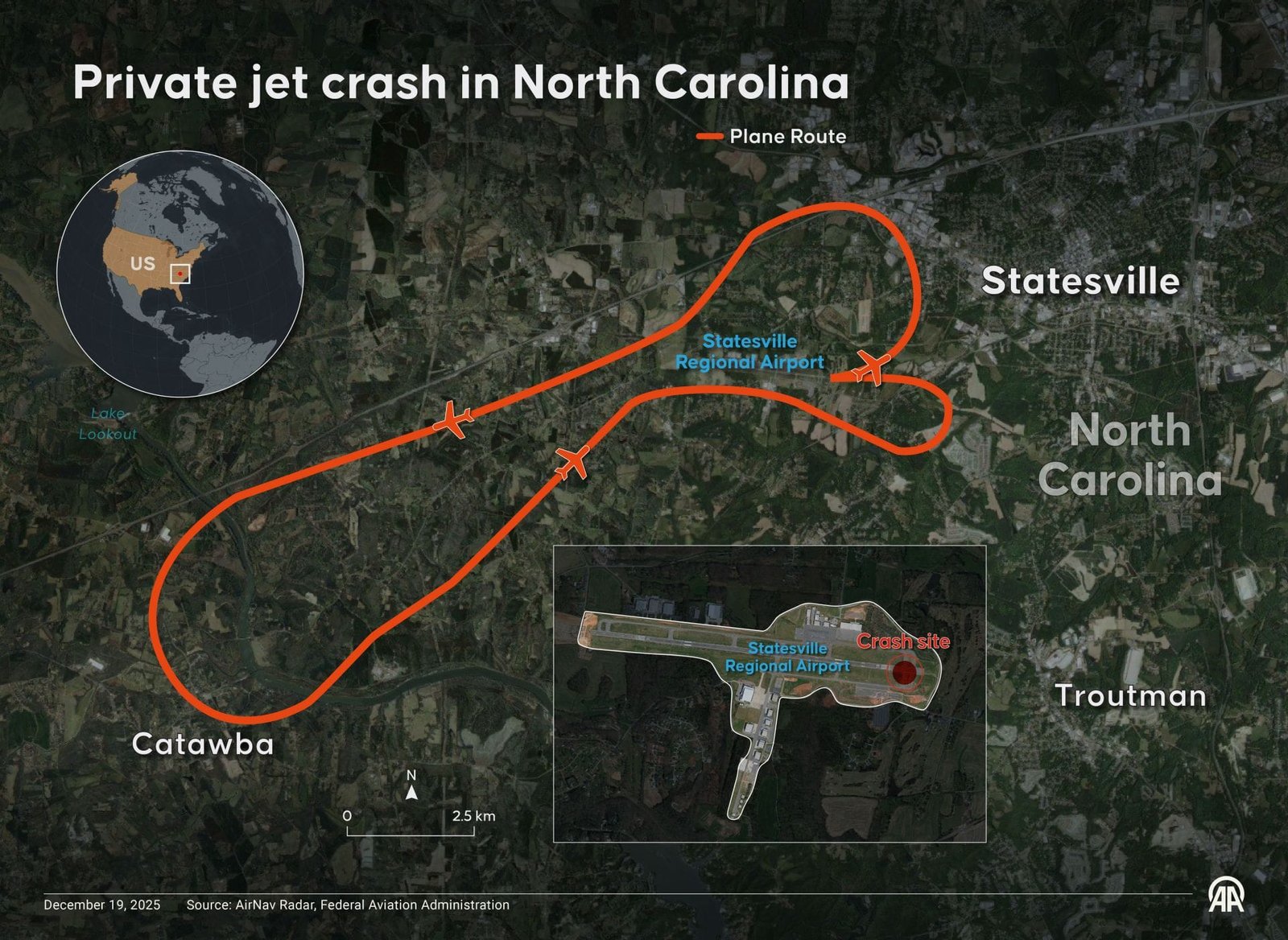

Former NASCAR driver Greg Biffle was one of seven people killed when a private plane crashed at Statesville Regional Airport in North Carolina on December 18, 2025. The National Transportation Safety Board released a preliminary report on Jan. 31 outlining what investigators have learned so far.
this Cessna Citation 550 The plane crashed shortly after 10:15 a.m. local time, sparking a post-impact fire near the east end of the runway. In addition to Biffle, the victims included his wife, Christina Grossu, their son Ryder, Biffle’s daughter Emma, Denise Dutton, Dutton’s son Jack and Craig Wadsworth. Airport operations were immediately suspended, and the FAA and National Transportation Safety Board launched a federal investigation the same day.
Thanks for your submission!
NTSB investigator-in-charge Daniel Baker led the preliminary report, which also involved the FAA, Textron Aviation and Pratt & Whitney Canada. Researchers use Fairchild GA-100 Jet cockpit voice recorderalthough the quality is mostly poor. A full report and probable cause determination is expected within 12 to 18 months.
Who was the pilot of Greg Biffle’s private jet?

According to the National Transportation Safety Board, the captain was Dennis DuttonHe is an airline transport-rated pilot with 17,000 hours of extensive civilian flying experience, including 400 hours in the past 6 months. His 20-year-old son, Jack Dutton, was in the right seat and had 175.3 total flight hours on the single-engine land plane and was not eligible to serve as second captain.
Sitting in the back was Greg Biffle, who had 3,500 hours of civilian flying experience, 65 of them in the past six months. But he didn’t have the stellar medical credentials that the Duttons did. this National Transportation Safety Board report pointed out:
“CVR records confirm that the airline transport-rated pilot was seated in the left-hand seat and that the pilot’s adult son, who holds a private pilot certificate for single-engine land and instrument ratings, was a passenger in the right-hand seat. A rear-seat passenger, who held a private pilot certificate and multi-engine land, instrument airplane and gyroplane helicopter ratings, was located near the cockpit in the cabin area.”
Although several passengers held pilot certificates, There were no clearly structured and legally qualified two pilots in the cockpit.. The report said that in situations involving instrument anomalies and heavy workloads, a clear division of responsibilities is crucial. On the contrary, once the autopilot is disengaged, the workload increases sharply, instrument trust decreases, and the aircraft’s flight trajectory becomes increasingly unstable.
Technical issues discovered on Greg Biffle flight
this NTSB report outlines several anomalies This occurred from engine start to final approach. The left engine initially failed to start, but both engines later started successfully. Before takeoff, the Duttons discussed a non-functioning indicator light on the thrust reversers, which themselves were working.
Soon after departure, other problems arose. Dennis reported problems with his altitude indicator and the Garmin GTN-750 stopped recording airspeed and heading data for part of the flight. Later during the approach, the landing gear indicator light did not come on. The U.S. National Transportation Safety Board states:
“At 1014:05, the rear passenger asked the pilot for power to the ‘alternator’ (note: CE-550 aircraft are not equipped with alternators). Approximately 4 seconds later, the audio quality for all recorded CVR audio channels returned to its previous level. After the audio quality was restored, the pilot made a comment indicating that this was a ‘problem,’ but did not specify what the ‘problem’ was or what steps were taken to correct it.”
Investigators found no evidence of runaway engine failure. Both engines remained connected, the thrust reversers were retracted, and there was internal damage consistent with rotation at impact. These points identify electrical or instrumentation issues that complicate situational awareness.
How the weather affected Greg Biffle’s accident

Weather conditions in Statesville worsened around the time of the accident. Although the flight took off under visual flight rules and was scheduled to be airborne with an IFR clearance, conditions included drizzle, reduced visibility and ceiling damage as low as 1,200 feet.
According to preliminary situation NTSB report on Greg Biffle crashAt 10:15 a.m., the Meteorological Airport Report (METAR) reported heavy drizzle and multiple layers of clouds, with a minimum topping height of 1,200 feet above the ground. This meant the plane entered the clouds shortly after takeoff, at a time when questions were being raised about the instrument’s reliability.
Greg Biffle Flight’s final approach and impact
Once the crew regains visual contact with the ground, the focus shifts to getting the aircraft onto the runway. However, stress levels are high, system reliability remains problematic, and the lack of a gear indicator light adds further doubt during configuration.
Record data shows ongoing losses Altitude and airspeed on final approach.
“Data recorded by GTN-750 showed a continued decrease in airspeed and altitude from the aircraft’s final approach to the runway until 1015:18, when the aircraft averaged 984 feet and an IAS of 99 knots…the IAS increased to 107 knots and then dropped to approximately 93 knots within the last 5 seconds of the data,” the NTSB said.
An airspeed of 93 knots is almost within the safe range for a Citation 550 approach, especially where configuration uncertainty may exist. The plane struck approach lights before reaching the runway threshold, consistent with reports earlier last month that the plane NTSB says there’s ’emergency landing’ text From Greg Biffler’s wife to her mother.
The jet aligned with the runway and descended under control, with no evidence of structural damage or loss of control in the traditional sense. Instead, the sequence demonstrated last-minute reduced situational awareness, reduced instrument performance, and insufficient energy.
Edited by Hitesh Nigam