itstargetnews
Before the US launched its military offensive against Iran on Saturday, President Trump said frustration with the progress of talks on Iran’s nuclear program and deployed “fleet” to the Middle East. But he said he did not say much about the reasons why the US would conduct a bombing campaign against the regime.
Mr Trump on Monday articulated the reasons why the US launched an attack on Iran, bombing more than 1,000 targets in the early days of what he said he expected to be a weeks-long war.
In his first live public address on the operation, he offered four reasons for the campaign:
- Destruction of Iran’s missile capabilities;
- Destruction of the Iranian Navy;
- Preventing Iran from developing nuclear weapons;
- Ensure that the regime cannot continue to arm, finance or direct “terrorist armies” beyond its borders.
A senior administration official said the operation would continue until all four targets were achieved. The president has said he expects the war to last four or five weeks, but administration officials say the operation could be completed sooner or later than Mr. Trump’s estimated timeline.
Free press: Will the Iran War Turn Trump’s Base Against Him?
Here’s what the president and other top officials said about why the US is attacking Iran:
The immediate threat posed by Iranian ballistic missiles
President Trump said Saturday, hours after the offensive began, that his goal was to “eliminate the immediate threat posed by the Iranian regime.”
Iran’s “threatening activities directly threaten the United States, our troops, our bases overseas and our allies around the world,” Mr. Trump said in short address he posted on Truth Social.
He said that after the attack on Iran’s nuclear facilities last year, the regime continued to “develop long-range missiles that can now threaten our very good friends and allies in Europe, our troops stationed abroad, and could soon reach the American homeland.”
But a Defense Intelligence Agency Assessment last year indicated that Tehran would not have intercontinental ballistic missiles capable of reaching the US by 2035.
on Saturday, senior officials of the Trump administration told reporters that they “had indications” that Iran could potentially use conventional missiles “preemptively, but if not, simultaneously” with any U.S. actions against the regime. The president “will not sit and wait to be the first to be hit,” and if he was, “the amount of casualties and damage would be significantly higher” than if the US had acted preemptively, they said.
Defense Secretary Pete Hegseth indicated on Monday that the justification for the offensive was Iran’s “growing arsenal of ballistic missiles and killer drones,” which he said they were using to “create a conventional shield for their nuclear blackmail ambitions.”
Secretary of State Marco Rubio offered a somewhat different reasoning on Mondaytelling reporters that the Trump administration decided to attack because Israel was planning to attack Iran, and “we knew that would precipitate an attack on American forces.” For this reason, he said, the US decided to attack Iran “preemptively” to remove many of its missiles.
Sen. Mark Warner of Virginiathe top Democrat on the Senate Intelligence Committee, told the CNN’s “State of the Union” show Sunday, “I have seen no evidence that Iran was on the verge of launching any kind of pre-emptive strike against the United States of America.”
Warner is one of the “Gang of Eight” members of Congress briefed by Rubio before the operation began. After another Rubio briefing on Monday, Warner said he did not believe Iran’s missiles posed an immediate threat to the U.S. — although they did pose a significant threat to Israel.
“This is still a war of choice that others have acknowledged is dictated by Israeli goals and deadlines,” Warner said.
Iran’s nuclear program
Negotiations completed Iran’s nuclear program it lasted for weeks. During his State of the Union address last week, Mr. Trump drew a red line.
“I want to solve this problem through diplomacy, but one thing is certain: I will never allow the world’s No. 1 sponsor of terror – which they are by far – to have nuclear weapons,” he said. “I can’t let that happen.”
On Friday, a few hours before the strikes began, the Omani foreign minister, who was mediator in these conversationshe said that “substantial progress” had been made and that a deal was “within reach”. He told CBS News’ Margaret Brennan that Iran had agreed it would “never, ever have … nuclear material that would create a bomb.”
But the same day, the president told reporters that he he was not happy as the talks progressed. “I’m not happy with the fact that they’re not willing to give us what we have,” he said. – I’m not enthusiastic about it.
Mr. Trump has demanded that Iran stop enriching uranium. Iran has long refused to give up its enrichment capabilities, insisting that the program is for peaceful purposes, although in recent years Iran has enriched uranium to near-weapons-grade levels, well above the purity required for most peaceful uses.
“They want to get a little rich. You don’t have to get rich when you have so much oil,” Mr Trump said.
Senior administration officials have indicated they do not believe Iran is negotiating in good faith. They said it was “clear to us that they were in the throes of rebuilding everything that was destroyed in Midnight Hammer,” the June operation that hit the regime’s nuclear facilities, and that Iran’s intention “was to preserve its enrichment capability, so that eventually it could be used for a nuclear bomb.” They concluded that the president “had no choice” but to act.
IN announcing an attack on Iran early Saturday, Mr. Trump stressed that “it has always been the policy of the United States, particularly of my administration, that this terrorist regime can never have nuclear weapons.”
He said Iran had “rejected every opportunity to give up its nuclear ambitions and we can’t take it anymore”.
The Global Threat Assessment 2025 released by the Defense Intelligence Agency, said: “Iran is almost certainly not producing nuclear weapons, but Iran has taken activities in recent years that better position it to produce them, if it chooses to do so.”
Rubio told reporters last week that Iran is not currently enriching uranium.
On Sunday, ua another videothe president said the military operation was “necessary to ensure that Americans never have to face a radical, bloodthirsty terrorist regime armed with nuclear weapons and many threats.”
Destruction of the Iranian Navy
In his first The truth of SociaIn a post on Sunday, Mr. Trump wrote that he had been told “that we have destroyed and sunk 9 Iranian Navy ships, some of them relatively large and important.” And, he added, “We are going after the others – and they will soon be floating at the bottom of the sea!” The president said another attack destroyed the regime’s naval headquarters.
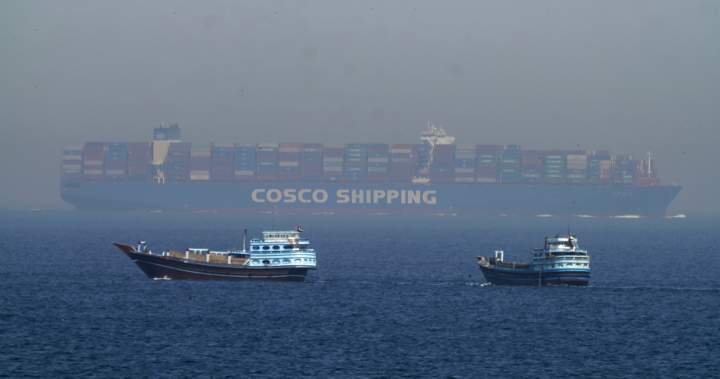
Until Monday afternoon, CENTCOM said that all 12 ships that the Iranian Navy had in the Gulf of Oman were destroyed. The regime relied on its navy to throttle shipping through the Strait of Hormuz — a key passage for transporting about 20% of the world’s oil and liquefied natural gas.
The Iran war brought oil tanker traffic through the strait to a virtual standstill. Shipping giants Maersk and Hapag-Lloyd said they did suspending all shipments through the strait.
Oil prices have soared Monday on concerns that a prolonged outage in the region’s crude oil supply could sharply increase energy costs, including U.S. gas prices.
Iran’s Revolutionary Guard announced on Monday that the strait would be closed and said it would “set fire to any ship that tries to pass through the Strait of Hormuz.”
“We will not allow a single drop of oil to leave the region,” the IRGC said.
But as energy analyst Kevin Book of Clearview Energy told the AP, “Iran has two ways to close the strait. One is to harass or attack ships, and the other is to lay mines. And without a navy, both of those things would be difficult.”
Ending the financing of Iranian proxy terrorist groups
The president also said Monday that the offensive was aimed at ensuring that “the Iranian regime cannot continue to arm, finance and direct terrorist armies outside its borders.”
In 1984, the US State Department designated Iran as a state sponsor of terrorism. The Ministry’s newest country report on terrorismreleased in 2023, identified the regime as a leading state sponsor of terrorism, “facilitating a wide range of terrorist and other illegal activities in the United States and globally.”
Iran is said to support acts of terrorism through authorized representatives and partners which include Hezbollah in Lebanon, Ansar Allah (known as the Houthis) in Yemen, Hamas in the Palestinian territories, and groups operating in Bahrain, Iraq, Syria and elsewhere.
Hamas carried out a terrorist attack on October 7, 2023, which killed 1,200 people in Israel and took 251 hostages, starting a war with Israel that lasted just over two years. AND cease-fire in Gaza is now in its second phase.
Yemen’s Houthis attacked waterways in the Red Sea in late 2023, “significantly disrupting maritime trade and global trade,” the report said.
Other groups have carried out drone attacks on US forces in Iraq and Syria, the report said, and also said Iran’s IRGC Quds Force and the Ministry of Intelligence and Security supported terrorist recruitment and plotting in Africa, Asia, Europe and the Americas.
In recent years, the Israel Defense Forces have carried out a series of fatal blows to the leaders of Iran’s main proxy groups, including Hezbollah leader Hassan Nasrallah, key Houthi official Mohammed al-Ghamari, and top Hamas leaders Yahyah Sinwar, Mohammed Sinwar, and Mohammed Deif.
The IDF called the strike that killed Iran’s supreme leader Ayatollah Khamenei “the culmination of a continuing effort to eliminate the senior leadership of Iran’s terrorist axis.”
Hamas political leader Ismail Haniyeh was also killed in Tehran in Operation 2024 by a US official attributed to Israelalthough the Israeli army has not claimed responsibility.
Death of Iranian protesters and regime change
Regime change was not among the reasons for the military operation that Mr Trump cited on Monday, but the US-Israeli offensive has targeted dozens of Iran’s top leaders, including Khamenei, who was killed on the first day. While the US said Israeli forces carried out the attack, they did so afterwards receiving intelligence about his location from the CIA.
Mr Trump said on Monday that 49 of Iran’s top leaders had been killed.
In his Saturday video, he called on Iranians to finish what the US and Israel started and overthrow the government.
“Now is the time to take control of your destiny,” he told the Iranian people. “This is the moment for action. Don’t let it pass.”
In the midst of the Iranian government bloody crushing on protesters in January, in which thousands were killed, Mr. Trump warned “very strong action” against the regime and he told the Iranians that American “help is on the way”.
During the weekend, he he told the Washington Post the goal is “freedom for the people” of Iran.
All I want is freedom for the people, he said.