itstargetnews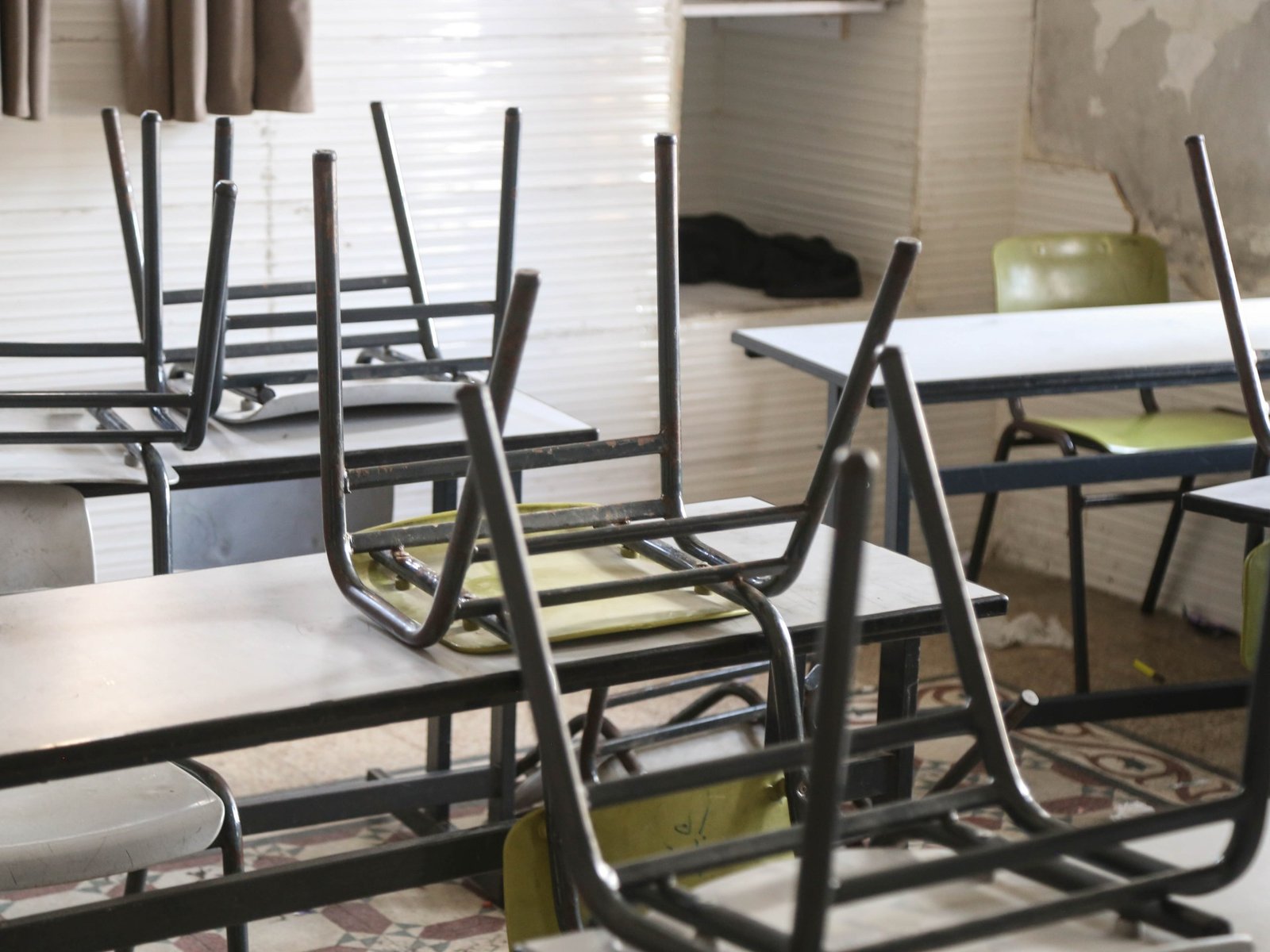
Nablus, occupied West Bank – For decades, Zenabiya Primary School has provided an intimate learning environment for aspiring young students in various educational fields in the northern West Bank city of Nablus.
But now, because Israel Withholding tax income for many years The Palestinian school system is effectively broken due to the influence of the Palestinian Authority. Like all public school administrators in the West Bank, Zenabiya School Principal Aisha al-Khatib is struggling to keep her small public school afloat.
Zenabia schools are closed for much of the week, leaving children wandering the streets or staying home. School supplies are severely lacking, and even ordinary textbooks are now reduced to “bundles of pages.”
“We try our best, but we don’t have the time, materials or consistency to properly educate our children and keep them off the streets,” Khatib said. “This is happening all over the West Coast.”
Targeting education for Palestinian children “means the destruction of this country,” she said.
Under the leadership of far-right Finance Minister Bezalel Smotrich, Israel has systematically withheld billions of dollars in taxes collected by Israel on behalf of the Palestinian Authority (PA) over the past two years. The measure is designed in part to punish the Palestinian Authority for its longstanding policy of paying families of Palestinians imprisoned by Israel for resisting the occupation — even though the Palestinian Authority announced early last year that it was reforming such policies.
Public services face severe cuts, affecting the salaries of bureaucrats, sanitation workers and police officers.
But perhaps nowhere is the budget crisis felt more than in the education sector.
In Zenabia and elsewhere in the West Bank, public schools are currently open only a maximum of three days a week. Teachers face a long-term situation of not being paid, and even if they are paid, they can only get about 60% of their previous income, which leads to strikes.
The impact of these education funding cuts is being felt during the start of school. Classroom time in Zenabia has been so reduced that teachers focus almost exclusively on teaching math, Arabic and English, while subjects like science have been essentially cut entirely.
Educators warn that the result could leave a generation of Palestinian students facing lasting educational gaps.
“As a school principal, I know (students’) level of (education) is different than it was before,” Khatib said.
“We’re always missing school”
Ten-year-old star student Zaid Hasseneh spends most of his time outside of school trying to improve his English by looking up words on Google Translate. Zaid dreams of one day going to college in the United States and hopes to become a doctor.
“I want my son to grow up to be literate and not just remember what he learned in school,” said his mother, Eman. “No, I want his cultural knowledge to develop and become diverse and advanced.”
Ayman did what she could to help Zeid study, but she was busy trying to support the family financially after her husband lost his job in Israel. Before Israel’s war on Gaza began in 2023, Eman’s husband worked as a mechanic in Tel Aviv. He has been unable to find work after Israel revoked his work permit and that of some 150,000 other West Bank Palestinians. Eman now works in a Halawa factory and is the sole breadwinner for his family.
“I come home from get off work tired, but I have to keep up with (Zaid) regularly,” Iman said. “I told him, ‘The most important thing is learning. Learning is essential to life.'”
But Iman realized how limited she was in helping her son learn. “The teacher knew one thing, but I didn’t know how to explain it,” Eyman said. “Now, the books they receive in school are no longer full books. They’re bundles. Regular books are 130 pages, but these are 40 or 50 pages.”
Compounding the problem, schools are poorly resourced and students and their families have erratic schedules that make cumulative learning nearly impossible. “The whole family’s daily life is affected,” Iman said.
Even Zeid now spends a lot of time on the streets instead of studying in classrooms or playing mobile games on his phone.
Most students are like this now.
Mohammed and Ahmed Haji joined Zenabia four years ago when they were six years old after facing extreme bullying at another school. They began to like the new school and the welcoming environment it provided. But the twins now spend most of their time on their phones. As their parents are also struggling to earn enough money to make ends meet, they are left home alone on days off from school.
“It’s not good at all. We miss school all the time,” one of the twins said. “It’s not like a full schedule, we try to learn as much as we can, but we still don’t feel good.”
Some families transfer their children to private schools, but few can afford it. “My (monthly) salary is 2,000 shekels ($650),” explains Eman Hassaneh. “About 1,000 yuan is for rent. Another 500 yuan is for bills. There is very little money left for food. I can’t take care of his education either.”

Teachers resign, dropouts are on the rise
Overall, years of billions of dollars in budget cuts by the Palestinian Authority have also resulted in fewer students and teachers.
“Many teachers left school work and went to work in factories because they were not paid enough,” Khatib said. “And they feel like they’re not giving students what they need.”
Due to reduced funding, Zenabia teacher Tamara Shtayeh now only teaches math, English and Arabic. “As a teacher, the three-day solution is a bad solution because it doesn’t cover the minimum education required,” she said. “Not suitable for students and not suitable for teachers.”
Shtayeh, a mother of three girls, works part-time selling products online to support her family due to reduced wages. Even Khatib, the school principal, said she can now only afford one of her two college-age daughters to go to college while the other stays at home.
School hours are further reduced as Israeli soldiers regularly raid surrounding areas, closing schools with each attack. As the crisis drags on for years, Stayer senses a growing generational gap, with the previous generation receiving five days of schooling and the current generation attending school for half that time.
Shtaye and Khatib worry about the lack of structure in their children’s lives. For students like Zaid who are committed to self-education regardless of circumstances, there are many more who are dropping out of the system entirely.

Not far from Zenabiya, 15-year-old Talal Adabiq now sells sweets and drinks on the streets of Nablus for eight hours a day.
“I really didn’t like school,” Talal said. “I prefer working.”
Talal told his parents about a year ago that he wanted to drop out of school. Although they wanted him to continue his education, he told them that he saw little use for school anymore—and he used an irregular school schedule to prove his point.
Talal dropped out of Jindi School after offering to support his struggling family financially. Now he sells his wares on the streets, earning “about 40 to 50 shekels a day” ($13 to $16).
On Tuesday afternoon, several teenage boys watched nearby as he sold lollipops and other sweets. They said they were still in school, but on this budgeted day off, some of the boys joked about how “fun” it would be to not go to school at all.
Talal, meanwhile, shrugged off questions about what dropping out of school would mean for his future. “God willing, things will get better,” Talal said. “I don’t know what to do.”
Educators and Palestinian Authority representatives estimate that about 5 to 10 percent of students in the West Bank have dropped out of school in the past two years.

‘Our children deserve a chance at life’
While massive budget cuts have disrupted the education sector, the Palestinian Authority is struggling to find solutions as budget woes deepen, without which schoolchildren face threats, violence and demolition by Israeli soldiers, settlers and Israeli civilian authorities.
Even before the war in Gaza began, the school sector faced various crises, with teacher strikes commonplace, Israeli attacks on school infrastructure and on children on their way to school, At least 36 demolitions were carried out in 20 schools Between 2010 and 2023.
but systemic attack on education It’s intensifying now. According to Nablus Governor Ghassan Dagras, in his region alone, three schools have been attacked by settlers in the past two months. Last month in nearby Jarud, Settlers set fire to school. Daglas said the increase in violence has left students immediately traumatized and fearful of going to school.
“In the past three months, most of the home invasions in the Nablus area have been against school children. They would take the children with one of the parents. They would interrogate them for several hours,” the governor said. “What will be the mental state of the students after these interrogations?”
The Palestinian Authority estimates that the education of more than 84,000 students in the West Bank has been disrupted by incidents such as settler attacks, military attacks and school demolitions. More than 80 schools with approximately 13,000 students in the West Bank and occupied East Jerusalem are under threat of total or partial demolition by the Israeli authorities. Between July and September 2025 alone, more than 90 such education-related incidents were recorded in the West Bank.
In Area C — 60 percent of the West Bank under full Israeli military control — students from remote villages sometimes have to walk several kilometers to reach school, often and increasingly facing harassment or attacks by settlers and soldiers along the way. settler outpost deliberately placed close to school.
“These are not the individual acts of a few violent settlers,” said Mahmoud Aroul, deputy chairman of the central committee of the Palestinian Authority’s ruling Fatah party. “Rather, it is an overarching policy that is supported by the occupation.”
According to Dagras, 19 students were shot dead by Israeli forces in Nablus governorate alone in 2025. A total of 240 people were injured.
Education officials say the longer the crisis lasts, the greater the long-term impact will be, as teacher attrition, learning disruptions and rising dropout rates will intensify over time.
“The persistence of the crisis means the risk of long-term institutional erosion, with temporary solutions becoming permanent and regimes increasingly unable to restore previous levels of quality, efficiency and justice,” said Refat Saba, president of the Global Movement for Education. “Saving education today is not a sectoral choice but a strategic necessity to protect societies and their futures.”
For Eman Hassaneh, this means defending her son Zaid’s hopes and dreams for the future. “We hope that all of these barriers to education don’t actually impact our children and their enthusiasm for learning,” she said.
“Our children deserve a chance at life.”