March WTI crude (CLH26) is up +1.28 (+2.00%) today and March RBOB gasoline (RBH26) is up +0.0331 (+1.691%).
Crude oil and gasoline prices are rising today, with crude hitting a 1.5-week high and gasoline hitting a 2.75-month high. Escalating tensions between the US and Iran supported crude prices today after the Wall Street Journal said the US is considering seizing tankers carrying Iranian crude, and Axios reported the US could send a second aircraft carrier strike group to the Middle East if nuclear talks with Iran fail. Crude oil prices fell from their best levels after the EIA’s weekly crude and gasoline inventories rose more than expected.
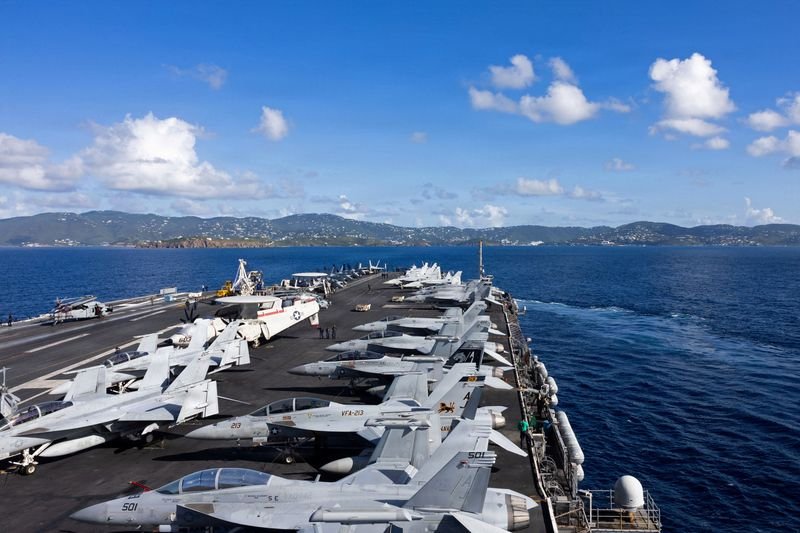
Escalating geopolitical risk in the Middle East has added a risk premium to crude oil, supporting prices. The Wall Street Journal said today that the US has discussed seizing tankers carrying Iranian oil. Also, Axios reported today that the United States is considering sending a second aircraft carrier strike group to the Middle East to prepare for military action should nuclear talks with Iran fail. The US Department of Transportation issued a maritime advisory on Monday that said US-flagged ships should stay as far as possible from Iranian waters when sailing through the Strait of Hormuz. Iran is OPEC’s fourth largest producer, and a US attack on the country could disrupt its 3.3 million bpd of crude output and potentially close the Strait of Hormuz, through which about 20% of the world’s oil passes.
Today’s US monthly jobs report was stronger than expected and supported energy demand and crude oil prices. January nonfarm payrolls rose +130,000, beating expectations for +65,000 and the most in 13 months. Also, January’s unemployment rate unexpectedly fell from -0.1 to 4.3%, showing a stronger labor market than expected to be unchanged at 4.4%.
An increase in Venezuela’s crude exports is also boosting global oil supplies and is bearish for prices. Reuters reported last Monday that Venezuelan crude exports rose to 800,000 bpd in January from 498,000 bpd in December.
Crude oil is also supported after Russia recently threw cold water on hopes of progress in peace talks with Ukraine, after the Kremlin said the “territorial issue” with Ukraine remains unresolved and there is “no hope of a long-term settlement” of the war until Russia’s demand for territory in Ukraine is accepted. Prospects for continued war between Russia and Ukraine will keep restrictions on Russian crude and are bullish for oil prices.
On Tuesday, the EIA raised its 2026 U.S. crude production estimate to 13.60 million bpd from 13.59 million bpd last month, and raised its 2026 U.S. energy consumption estimate to 96.00 (quadrillion btu) from 95.37 last month. The IEA last month cut its global crude surplus estimate for 2026 to 3.7 million bpd from last month’s estimate of 3.815 million bpd.
Vortexa reported on Monday that crude oil stored in tankers that have been parked for at least 7 days fell -2.8% y/y to 101.55 million bbl in the week ended 6 February.
On February 1, OPEC+ said it would stick to its plan to halt production increases until the first quarter of 2026. OPEC+ at its November 2025 meeting announced that its members would increase production by +137,000 bpd in December, but then pause production increases in the first quarter of 2026 due to the emerging global oil surplus. OPEC+ is trying to restore all of the 2.2 million bpd production cut it made in early 2024, but still has 1.2 million bpd of output left to restore. OPEC crude output in January fell by -230,000 bpd to a 5-month low of 28.83 million bpd.
Ukrainian drone and missile attacks have targeted at least 28 Russian refineries over the past six months, limiting Russia’s crude export capabilities and reducing global oil supplies. Also, since late November, Ukraine has stepped up attacks against Russian tankers, with at least six tankers targeted by drones and missiles in the Baltic Sea. In addition, new US and EU sanctions on Russian oil companies, infrastructure and tankers have slowed Russian oil exports.
The weekly AIA report today was mixed for crude oil and products. On the upside, EIA distillate inventories fell -2.7 million bbl, a bigger draw than expectations for -1.7 million bbl. On the downside, EIA crude inventories unexpectedly rose +8.53 million bbl to an 8-month high vs. expectations for a -24,000 bbl draw. Also, gasoline supplies rose by +1.16 million bbl to a 5.5-year high, a bigger-than-expected build of +840,000 bbl. Also, crude inventories at Cushing, the delivery point for WTI futures, rose by +1.07 million bbl to a 9-month high.
Today’s EIA report showed that (1) US crude oil inventories on February 6 were -3.4% below the 5-year seasonal average, (2) gasoline inventories were +4.4% above the 5-year seasonal average, and (3) distillate inventories were -3.3% below the 5-year seasonal average. US crude output for the week ended February 6 rose +3.8% y/y to a 14-month low of 13.713 million bpd, just below the all-time high of 13.862 million bpd in the week of November 7.
Baker Hughes reported last Friday that the number of active US oil rigs for the week ended Feb. 6 rose by +1 to 412 rigs, just above the 4.25-year low of 406 rigs posted in the week ended Dec. 19. 2022.
As of the date of publication, Rich Asplund had no positions (either directly or indirectly) in any of the securities mentioned in this article. All information and data in this article is for informational purposes only. This article was originally published on Barchart.com
 itstargetnews