itstargetnews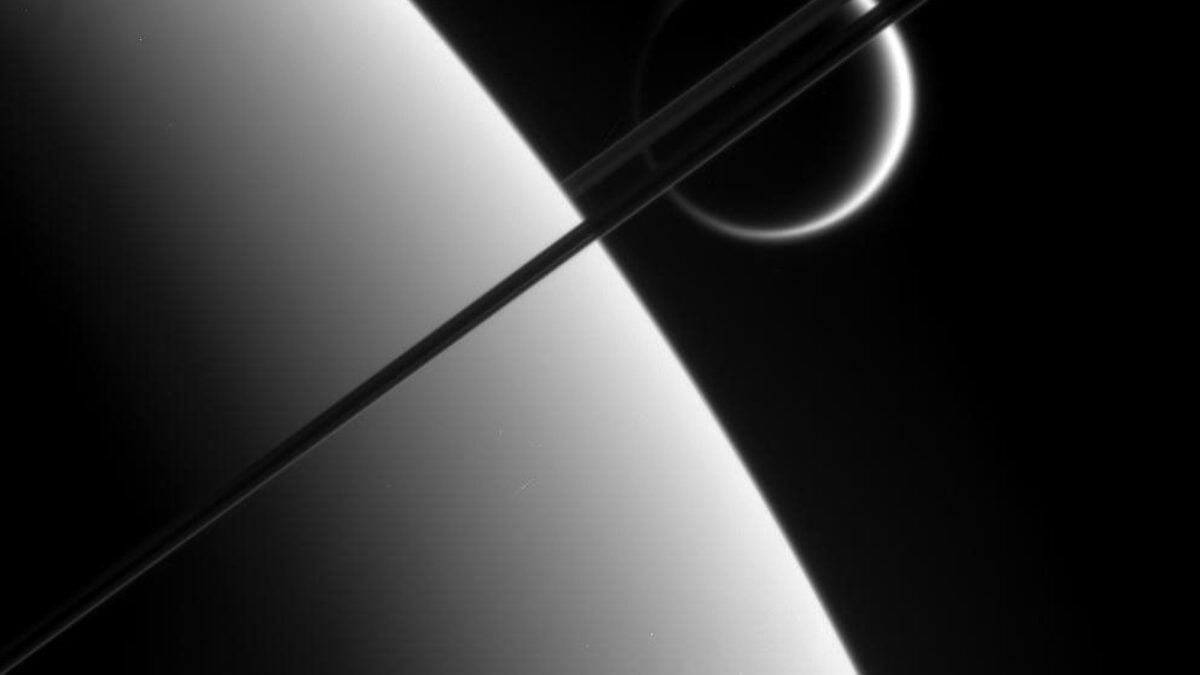
Among the solar system’s planets, Saturn sparks the human imagination with its signature rings and impressive moon count of 274. But compelling new research is bringing back theories of an ancient collision that shaped the Saturn we know today—especially Titan, its largest moon.
The study, accepted for publication in the Planetary Science Journal, addresses a well-known mystery surrounding the unusually young age of Saturn’s rings as well as the strangeness of Titan’s orbit. Researchers led by the SETI Institute consider the possibility that Titan was born from a two-month collision, the impact of which led to the creation of Saturn’s younger rings. The paper is currently available as a preprint at arXiv.
Cassini’s amazing questions
Humanity’s first close-up of Saturn, the sixth planet from the Sun, came from NASA’s Pioneer 11 spacecraft in 1979. Voyagers 1 and 2 made their respective flybys a few years later.
But it is Cassini which brings Saturn into sharper focus. The spacecraft’s 13-year mission collected valuable data about Saturn, its rings, and its moons for Earthbound scientists to sift through.
However, some of the data sent back by Cassini is challenging some long-held beliefs of astronomers. For example, several of Saturn’s many moons have strange, crooked orbits that don’t quite fit the equations. Saturn’s rings are younger than expected.
In addition, the internal mass of the planet is more concentrated in the center than astronomers believed, suggesting gaps in the knowledge of the scientific consensus surrounding Saturn’s orbital behavior.
A daring what-if
In 2022, a group of astronomers proposed that these differences would be better understood if Saturn lost a moon about 100 million years ago, which is when Saturn’s young rings probably formed. The latest study tests this hypothesis, using computer simulations to investigate whether an extra moon could fly close enough to Saturn to form rings.
Of course, the impact of such a collision should be consistent with the distribution and characteristics of Saturn’s moons today, the team said in the paper. Consequently, what indicates the researchers a good starting point is a consistent anomaly in their simulations.
“Hyperion, the smallest of Saturn’s major moons, gives us the most important clue about the history of the system,” Matija Ćuk, the lead author of the study and a researcher at the SETI Institute, said in a statement.
Specifically, the addition of an unstable extra moon continues to drive Hyperion — a moon we know to be real — out of existence, alerting researchers that something is up. The team also noted that Hyperion’s orbit is locked with Titan’s, but the orbital lock between the two is likely several hundred years old.
Not one, but two

The team finally came up with a possible scenario. What if there were two early months, not one? If a so-called “Proto-Titan” merged with a smaller “Proto-Hyperion,” this would explain the overall lack of impact craters on the moon. If a smaller object disturbed Titan’s orbit before the merger, it would also make sense for Titan to have an eccentric orbit, the researchers added.
Then the fragments near the Titan merger could have joined together to form Hyperion—a lopsided, lumpy moon whose appearance might fit a wild, strange origin story.
Regarding Saturn’s rings, researchers were surprised to find that, more often than expected, Titan’s eccentric orbit damaged the inner moons of the planet. This would disrupt the orbits of the smaller moons, forcing them into extreme orbits that lead to massive collisions, forming the rings.
All that said, the team is now relying on NASA’s Dragonfly, an upcoming mission that will arrive at Titan in 2034, to investigate the mystery. Since the new research mainly focused on simulations, the more recent data from Dragonfly should allow them to put the hypothesis to the test, they said.