itstargetnews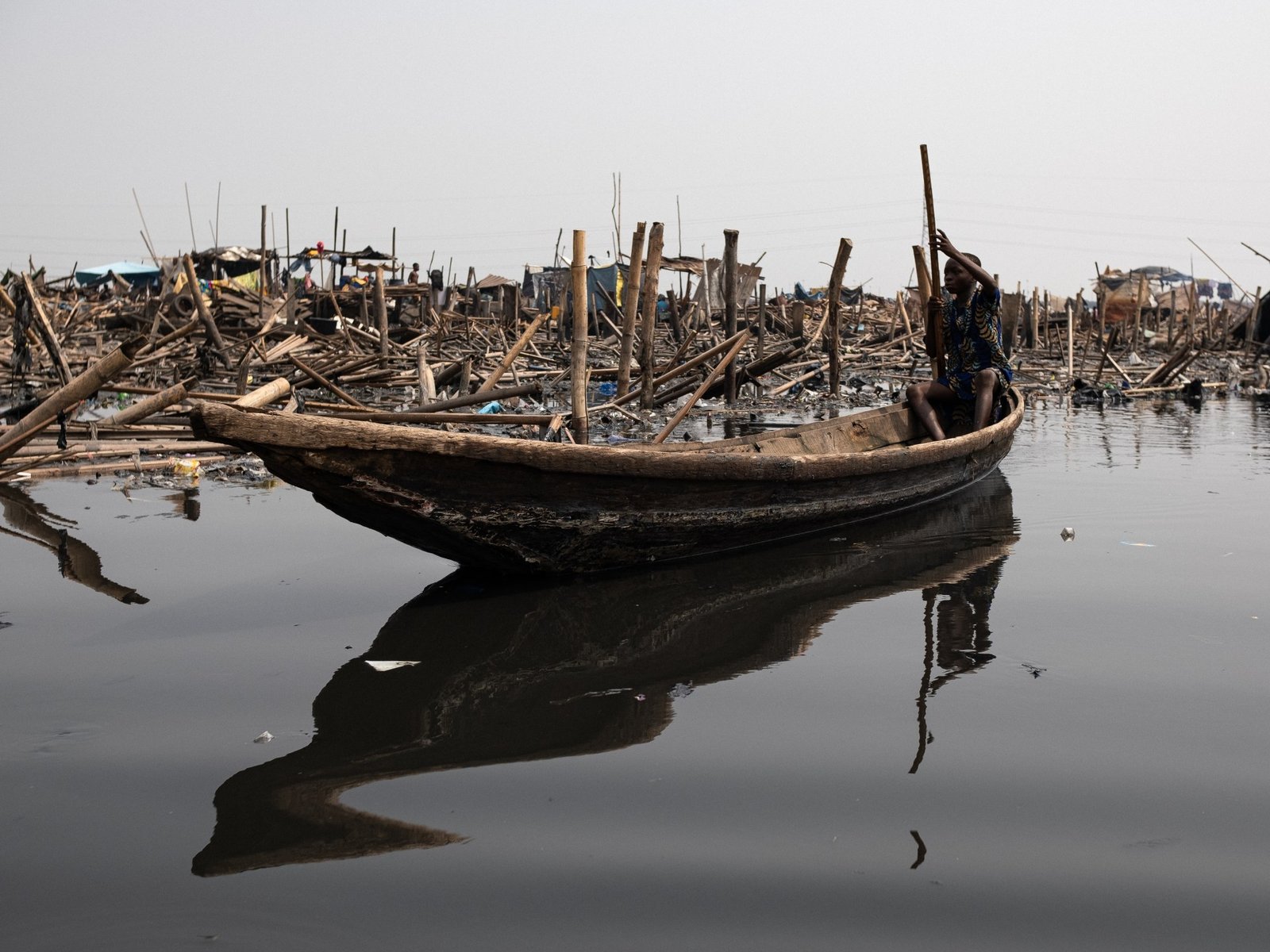
Lagos, Nigeria – One afternoon in January, Tunde Agando had taken his mother to the market and was paddling a canoe back to the floating settlement of Makoko when he saw an amphibious excavator demolishing his family’s house.
Before he could get close, the large house on stilts where he and 15 others lived in Lagos, Nigeria, collapsed, submerging everything inside – clothes, furniture, the carpentry tools his brother used to build wooden canoes, and his plug-in phone – under water.
Recommended Stories
3 item listend of list
Angry residents tried to stop the operator, but the police who came with them started firing tear gas.
“We are now sleeping on mats under a shed outside the pastor’s house while we try to find our lost (properties) and figure out what to do next,” said Agando, 30, who is still grappling with his newfound homelessness. Later that day, his barber shop was also demolished.
Agando was one of thousands of Makoko residents forcibly evicted from their homes by the Lagos State government, a demolition operation that began in late December and ended only when the Lagos State House of Assembly ordered a halt to it earlier this month.
The government said the demolition was being carried out because the community is close to power lines and people need to move back 109 meters (109 yards). But authorities have exceeded the 100-metre limit. Non-profit organizations (NGOs) working with communities said the demolitions took place 250 to 500 meters (about 270 to 550 yards) inside the settlement, destroying people’s homes, leaving thousands homeless and killing more than a dozen people, including two babies.
During weeks of demolition, the surrounding waters were dotted with canoes carrying beds, bowls and other household appliances, and anxious community members removed their valuables in case the operation reached them. Meanwhile, there are no plans to resettle or compensate victims.
“They didn’t stop, they just kept demolishing the whole place,” said Innocent Ahisu, one of the community leaders.
“This is where we live, this is where we eat and drink. We are all heartbroken and don’t know where this will end for us.”

“We are human beings”
Makoko, popularly known as the “Venice of Africa”, is a historic fishing village dating back to the 19th century, built on stilts off the coast of Lagos. It overlooks the Third Land Bridge that connects the wealthy island of Lagos to mainland Lagos, and its residents are mainly fishermen who fish in the same waters where they have lived for decades. As an economic center, it supplies fresh and dried seafood to markets across the city.
Although about 200,000 people live here, it has become a slum due to poverty and lack of government development and social infrastructure. However, its scenic waterways are lined with canoes selling daily necessities and food, and its unique culture makes it a popular destination for tourists. Most of the community is on the water, but part of it is on land.
On weekdays, the reflection of the sunset on the water, combined with the smoke rising from the wooden huts and children swimming nearby, makes Makoko look picturesque from a distance – its rugged imperfections testify to its resilience and give it a unique beauty.
But recently, the village has looked like what it looked like after a storm, with only the remains of wooden structures remaining in many places.
Women who work at one of Makoko’s many dried fish processing centers worry about what demolition will mean for their business and economic future.
“We hope they can see that we are human beings and stop demolishing our homes,” said an elderly woman in the local dialect Egun, who did not want to be named.
Observers note that such evictions will only add to the hardship of those already severely affected by Nigeria’s cost of living crisis.

“History will disappear”
Phoebe Ekpoesi, a mother of three, has been staying with a relative in Makoko after her house was demolished. She said everything she owned, including her business in the village, had been lost.
“This Makoko is all we have, my family lives here, my children go to school here, we have nowhere else to go,” she said in frustration.
Victoria Ibezim-Ohayri, executive director of Space for Change, a Lagos-based civil society organization that advocates for urban governance, gender rights and environmental justice, said the demolitions had a devastating impact on people like Ekposi.
“Children’s education is disrupted, people become increasingly homeless and vulnerability increases, particularly among women, disabled people and older people in the community,” she said.
Deji Akinperu, co-founder of Rethinking Cities, an NGO that advocates against the exclusion of the urban poor, said demolition would not only affect victims and community structures, but people would be deprived of ownership of public land and a sense of belonging to a place.
“Heritage will be lost, history will be lost,” he said.
Worse, many say, there is no relocation plan for the victims, many of whom now live with friends and relatives or sleep in canoes or what’s left of buildings.
Although the state government pledged funds to victims on February 4, Lagos State Information Commissioner Gbenga Omotoso told Al Jazeera that the amount of compensation could only be determined after the number of victims was counted and recorded.
Akinpelu said the authorities should consider compensation and resettlement issues before starting demolition rather than as an afterthought.
Advocates such as Ibezim-Ohaeri argue that the government’s failure to provide these is “illegal” because these considerations are clearly spelled out in Nigeria’s constitution, which prohibits the government from demolishing buildings without prior consultation and prompt payment of compensation.
However, Lagos State Governor Babajide Sanwo-Olu defended his state’s actions, saying: “What we are doing is not demolishing the entire Makoko. We are clearing areas to ensure they do not encroach on the Third Mainland Bridge and to keep residents away from high voltage lines.”

Expulsion “script”
While the government has cited safety reasons for demolishing the homes, activists say there are other motives. Last year, local stores in Nigeria report The government has reached an agreement with a private contractor to develop a property in Makoko and will immediately begin dredging and land reclamation opposite the area.
“The unofficial reason is that Makoko is located in a coveted area. Makoko is located on the waterfront, overlooking the lagoon from the Third Mainland Bridge. So the intersection between urban poverty and tasteful real estate development is one of the biggest pressures,” Ibezim-Ohaeri said.
Forced evictions and demolitions are not new to Nigeria’s economic capital. They follow a historical trend that has seen informal settlements and seaside communities being phased out to make way for luxury property developments.
In 1990, 300,000 people were forcibly evicted from Maroko, Lagos, to make way for what is now part of Victoria Island and Oniru Estate, both areas sought after by Nigeria’s wealthy. Otodo-Gbame is facing a similar situation destiny In 2017, 30,000 of the site’s residents were made homeless and it recently made way for the luxury Periwinkle Estate.
Another seaside community, Oworonshoki, is currently being demolished and campaigners say a luxury estate may soon appear in the area.
Between 1973 and 2024, 91 evictions were carried out in parts of Lagos.
“Lagos State has a playbook for evictions and if you look at all other evictions, you will see that it follows the same playbook,” Ibizim-Ohali said. “First it will be pointed out that there are problems in the area and eventually the area will be flooded with new tasteful developments that are well beyond the capabilities of the previous owners.”
Ibezim-Ohaeri, Makoko’s lawyer since 2005, said the state had made repeated attempts to evict residents of the village, but the community had resisted through court orders and pressure from civil society organizations.

Is it a wire or a person?
Ibezim-Ohali said other seaside communities and informal settlements were also at risk, with the Lagos government recently announcing plans to reclaim more informal land.
“What this means for Lagos is that it continues to follow the classist pattern it has had since colonial times,” Akinperu said, adding that “it is time for the government to start rethinking its approach because housing high-income earners creates imbalances in the city.”
Experts say the city of 22 million people with a brewing housing crisis should consider mixed-income housing models that would make housing available to everyone rather than leaving more people homeless.
“We have to think about what can give way to what. Is it the wires or the people? The wires themselves can move, but what they found is that the people are the ones who should move for the wires,” Akinpelu said.
On January 29, members of the Makoko community demonstrated at the Government Secretariat, demanding a meeting with the mayor, but were forcibly dispersed by police who fired tear gas. A large banner read: “Big cities cannot be built on the bones and blood of poor people.”
This week, Lagos State House and the community reached a compromise whereby residents would not rebuild on demolished buildings, compensation would be determined by a committee, and the Water City redevelopment project would be implemented in Makoko.
Meanwhile, the future looks bleak for those who have been evicted and displaced.
In Makoko, Agando returned to the pastor’s house and slept under a mosquito-infested shack with his pregnant wife and relatives. Once they have enough money, his family is considering looking for a place to live in Ikorodu, northeast of Lagos.
“This is what we have now,” he said.