itstargetnews
Russia will continue to respect the restrictions set by recently expired New START nuclear arms reduction agreement if the United States does the same, Russian Foreign Minister Sergei Lavrov said on Wednesday.
“We proceed from the fact that this moratorium on our part, announced by our president, will remain in force, but only until the United States exceeds the above-mentioned limits,” Lavrov said, addressing the lower house of the Russian parliament.
A new strategic arms reduction treaty (New START) was signed in 2010 between the USA and Russia. It limited the number of strategic nuclear warheads that both countries could deploy to 1,550 and included verification measures such as on-site inspections and data exchanges designed to ensure compliance.
The pact was originally set to expire in February 2021, but former President Joe Biden extended it for five years, keeping it in effect until February 2026.
President Vladimir Putin said last year that Russia was prepared to continue to abide by the treaty’s core limits if the US did the same, and Lavrov’s latest statements confirm that view after the pact expires.
EVGENIJA NOVOZHENINA/REUTERS 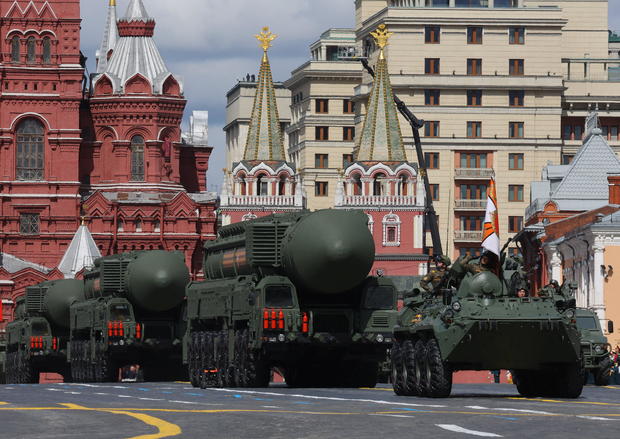
According to The Associated Press, Kremlin spokesman Dmitry Peskov also said last week that Russia “will maintain its responsible, thorough approach to stability when it comes to nuclear weapons. And, of course, it will be guided primarily by its national interests.”
In the US, the debate about the future of strategic arms control continues.
President Trump has previously argued that any nuclear deal should include China, which has expanded its nuclear arsenal in recent years. Beijing has repeatedly rejected calls to join trilateral talks on nuclear arms control, however, noting that its weapons stockpile is far less than that of the US and Russia.
A White House official told CBS News in January that the president will decide on the way forward for nuclear arms control “which he will clarify in his time frame.”
Last week, the US and Russia reached an agreement re-establish official high-level military communications that were suspended in late 2021, ahead of a full-scale Russian invasion of Ukraine.
But there was no sign of progress toward a new deal to regulate the arsenals of the world’s two biggest nuclear powers.
Mr. Trump the Pentagon instructed in October to continue testing nuclear weapons “on equal footing” with other countries’ tests, a move that could break a US standstill that stretches back to the end of the Cold War.
“Due to the testing programs of other countries, I have directed the War Department to begin testing our nuclear weapons on an equal basis,” the president wrote. Social truthusing the term preferred by his administration for the Department of Defense. – That process will start immediately.
Days later, Putin instructed his government submit proposals on the possible continuation of nuclear weapons testing in Russia.
During a meeting with his Security Council, Putin said Russia was complying with international Comprehensive Nuclear Test Ban Treatywhich prohibits nuclear test explosions, but said, “if the United States or any other state party to the Treaty were to conduct such tests, Russia would be obligated to take reciprocal measures.”