itstargetnews
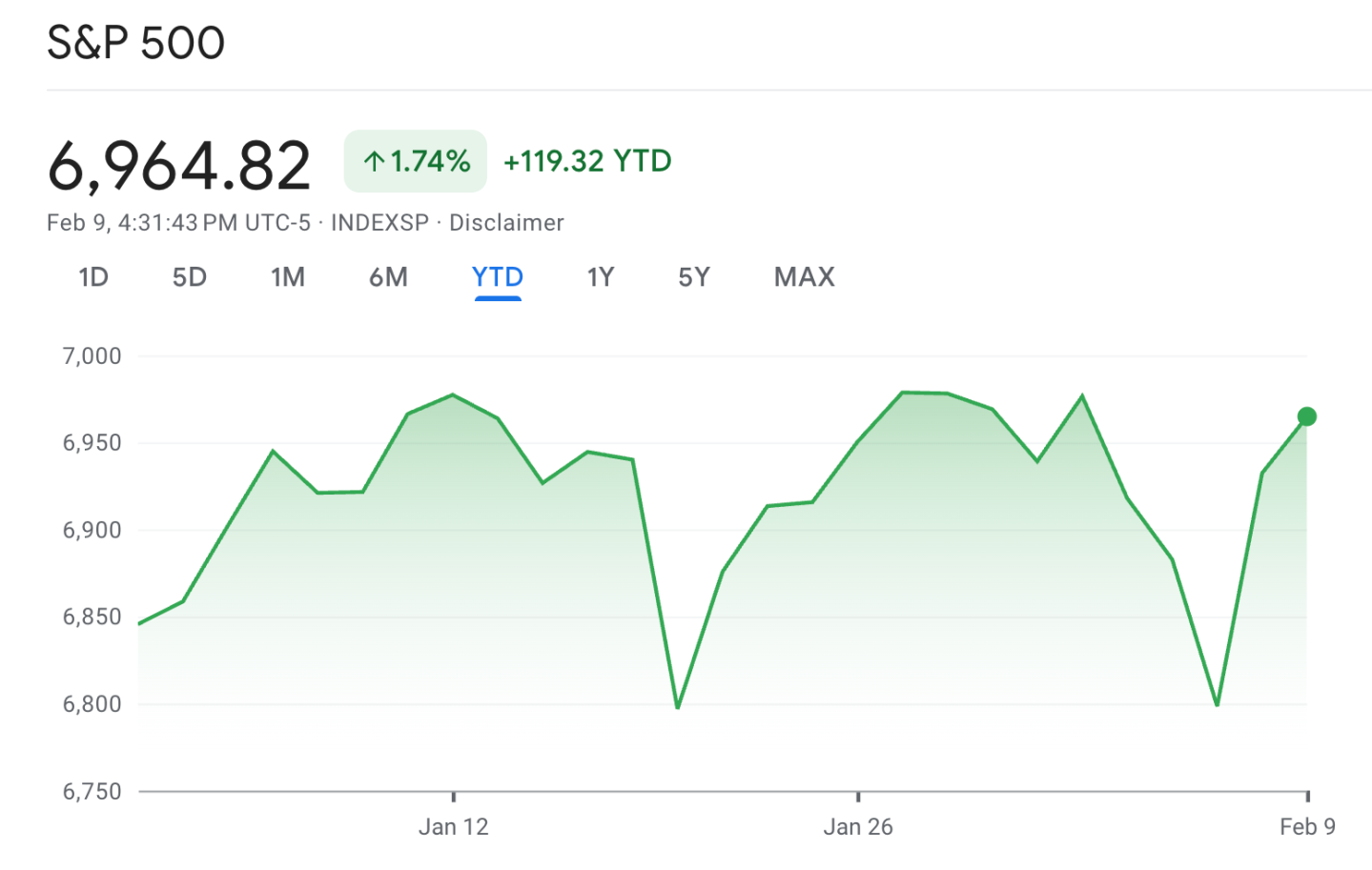
S&P 500 futures rose 0.18% this morning before the opening bell in New York after the index closed up 0.47% yesterday, leaving it one mark below its all-time high. Traders bought stocks after most S&P companies reported that they beat consensus earnings estimates for the day.
The contrast between this week’s bullish rally and last week’s AI-induced sell-off couldn’t be starker. To put this in perspective, $2 trillion was wiped off the market by software companies last week, which traders think could be lost to the AI companies that are replacing them.
“Software experienced its largest non-recessionary 12-month drawdown in more than 30 years (-34%), wiping ~$2 trillion of market cap from its peak and reducing its weight in the S&P 500 from 12.0% to 8.4%,” according to Dubravko Lakos-Bujas and his partner at JPMorgan. “This is largely driven by growing concerns over the disruptive impact of new LLM (large language model) capabilities and is further exacerbated by aggressive de-risking and extreme technical positioning that have pushed sentiment to more pessimistic levels.”
“The market is pricing in a worst-case AI disruption scenario that is unlikely to happen in the next three to six months. Business software remains deeply embedded in the corporate landscape, backed by multi-year contracts and high switching costs that provide a significant buffer against near-term displacement. Importantly, emerging evidence suggests that AI is more likely to be a replacement,” rather than a software. he told clients in a recent note.
Capex is going through the roof
There are good reasons to think that the “SaaSpocalypse” won’t show up anytime soon: In their Q4 earnings calls, the big tech companies all revealed that they are massively increasing capital expenditures (“capex”) on AI.
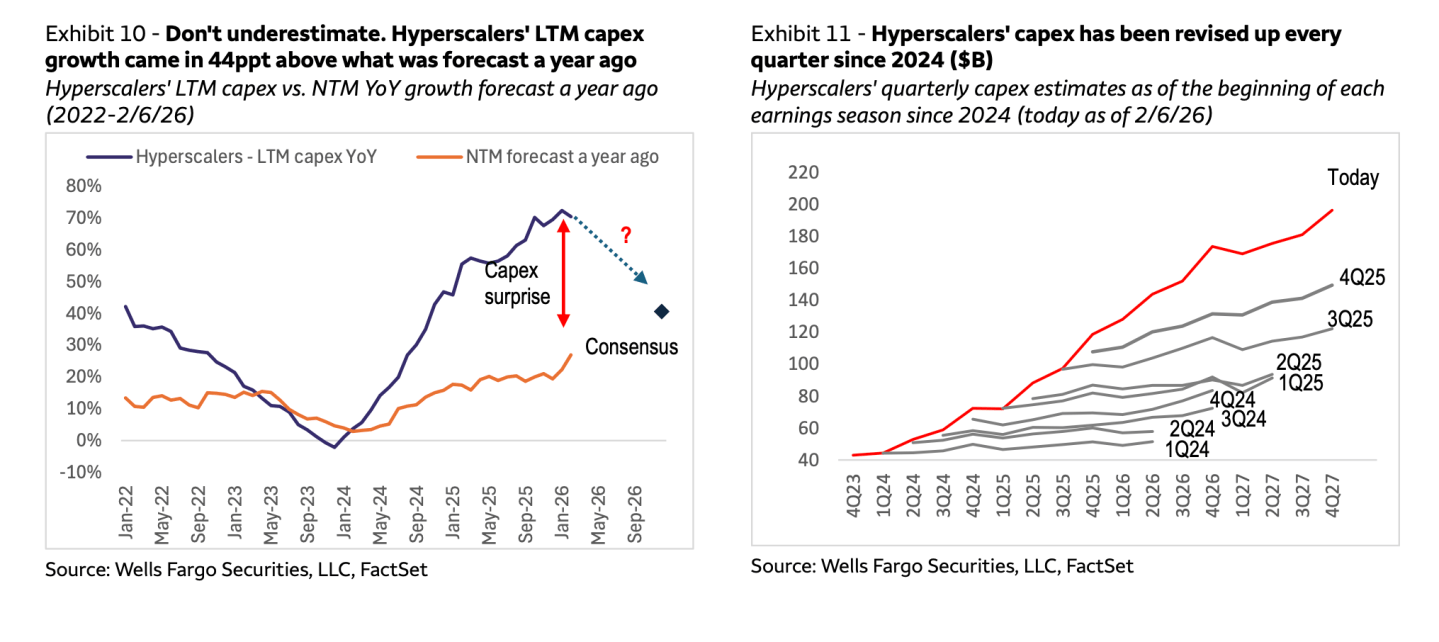
The “hyperscalers'” capex guidance for 2026 is up 24%, $117 billion more than last year, according to Ohsung Kwon and his colleagues at Wells Fargo. They estimate that $1.3 trillion will be spent on building AI facilities through 2027. Of that, $660 billion is planned for this year, according to the Financial Times.
“Hyperscalers have consistently invested more than the consensus expected – in (the last 12 months), they increased capex 50 percentage points above what the consensus wrote a year ago,” said Kwon and his team. Here’s what the downgrades look like on the charts:
AI is more debt-financed
Increasingly, large technology companies are borrowing to pay for that capex. Alphabet was issued a rare 100-year bond for $20 billion. However, the level of debt-financed expansion remains below previous increases, Wells Fargo said.
“Currently, hyperscalers have funded only 2% of capex since (in the first quarter of 2024) with an increase in net debt, well below previous investment cycles: 13% during Shale and 30% during Telecom,” Kwon et al said. “We’re tracking $243 billion in debt raised for data center development since the start of 2025, with $167 billion coming in since the start (fourth quarter of 2025) alone.”
Bank of America’s Tom Curcuruto has a similar take: “We maintain our forecast of ~$140 billion hyperscaler direct (debt) issuance for 2026, but the risks are very high.”
All that money will filter down to the 10 biggest AI companies (OpenAI, Anthropic, etc.) and will instead be spent on real estate development, data center kit, and power stations needed to provide AI with energy—which is likely good for stocks in those sectors.
All this spending and building is a tailwind for stocks. Seventy-five percent of S&P 500 companies reported fourth-quarter earnings, and the companies’ earnings per share were 12% higher than last year, according to BofA and Wells Fargo. That was 5% higher than the consensus estimate before the quarter, BofA’s Savita Subramanian told clients.
Here’s a snapshot of the markets ahead of the opening bell in New York this morning:
- S&P 500 futures rose 0.18% this morning. The last session closed at 0.47%.
- STOXX Europe 600 flat in early trading.
- The UK’s FTSE 100 down 0.31% in early trading.
- Nikkei 225 in Japan increased by 2.28%.
- CSI 300 in China increased by 0.11%.
- The South Korean KOSPI is flat.
- NIFTY 50 in India increased by 0.32%.
- Bitcoin available at $69.2K.