itstargetnews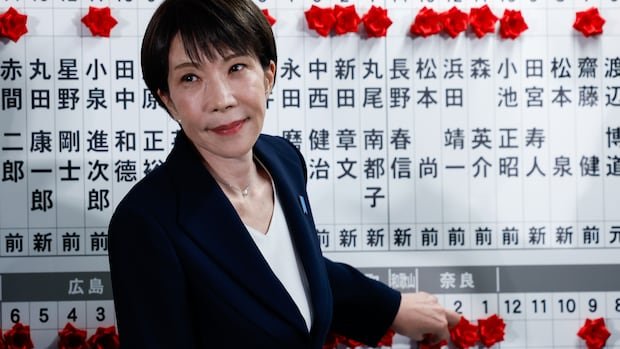
Prime Minister Sanae Takaichi’s ruling party secured a two-thirds majority in key parliamentary elections on Sunday, Japanese media reported citing preliminary results, scoring a landslide victory thanks to its popularity.
In a televised interview with public broadcaster NHK after her big win, Takaichi said she is now ready to implement policies to make Japan strong and prosperous.
NHK, citing the results of the vote count, said Takaichi’s Liberal Democratic Party, or LDP, had secured 316 seats on its own by early Monday, comfortably surpassing an absolute majority of 261 seats in the 465-member lower house, Japan’s more powerful bicameral parliament. This is a record since the party was founded in 1955 and surpasses the previous record of 300 seats won in 1986 by the late Prime Minister Yasuhiro Nakasone.
With 36 seats won by its new ally, the Japan Innovation Party, Takaichi’s ruling coalition won 352 seats.
A smiling Takaichi placed a large red ribbon above each awardee’s name on a plaque at LDP headquarters as party leaders clapped along.

Despite lacking a majority in the second house, the upper house, a big jump from his pre-election share in the superior lower house would allow Takaichi to make progress on a right-wing agenda aimed at boosting Japan’s economy and military capabilities as tensions rise with China and it tries to nurture ties with the United States.
Takaichi said she will try to win the support of the opposition while firmly pushing her political goals.
“I’ll be flexible,” she said.
Takaichi is hugely popular, but the ruling LDP, which has ruled Japan for most of the past seven decades, has struggled in recent years with funding and religious scandals. She called Sunday’s snap election after only three months in office, hoping to change that while her popularity is high.
all the best @takaichi_sanae about your decisive victory in the general election in Japan.
I look forward to working with you to further advance the strong partnership between Canada and Japan, to create more opportunities for both our peoples.
The ultra-conservative Takaichi, who took office as Japan’s first female leader in October, has promised to “work, work, work” and her style, seen as both playful and edgy, has resonated with younger fans who say they were previously uninterested in politics.
The opposition, despite the formation of a new centrist alliance and a rising far-right, was too divided to be a real challenger. The new opposition alliance of the LDP’s former coalition partner, the dovish Buddhist-backed Komeito, and the liberal-leaning Constitutional Democratic Party of Japan is projected to sink to half of its overall 167-seat electoral share.

With these elections, Takaichi bet that her LDP party, together with its new partner JIP, would secure a majority.
Akihito Iwatake, a 53-year-old office worker, said he welcomed the LDP’s landslide victory because he felt the party had become too liberal in recent years. “Because Takaichi moved things more toward the conservative side, I think that’s what brought about this positive result,” he said.
Takaichi’s politics
The prime minister wants to push for a significant shift to the right in Japan’s security, immigration and other policies. The LDP’s right-wing partner, JIP leader Hirofumi Yoshimura, said his party would serve as an “accelerator” for this push.
In Japan, far-right populists have recently gained strength, such as the anti-globalist and growing nationalist Sanseito Party. Exit polls predicted a big win for Sanseito.
The first big task for Takaichi when the lower house reconvenes in mid-February is to work on a budget bill, which has been delayed for the election, to fund economic measures to address rising costs and low wages.

Takaichi has pledged to overhaul security and defense policy by December to strengthen Japan’s offensive military capabilities, lift an arms export ban and move further away from the country’s postwar pacifist principles.
She has pushed for tougher policies on foreigners, counter-espionage and other measures that resonate with far-right audiences but that experts say could undermine civil rights.
Takaichi also wants to increase defense spending in response to US President Donald Trump’s pressure for Japan to loosen its grip.
There is time to work on these policies now, with no elections until 2028.
Although Takaichi has said she is trying to win support for policies seen as divisive in Japan, she has largely avoided discussing ways to finance rising military spending, how to mend diplomatic tensions with China and other issues.
Her shift to the right is unlikely to reorient Japan’s foreign policy and Takaichi is expected to maintain good relations with South Korea, given shared concerns about threats from North Korea and China.
But Seoul would worry about a Japanese attempt to revise the country’s pacifist constitution or further strengthen the military because of Japan’s wartime past, said Leif-Eric Easley, a professor of international studies at Ewha Womans University in Seoul.

Tensions between China and Japan have been rising over recent comments by Japanese Prime Minister Sanae Takaichi about Taiwan, combined with a long-standing dispute over the uninhabited island chain. Andrew Chang explains why these tiny islands are so valuable, how Taiwan is influencing and how this dispute has pushed Asia’s two biggest powers to a tipping point. Images courtesy of The Canadian Press, Reuters and Getty Images
In her campaign speeches, Takaichi spoke enthusiastically about the need for proactive government spending to fund “investment and growth in crisis management,” such as measures to boost economic security, technology and other industries. Takaichi is also pushing for stricter immigration measures, including tougher requirements for foreign property owners and a cap on foreign residents.
Sunday’s election “highlights a troubling trend in Japanese politics in which political survival takes priority over substantive political results,” said Masato Kamikubo, a politics professor at Ritsumeikan University. “Whenever a government tries to implement necessary but unpopular reforms … the next election looms.”
Sunday’s vote coincided with fresh snowfall across the country, including in Tokyo. Record snowfalls in northern Japan over the past few weeks have blocked roads and been blamed for dozens of deaths across the country.