itstargetnews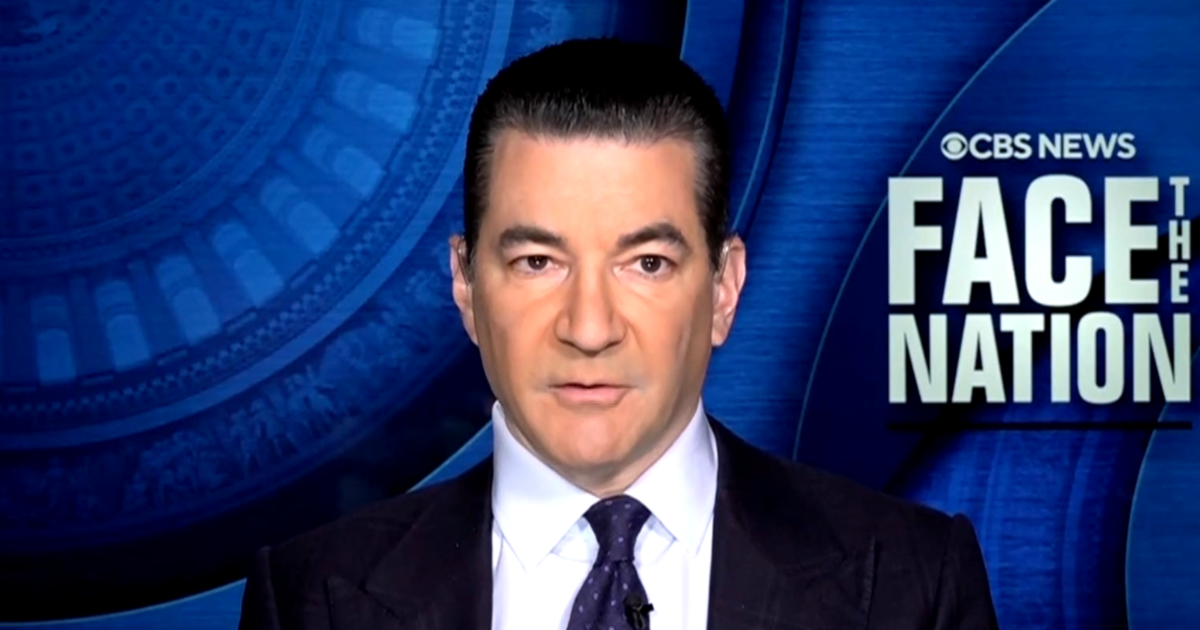
The following is a transcript of an interview with Dr. Scott Gottlieb, former FDA commissioner, that aired on “Face the Nation with Margaret Brennan” on February 8, 2026. Gottlieb also sits on the boards of Pfizer and United Health Care.
MARGARET BRENNAN: We now turn to former FDA Commissioner Dr. Scott Gottlieb. He is also on the board of Pfizer and United Healthcare. dr. Gottlieb, welcome back.
DR. SCOTT GOTTLIEB: Thank you.
MARGARET BRENNAN: You have a history of making accurate predictions that are also scary on this program, and around this time last year you said you were very concerned about the measles outbreak and that it was going to spread. you’re right In South Carolina, about 900 reported cases, the largest outbreak since measles was declared eliminated. You went out at Disneyland in California, two cases. Here in DC, cases discovered. Should we avoid mass gatherings? How worried should we be?
DR. SCOTT GOTTLIEB: Look, I don’t think we should be concerned about mass gatherings at this point. I think this is going to get worse before it gets fixed, unfortunately. Last year we had 2000 cases. So far this year, we have 750 reported cases. It will be much bigger by the end of the year. I think this is going to be a long cycle now. If you look at people who get measles, most people are between the ages of five and 17. They are not young children, and we see vaccination rates among young children declining, in fact, as part of a broader shift away from pediatric vaccines in this country, as these young children grow into school age, the extent of measles outbreaks will continue to escalate in this country. If you think back to the early 1990s, in 1991 there were about 25,000 cases of measles. In 1992, we had about 10,000. Vaccination rates fell in the 1990s, with only about 88% of American children vaccinated against measles, mumps, and rubella. Right now it’s about 90%, but in some of the states where you see these outbreaks, the rate is as high as 81% in Alaska. 88% in many countries that currently have epidemics. So we’re starting to get down to lower levels and I think it’s going to continue to go down. And again, as these unvaccinated children grow into school years, they will begin to spread larger and larger epidemics. So I think this is a long cycle, especially now that this has become embedded in the political psyche in this country. I think this is a change of generations.
MARGARET BRENNAN: Yes, well, those percentages you point out are also important because we are below herd immunity. And as far as I understand, not only the United States, Britain, Canada, Spain, numerous European and Central Asian countries have lost their measles elimination status. This appears to be a global anti-vaccine movement.
DR. SCOTT GOTTLIEB: Look, I think that’s right. And I think a lot of that stems from the Covid pandemic, where people felt compelled to take vaccines that they were hesitant about because of government measures. At the time I thought it was a mistake. I still think the mistake we talked about on this show would cause an anti-vaccine backlash. And I think that’s what we’re seeing, and it’s given a voice to a lot of people who have been anti-vaccination from the beginning, who are now gaining political resonance and starting to drive a lot of the political agenda, including the Department of Health and Human Services. Therefore, their scope will continue to grow. Not just MMR, but also diphtheria, tetanus and pertussis. We are witnessing an outbreak of whooping cough in this country. They will continue to grow. Now we are in a long cycle and I think it is important that we continue to educate people about the importance of these vaccines, especially the MMR vaccine. Measles is highly contagious, and as you said, the herd immunity rate is about 95% community vaccination in certain parts of this country, we’re way below that. You look in some states, there are pockets like communities where their vaccination rate is around 70% and you’re seeing outbreaks there, especially in South Carolina, Texas, Florida right now there’s an outbreak. There have also been large outbreaks in Utah and Arizona. Arizona had 250 cases. Utah, about the same.
MARGARET BRENNAN: There was a hearing this week with Dr. Jay Bhattacharyya. He is the director of the NIH. He said people should be vaccinated against measles. But he was pressed about the vaccine and testified under oath, and here’s what he said.
(SOT)
SEN. BERNIE SANDERS: Do vaccines cause autism? Tell that to the American people, yes, no.
JAY BHATTACHARYA: No, I don’t believe the measles vaccine causes autism.
SEN. SANDERS: I didn’t ask about measles. Do vaccines cause autism?
JAY BHATTACHARYA: Because I haven’t seen a study that suggests that any vaccine causes autism.
(END OF SOT)
MARGARET BRENNAN: I let those remarks go because I think it’s important to hear them directly. In a post on social media the next day, the director claimed that he was mischaracterized and that he fully agrees with Secretary Kennedy in finding the root cause of autism. Why are the messages here so messed up? Is this the political entrenchment you were talking about?
DR. SCOTT GOTTLIEB: Look, I think a lot of the appointees in the administration who work for Secretary of State Kennedy are reluctant to stand up to the secretary on this issue, and the secretary is a longtime anti-vaccine advocate. He’s really led the anti-vaccine movement for the past two decades, and now that he’s in that position, he’s able to give it much more voice and embed it in official policy. You know, Jay’s comments there were very carefully worded. He said no vaccine causes autism. The only vaccine that has been studied, as he pointed out at length in his Twitter post, is the MMR vaccine. So he backed off those comments the next day, I think because he and many other officials are reluctant to contradict the secretary. Mehmet Oz spoke about this issue this morning and he was very clear, and that is what I would expect from him. He is a good doctor. He was very clear about the importance of getting the MMR vaccine. I think it is important that more officials come forward with these very clear messages.
MARGARET BRENNAN: You have an author’s text that talks about your personal experience with cancer, and you relate it to a past infection with the virus. Can you explain that?
DR. SCOTT GOTTLIEB: Yeah, look, I think a lot of the anti-vaccine dogma, if you will, is that these infections aren’t that serious to begin with, and therefore any theoretical or actual risk from the vaccines themselves is not worth it. It is not worth vaccinating to alleviate a virus that is secondary in itself. That is not true. I had the Epstein-Barr virus. This led to the development of B cell lymphoma. We know that HSV-1 is associated with Alzheimer’s disease. Enterovirus is associated with type one diabetes. We now believe that the EBV virus is associated with multiple sclerosis and may be a causative factor in lupus as well. Thus, viruses have long-term consequences.
MARGARET BRENNAN: Well, Dr. Gottlieb, that’s an important read and another good point. Thank you for your time today. We’ll be right back.