itstargetnews
Economists, lawmakers, and Wall Street have long preached the need to increase the housing supply to improve affordability, but it’s not that straightforward.
According to a recent note written by UC Irvine PhD student Schuyler Louie with San Francisco Fed researchers John MondragonRami Najjar, and Johannes Wieland, average income growth is “strongly related” to house price growth.
“However, there is almost no connection between average income growth and housing supply growth,” they added. “Instead, housing supply growth has a strong positive relationship with population growth. In fact, almost all metro areas have seen housing units grow faster than their population—even in expensive residential markets like Los Angeles or San Francisco.”
That challenges deeply entrenched ideas that NIMBYism, red tape, and politicians who favor rent controls on new construction are exacerbating the housing affordability crisis.
Meanwhile, California’s expensive housing markets are held up as a prime example of these trends and often contrast with those in Texas, where homes are more affordable.
To be sure, California is expensive to live in, which increases homelessness and out-of-state migration. But since supply is not a factor, researchers have carefully examined how differences in demand affect home prices.
Drawing on data going back to the mid-1970s, they point out that house prices and median incomes tracked each other closely until 2000. But after that, home price growth significantly outpaced incomes.
“This research shows that regulatory reforms may have a limited impact on housing affordability and that differences in housing supply constraints are not the fundamental drivers of differences in housing dynamics across metro areas,” they said.
When looking at FOR the most part income, the researchers found, grew “basically one-to-one with house prices” from 1975 to 2024.
So rather than a lack of supply, housing affordability “will be the main component of differences in income growth at the top of the distribution relative to the middle.” In other words, income inequality drives up house prices.
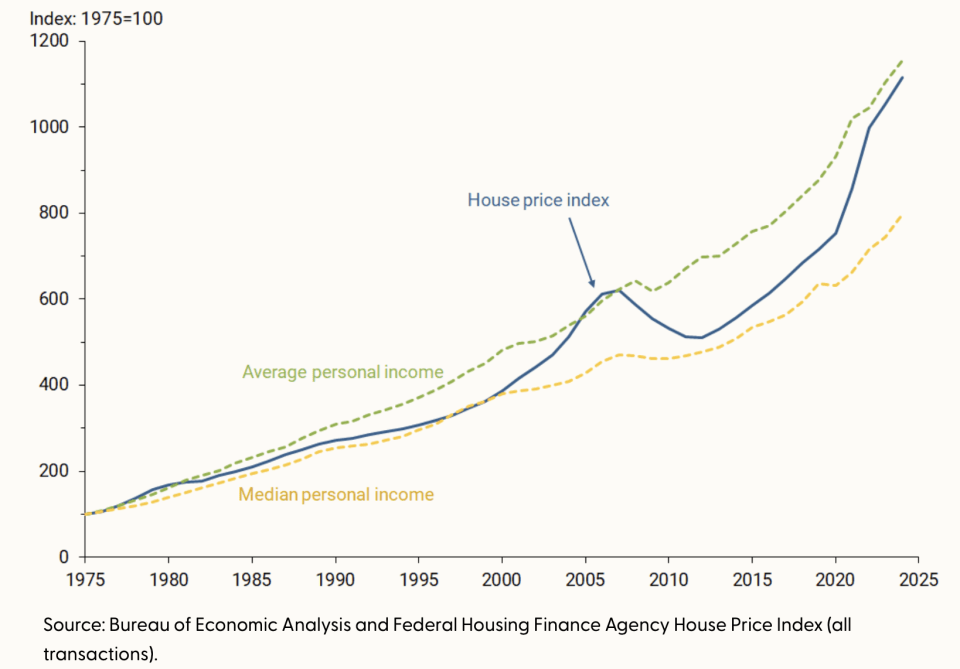
Meanwhile, when looking at income and housing supply from 2000 to 2020, there is no relationship. The reason may be that when US households become wealthier, they prefer to renovate houses, move to nicer areas, or find other ways to improve the quality of their homes-rather than buying more houses.
Rather than higher incomes, the arrival of new households in a city boosts supply, and the data shows that “growth in housing supply is strongly correlated with population growth in all metro areas.”
Researchers have highlighted two different types of needs. If the demand grows for better quality housing, house prices will rise while the demand for the number of housing units remains unchanged.
But if the demand for housing from the growth of the population that remains constant income, the demand for the number of units increases, which increases the price and supply.
“This suggests that the housing affordability crisis can best be addressed by understanding changes in the labor market, particularly the relative distribution of economic growth across income levels and occupations in different areas,” they concluded.