itstargetnews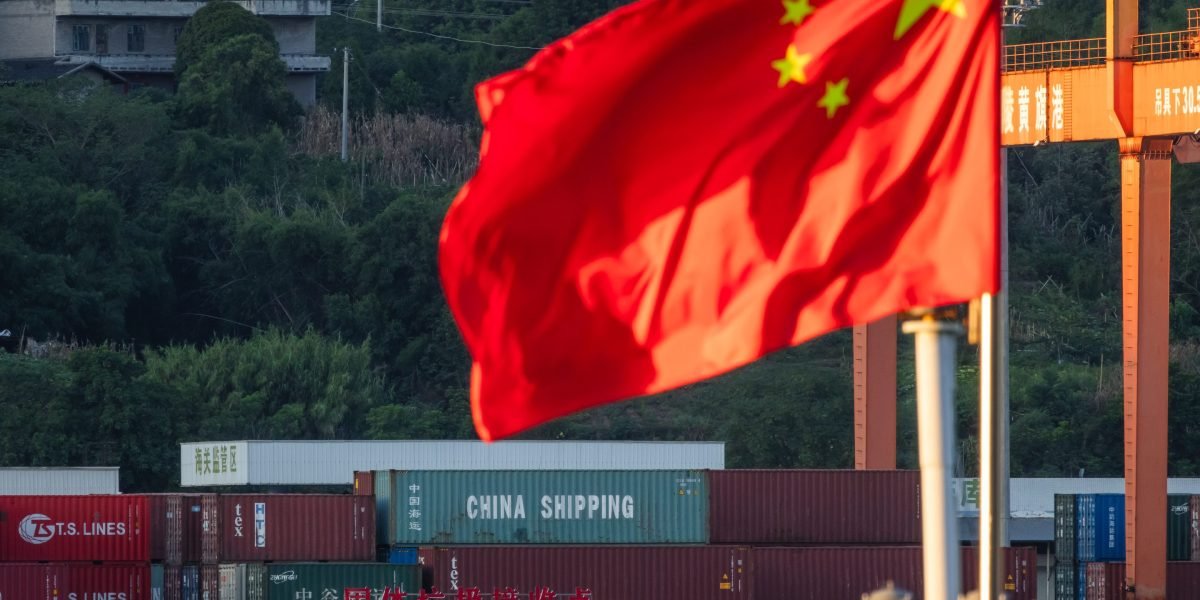
A flood of Chinese exports around the world has helped the economy pass a slew of tariff hikes by President Donald Trump, while Beijing touts breakthroughs in AI, EVs, robotics and other emerging technologies.
But that strength masked continued weakness in the consumer and property sectors.
China’s trade surplus jumped 20% to $1.19 trillion by 2025, marking the world’s largest ever, as shipments increased to the European Union, Africa, Latin America and Southeast Asia.
Exports rose 5.5% and accounted for a third of economic growth in 2025, the highest level since 1997. Imports were almost flat, reflecting weak domestic demand and Beijing’s push to become more self-sufficient.
A record trade surplus helped GDP grow 5% last year, matching the government’s target, but the headline figure contrasted with growing signs of broader weakness.
Growth actually slowed at the end of the year, with GDP rising 4.5% in the fourth quarter on an annualized basis versus a 4.8% gain in the third quarter.
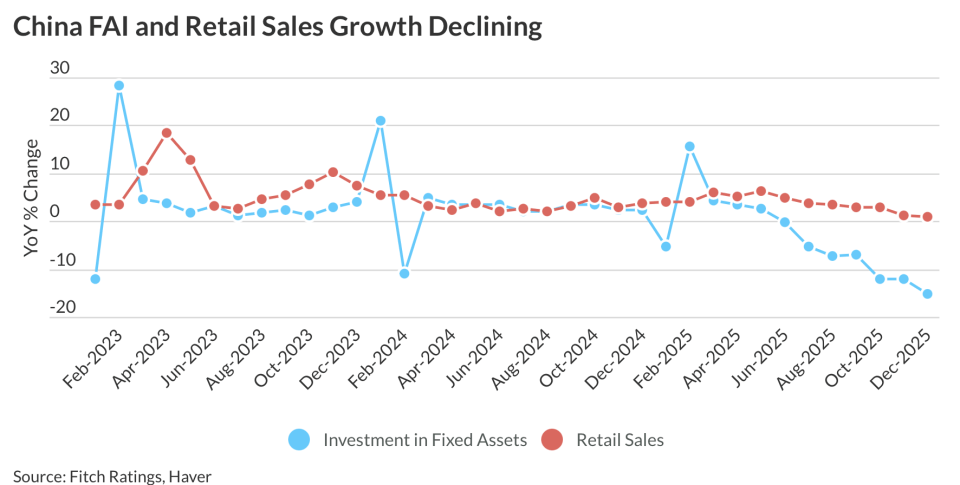
Retail sales in December rose just 0.9%, down from 2.9% growth in October and 6.4% in May. Investment in fixed assets returned sharply to a direct decline, collapsing 15% in December after spiking 15.7% in February.
In fact, fixed-asset investment saw its first annual decline in data going back nearly three decades. This is due to China’s real estate crash, which reduced property investment by 17.2% last year and offset heavy spending on high-tech industries that Beijing is trying to promote.
Fitch Ratings expects China’s economy to slow down this year, GDP growth forecast will cool significantly to 4.1% from 5% in 2025.
“We believe that domestic demand will remain restrained by weak consumer confidence, deflationary pressures, and investment headwinds that have extended beyond the correction of the property sector and been amplified by the increase in local government debt,” it said in a report on January 22.
But more than four years since China burst a construction bubble, about 80 million unsold or vacant homes continue to weigh on sales, prices, starts and completions.
After scuttling attempts to revive the property sector, China has signaled that it is pivoting to a new development model, away from promoting debt-based investment.
“This marks the virtual abandonment of an industry that once accounted for a quarter of China’s gross domestic product and roughly 15% of the nonfarm workforce,” Jeremy Mark, an Atlantic Council scholar and former IMF official, said. wrote on Wednesday.
Many other economic problems—such as weak retail spending, deflation, as well as low consumer and business confidence—can be traced back to the free fall of real estate, which is the main life savings store for hundreds of millions of households, he pointed out.
That’s as it is estimated that 85% of real estate price gains have disappeared since 2021. As a result, consumers are hoarding their money instead of spending it, forcing businesses to cut wages, staff and prices to stay afloat. In response, consumers are pulling back.
This feedback loop keeps consumer prices flat and producer prices in negative territory. China’s overcapacity and its support for manufacturers over consumers has also fueled an oversupply that has dragged down prices. A measure of prices across the economy shows that China has suffered deflation for three consecutive years, the longest consecutive growth streak since its transition to a market economy in the late 1970s.
The real estate crash is also spilling over into China’s banks and local governments, as efforts to prevent massive developer bankruptcies have created “zombie” companies and huge debts, Mark warned.
“Even if the shockwaves from China’s collapsed property bubble eventually subside, the task of rebuilding will be daunting,” he added. “This requires not only replacing a major pillar of China’s dynamic economy, but also reviving the increasingly damaged financial sense of homeowners.”
Export-led growth has run out of room
Economists have long urged China to rebalance its growth toward a consumer-led model and away from an export- and investment-led model. President Xi Jinping’s industrial policies have been flagged as a greater threat to the global economy than Trump’s trade war.
But confidence in exports last year shows the country’s leadership remains reluctant to make the transition. As Chinese businesses flex their muscle as global manufacturing powers, their ability to support the rest of the economy is in doubt.
“China’s growth model is becoming increasingly difficult to sustain,” Cornell professor Eswar Prasad wrote in a Financial Times op-ed in December.
Weak growth in employment and wages, in addition to the property crash and lack of confidence in the government, weighed on consumption, he added. With little domestic demand, the only option for Chinese factories is to export their output.
But Trump’s tariffs are forcing exporters to look elsewhere, creating a backlash in other markets that could put up more trade barriers and limit future growth, Prasad said.
The EU and other major economies such as Indonesia and India have already imposed some targeted tariffs on some Chinese products.
“As the world’s second-largest economy, China is too big to generate much growth from exports, and remains vulnerable to risks to export-led growth that exacerbate global trade tensions,” IMF Managing Director Kristalina Georgieva Warned in December.