itstargetnews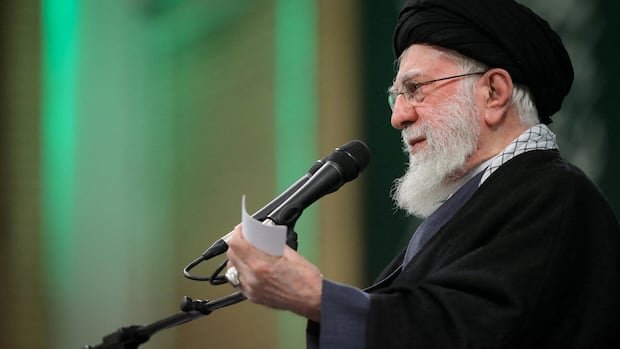
Iran’s supreme leader warned on Sunday that any attack by the United States would spark a “regional war” in the Middle East, further escalating tensions as US President Donald Trump threatened a military strike against the Islamic Republic over its crackdown on recent protests across the country.
The 86-year-old Ayatollah Ali Khamenei’s comments are the most direct threat he has issued yet since the aircraft carrier USS Abraham Lincoln and associated US warships are in the Arabian Sea, where they were sent by Trump after Tehran’s bloody crackdown on recent protests across the country.
It remains unclear whether Trump will use force. He has repeatedly said Iran wants to negotiate and has brought up Tehran’s nuclear program as another issue he wants to see resolved.
But Khamenei also called the protests across the country a “coup d’état”, reinforcing the government’s stance as tens of thousands of people have reportedly been detained since the protests began over the state of Iran’s economy. Sedition charges in Iran can lead to the death penalty, reigniting concerns that Tehran is carrying out mass executions of those arrested — a red line for Trump.
Iran also planned a military live-fire drill for Sunday and Monday in the strategic Strait of Hormuz, the narrow entrance to the Persian Gulf through which a fifth of all oil trade passes. The U.S. military’s Central Command warned against threats to U.S. warships or aircraft during exercises or disrupting commercial traffic.
Khanei Warnei warns the US
Khamenei addressed the crowd at his compound in Tehran as Iran marked the start of a multi-day commemoration of the country’s 1979 Islamic Revolution.
At one point he described the US as interested in Iran’s oil, natural gas and other mineral resources, saying they wanted to “take over this country, as they used to control it.”
“The Americans must be aware that if they wage war this time, it will be a regional war,” he said.
Khamenei added: “We are not instigators, we will not be unfair to anyone, we do not plan to attack any country. But if anyone shows greed and wants to attack or harass, the Iranian nation will deal a heavy blow to him.”

Khamenei also toughened his stance on the protests after earlier acknowledging that some people had legitimate economic problems that fueled their protests. Demonstrations began on December 28, initially due to the fall of the Iranian currency, the rial. It soon grew into a direct challenge to Khamenei’s rule.
“The recent uprising was similar to a coup. Of course, the coup was suppressed,” he said. “Their aim was to destroy sensitive and effective centers involved in the running of the country, and for this reason they attacked the police, government centers, (Revolutionary Guard) facilities, banks and mosques – and burned copies of the Koran. They aimed centers that lead Earth.”
A new US-based human rights agency, which relies on a network inside Iran to verify its information, reports that more than 49,500 people have been detained in the crackdown.
At least 6,713 people are said to have been killed in the violence, the vast majority of them protesters. The Associated Press could not independently estimate the number of dead and arrested, given that authorities have cut off Iran’s internet from the rest of the world.
As of January 21, the Iranian government put the death toll far lower at 3,117, saying 2,427 were civilians and security guards force, calling the others “terrorists”. in In the past, the Iranian theocracy has undercounted or underreported unrest-related deaths.
The death toll exceeds any other round of protests or unrest in Iran in decades and is reminiscent of the chaos that surrounded the 1979 revolution.
EU armies are considered terrorist groups
Iran’s parliament speaker, meanwhile, said the Islamic Republic now considers all European Union troops to be terrorist groups, lashing out after the bloc designated the paramilitary Revolutionary Guard as a terrorist group for its involvement in the bloody crackdown.
Mohammad Bagher Ghalibaf, the former commander of the Guard, announced the terrorism designation, which is likely to be largely symbolic.
Iran used a 2019 law to reciprocally designate other countries’ militaries as terrorist groups after the United States designated the Guard as a terrorist group that year.

Iran announced it would conduct live-fire drills in the Strait of Hormuz on Sunday and Monday, prompting the US military to warn Tehran not to threaten its warships or commercial traffic in the key waterway. CBC’s Julia Chapman and Thayer Marshall Institute’s David Des Roches break down the latest news on the growing tensions between the two countries.
Ghalibaf made the announcement as he and others in parliament wore Guard uniforms in support of the forces.
The Guard, which also controls Iran’s ballistic missile arsenal and has huge economic interests in Iran, answers only to Khamenei.
“By seeking to attack (the Guard), which in itself is the biggest obstacle to the spread of terrorism in Europe, the Europeans actually shot themselves in the foot and once again, through blind obedience to the Americans, decided against the interests of their own people,” Ghalibaf said.
During the session, the representatives later chanted “Death to America!” and “Death to Israel!”
Trump says Iran is in ‘serious talks’ with US
Trump has set two red lines for military action: the killing of peaceful protesters or the possible mass execution of those arrested in a massive crackdown on protests.
He also increasingly began to discuss Iran’s nuclear program, which the US negotiated with Tehran in multiple sessions before Israel launched a 12-day war with Iran in June.
The US bombed three Iranian nuclear sites during the war. The activity at the two sites suggests that Iran may be trying to obscure the view from the satellites as it tries to salvage what remains there.
The US president declined to say on Saturday night whether he had made a decision about what he wanted to do about Iran.
Speaking to reporters as he flew to Florida, Trump sidestepped the question of whether Tehran would be emboldened if the US backed off from attacking Iran, saying: “Some people think so. Some people don’t.”
Trump said Iran should negotiate a “satisfactory” deal to prevent the Middle Eastern country from getting any nuclear weapons, but added: “I don’t know if they will. But they’re talking to us. They’re talking to us seriously.”