itstargetnews
Rep. John Mannion, a New York Democrat, called ICE “a personal paramilitary unit to the president.” Journalist Radley Balko, who wrote a book about how America’s police forces are militarized, contended that President Donald Trump uses force “the way an authoritarian uses a paramilitary force, to create his own personal grudges, to inflict pain and violence, and discomfort on people he sees as his political enemies.” And New York Times columnist Jamelle Bouie describes ICE as “virtual secret police” and “paramilitary enforcers of despotic rule.”
As a professor of government who studies policing and state security forces, I believe it is clear that ICE meets many but not all of the most important definitions. It is worth examining what this is and how the administration is using ICE compared to the ways paramilitaries have been deployed in other countries.
The term paramilitary is often used in two ways. The first refers to the highly militarized police forces, which are an official part of the country’s security forces. They typically have access to military-grade weapons and equipment, are highly centralized in a hierarchical command structure, and deploy large-scale formation units to enforce domestic policing.
The second definition refers to less formal and often more partisan armed groups that operate outside the regular state security sector. Sometimes these groups, such as United Self-Defense Forces of Colombiaemerged in community self-defense efforts; in other cases, they are established by the government or receive government support, although they have no official status. Political scientists also call these groups “pro-government militias” to convey their political orientation in support of the government and less formal status as an irregular force.
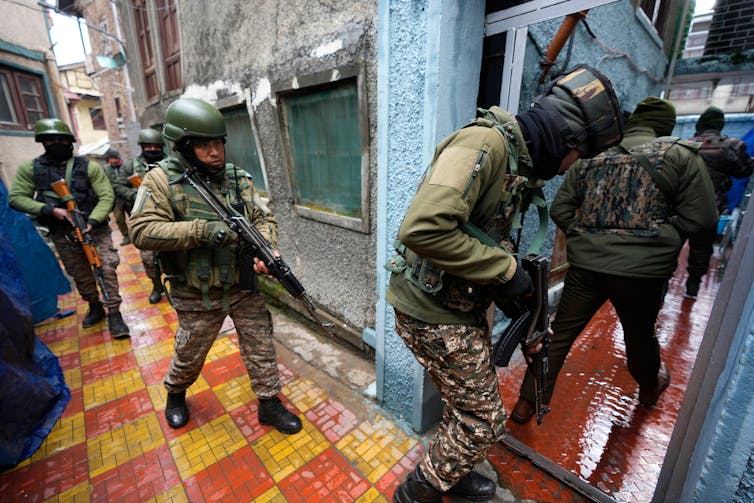
They usually receive less training than regular state forces, if any at all. How well equipped they are can vary. Leaders may turn to these informal or unofficial paramilitaries because they are cheaper than regular forces, or because they can help them. avoid liability for violent repression.
Many informal paramilitaries are engaged in regime maintenance, meaning they preserve the power of the current rulers by repressing political opponents and the wider public. They may share partisan affiliations or ethnic ties with prominent political leaders or the incumbent political party and work together to achieve political goals.
In Haiti, President François “Papa Doc” Duvalier Watch Macouts provides a prime example of this second type of paramilitary. After Duvalier survived a coup attempt in 1970he established the Tonton Macouts as a paramilitary counterweight to the regular military. Originally a ragtag, undisciplined but fiercely loyal force, it became the central instrument through which the The Duvalier regime implemented political repressionspying, harassing, detaining, torturing and killing ordinary Haitians.
Is ICE a paramilitary?
Recent references to ICE in the US as a “paramilitary force” use the term in two senses, viewing the agency as a militarized police force and tool for repression.
There is no question that ICE fits the definition of a paramilitary police force. It is a police force under the control of the federal government, through the Department of Homeland Security, and it is very militarizedwhich adopted the weaponry, organization, operational standards and cultural markers of the regular military. Other federal forces, such as the Customs and Border Patrol, or CBP, also fit this definition.
the data that I have collected of the state security forces indicated that approximately 30% of countries have paramilitary police forces at the federal or national level, while more than 80% have smaller militarized units similar to SWAT teams within the civilian police.
The United States has been almost alone among established democracies in creating new paramilitary police forces in recent decades. Indeed, the creation of ICE in the US after the terrorist attacks on Sept. 11, 2001, is one of only four times I have seen since 1960 the democratic country created a new paramilitary police forcethe others are Honduras, Brazil and Nigeria.
ICE and CBP also share some, though not all, of the characteristics of a paramilitary in the second sense of the term, which refers to forces as repressive political agents. These forces are informal; they are official agents of the state. However, their officials less professional, receive less supervision and operate in more overtly political ways than the regular military forces and local police in the United States. The lack of professionalism is prevalent in the current administration. In 2014, for example, the head of CBP’s internal affairs described the lowering standards for the post-9/11 expansion that led to the recruitment of thousands of officers who “may not be fit to carry a badge and a gun.” This problem is only exacerbated by rapid expansion made by the Trump administration. ICE has added approximately 12,000 new recruits — more than doubling its size in less than a year — while cutting the length of training they receive. ICE and CBP not subject to the same constitutional restrictions that apply to other law enforcement agencies, such as the Fourth Amendment’s prohibition on unreasonable search and seizure; both received exemptions from supervision intended to hold officers accountable for excessive force. CBP regulations, for example, allow this search and seizure of property of persons without warrant or the “probable cause” requirement imposed by other forces within 100 miles, or about 161 kilometers, of the border. In terms of partisan affiliations, Trump has cultivated immigration security forces as political alliesan effort that appears to be succeeding. In 2016, the union representing ICE officers endorsed the Trump campaign with support from more than 95% of its voting members. Now, ICE’s recruiting efforts are ramping up trust the far right message to appeal to political supporters. Both ICE and CBP have been deployed against political opponents in non-immigration contexts, including Black Lives Matter protests in Washington, DCand Portland, Oregonin 2020. They also gathered data, according to political scientist Elizabeth F. Cohen, to “guarding the political beliefs and activities of citizens – including the protest actions they’ve taken on issues as far away as gun control – in addition to immigrant rights.” In these ways, ICE and CBP bear some resemblance to the informal paramilitaries used in many countries to enforce political repression along partisan and ethnic lines, even though they are official agents of the state. A wide body of research shows that more militarized forms of policing are involved higher rates of police violence and rights violationswithout reducing crime or improving officer safety. Studies have also found that more militarized police forces are the more difficult it is to reform than less-militarized law enforcement agencies. The use of such forces will also create tensions between the regular military and civilian police, as seen today. happened at ICE in Minneapolis. The ways in which federal immigration forces in the United States resemble informal paramilitaries in other countries — operating with less effective management, less qualified recruits and more entrenched partisan identities — make all of these issues more difficult. That is why, I believe, many commentators have come up with the term paramilitary and used it as a warning. Erica De BruinAssociate Professor of Government, Hamilton College This article was reprinted from The Conversation under Creative Commons license. Read the original article.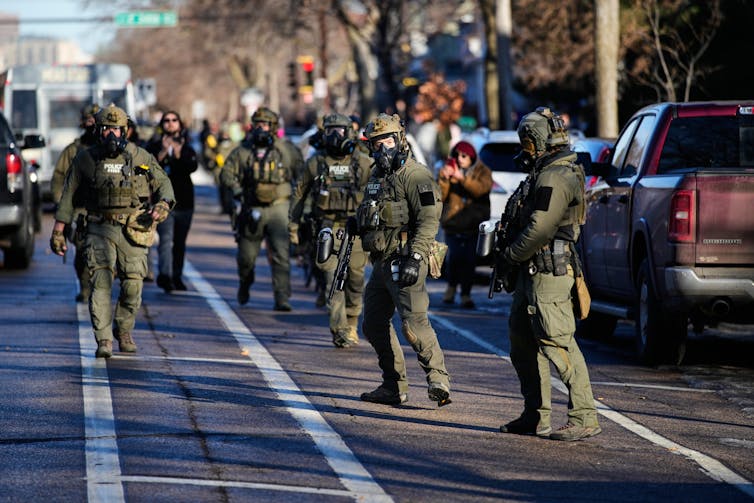
Why is this important?