itstargetnews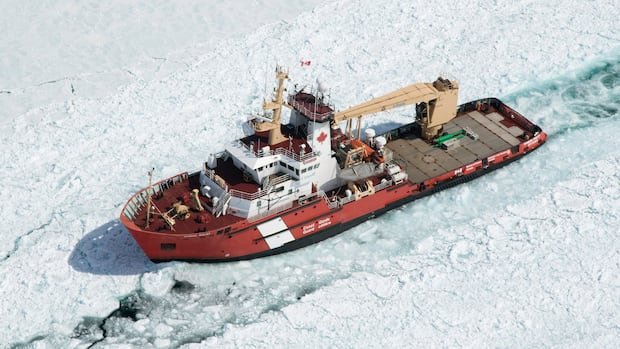
US President Donald Trump’s threats to Greenland and claims of continental hegemony contained in the new US national security strategy have awakened Canadians to realize the threat to their own Arctic sovereignty.
But Canada is still helping the Americans develop the very technology that could one day allow them to take control of all or part of Canada’s Arctic archipelago.
Canadian cooperation and design is key to building a new fleet of ships that the US intends to use to strengthen its presence in the regions surrounding the North Pole.
That new fleet will enter service under a new national security strategy that asserts the right to claim access to all regions of the Western Hemisphere.
“The DoW (Department of War) will therefore provide the President with credible options to guarantee US military and commercial access to key terrain from the Arctic to South America, particularly Greenland, the Gulf of Mexico and the Panama Canal,” the statement said. document. “We will ensure that The Monroe Doctrine takes place in our time.”
A controversial trip 40 years ago
The current situation between the US and Canada in the high Arctic is governed by informal agreements reached after the last sovereignty dispute in 1985.
That year, the US Coast Guard heavy icebreaker USCGC Polar Sea sailed from Greenland to the Chukchi Sea through the Northwest Passage. The US government did not seek Canada’s permission, but merely gave notice, in line with its long-standing rejection of Canada’s claims of passage.
(The distance between Arctic islands often exceeds the standard 12 nautical miles considered a nation’s territorial waters. Therefore, other countries question Canada’s claim that the channels between the islands are “internal waters”.)
The trip caused quite a stir in Canada, which the US government tried to defuse by allowing Canadian observers on board.
Two years after the Arctic Sea crossing, the US quietly agreed to seek Canada’s permission for future voyages, without recognizing Canadian rights. That situation it continues today.
As Brian Mulroney noted at the time, “One of the great ironies of the position taken by the United States, if followed to its logical conclusion, is that it could lead to much greater freedom of navigation in the Arctic for the Soviets.”
That’s because if the US insists the Northwest Passage is an international waterway, it risks opening it up to the world, says Rob Huebert, an expert on Arctic sovereignty and security at the University of Calgary.
“In whose mind would that be safer from an American perspective?” he said.
Who controls the passage?
Those considerations could convince the US to leave the status quo in the balance.
But those same legal realities could also persuade Washington to take a more aggressive stance by seizing land on both sides of the strait to assert its claim to “inland waters,” says Vincent Rigby, who served as the prime minister’s national security and intelligence adviser until 2021 and now teaches at McGill University.

CBC News Chief Political Correspondent Rosemary Barton asked The National’s At Issue panel about US President Donald Trump’s threats to seize Greenland and how Canada should respond.
In such a scenario, the US would require other nations – including Canada – to request permission to sail through what Canada considers Canadian territorial waters.
“If you did that,” said Huebert, “you’d have to take the whole coast by going through the Northwest Passage.”
“You could do that. There’s not much Canadian resistance up there.”
Huebert says that while the exact demands and actions the US will take remain unclear, pressure is almost certainly coming, and Canada should expect to hear false claims similar to those made by Trump about Russian and Chinese ships surrounding Greenland.
“I don’t think there’s any question at all, given how Trump has been so wrong in mischaracterizing the Greenland issue, that he’s just going to slide into the Canadian issue and misrepresent it as well,” he said.
ICE Pact
That reality sheds new light on the ICE (Icebreaker Collaboration Effort) pact, a 2024 agreement under which Canada, the U.S. and Finland will build icebreakers together, giving the U.S. a far greater ability to reach the high Arctic than it currently has.
“We intend to increase our capabilities using expertise and knowledge from Finland and Canada,” said a senior US security official he told CBC News in a background briefing in Washington in July 2024. “This is a strategic imperative.”
The tri-state ICE pact includes both of Canada’s largest shipbuilders, Davie and Seaspan. Quebec-based Davie Shipbuilding said it would help NATO catch up with adversaries whose shipbuilding efforts “operate on an effective war footing.”
“No nation can solve this challenge alone, but trusted allies with common goals and advanced shipbuilding can,” he said. company release.
But in the 18 months since that statement was issued, Washington’s status as a “trusted ally” has been repeatedly called into question.
“This is a good deal,” says ICE Pact’s Rigby. “Of course, when we first saw it before Trump’s return, it seemed good that we were helping each other build those capacities as NATO allies. But the question is now with the way Trump and the US administration have been operating, is that the right way to go? Should we be working with the US and potentially helping them build vessels that they will then use to violate Canadian sovereignty?”
“Don’t hit the panic button yet”
Delivery times are a factor in that calculation, experts say.
The first deliveries of the medium-sized Arctic Security Cutter are not expected until 2028-2029, when the current president’s term should end. The larger Polar Security Cutters will not be ready for years after that.
Rigby says this buys Canada some time.
“Don’t hit the panic button yet, don’t reject this agreement,” he said. “But you’re going to have to watch it very, very carefully as we move forward. And if the U.S. becomes more assertive and aggressive, those kinds of things will have to be reconsidered.”

“I don’t think we’ll ever get back to full normality with Canada-US relations. But we all hope that whoever comes in, there will be some renewed stability.”
Huebert says threats to Canadian sovereignty should not focus solely on America’s icebreaking capacity.
“People focus on the icebreakers, but it’s more about the amphibious capabilities (of the Americans) to go and occupy those four airspaces that we have (in Yellowknife, Inuvik, NWT, Iqaluit and Goose Bay, NL),” he said.
“Because if they can get in and take the four forward operating locations, we have no other routes to get up there. That gives you strategic command of the region.”
Canada has long talked about strengthening its presence in the Far North, and is now paying the price for failing to meet that commitment, experts say.
“We’ve been cruising the Arctic for a long, long time,” Rigby said. “If we say we’re going to get submarines, let’s move, let’s choose a submarine. If we’re going to improve our satellite capabilities, let’s move. This has to be the military’s number one priority.”
The need to see
In the meantime, Rigby says, Canada should send its new Arctic Offshore Patrol Vessels (AOPS) through the Northwest Passage more regularly to make its presence felt.
Huebert sees a threat more present in Canada’s Arctic islands than the passage.
While Trump himself may have his own motives, the US defense establishment is genuinely concerned about recent developments in Russian nuclear weapons technology, including stealthy hypersonic missiles and nuclear torpedoes that could target US ports.
Fears that America’s missile defense and deterrence will become obsolete are the impetus for the Gold Dome.
“It’s really about monitoring hypersonic, invisible cruise missiles that the Russians would come in with their bombers or with their submarines, trying to be undetected, launching and hoping that the old systems don’t detect them,” Huebert said. “That’s what this is about.”
It is in Canada’s interest, experts said, to continue to work with the Americans where Canada can safely do so, while building its own capabilities as quickly as possible.
“It’s a two-track game we’re playing now, Rigby said, adding that the upsides of the ICE Pact still outweigh the risks.
“I think it’s probably too early to start talking about terminating the agreement,” he told CBC News. “Let’s get on with that work and keep it short.”