itstargetnews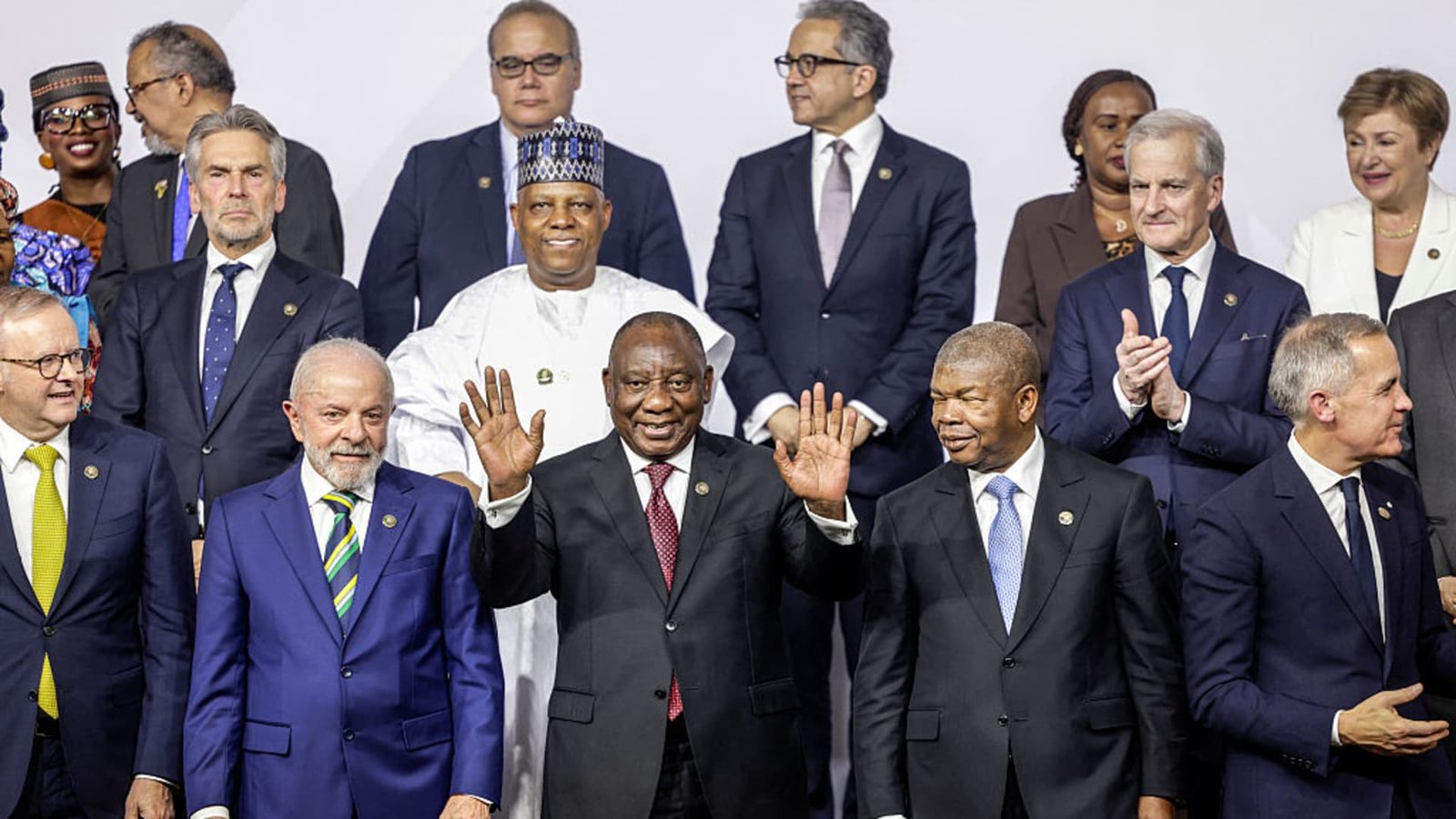
(First row from left to right): On November 22, Australian Prime Minister Anthony Albanese, Brazilian President Luiz Inacio Lula da Silva, South African President Cyril Ramaphosa, Angola President and African Union Chairman Joao Lourenco and Canadian Prime Minister Mark Carney attended a family photo event at the plenary session of the G20 Leaders’ Summit held at the Nasrec Expo Center in Johannesburg. 2025.
Gianluigi Gurcia | AFP | Getty Images
As U.S. dominance in the West reasserts itself and the rules-based international order becomes increasingly fractured, some are beginning to see the world’s “middle powers” as possible bulwarks against the growing unilateralism of the global superpowers.
Canadian Prime Minister Mark Carney expressed this hope last week, telling delegates at the World Economic Forum (WEF): The “middle powers” must work together Counter the rise of hard power, the disintegration of multilateral institutions such as the United Nations and the World Trade Organization, and build a more cooperative and peaceful world.
“Right now, the big powers have the ability to go it alone. They have the market size, the military capabilities and the influence to decide the terms. The middle powers don’t,” Carney told delegates.
“The middle powers must act together, because if we are not at the table, we will be on the menu,” he warned.
super power usually defined as Countries that hold permanent seats on the United Nations Security Council, such as China, France, Russia, the United Kingdom, and the United States. However, the only truly influential superpowers in the world right now are arguably China and the United States.
The definition of “middle power” is more opaque, although it is often used to refer to states that have economic, diplomatic, or political influence but are considered the “second echelon” of the geopolitical hierarchy.
On November 22, 2025, the G20 Leaders’ Summit opened at the Nasrec Expo Center in Johannesburg, South Africa. Leaders of various countries took a group photo.
Misper Apau | via Reuters
For example, according to the World Economic Forum’s white paper titled “Shaping Cooperation in a Fragmented World,” most countries in the G20 will be classified as “middle powers,” with Australia, Canada and South Korea being the most important middle power economies in the northern hemisphere, while Argentina, Brazil and Indonesia will be placed in the same camp in the southern hemisphere.
Counterattack by middle powers
Although he did not mention Trump by name, Carney’s speech was seen as a thinly veiled attack on the US president’s widespread threats and use of tariffs to suppress the US economy last year. Force partners to comply with trade terms Good for the states.
Trump’s comments also alarmed Western allies. Threaten to use force to seize Greenlanda semi-autonomous territory of Denmark. While there is no love lost for Venezuelan leader Nicolás Maduro, the United States’ unceremonious arrest of the leader has also raised questions about the United States. comply with international law.
Carney’s speech echoed the zeitgeist among Davos delegates, many of whom have expressed growing frustration with Trump’s hostility and disrespect for long-time allies. The Canadian leader has since been credited with leading the “middle power accusations” against Trump.
Analysts say if such accusations gain momentum, we could see more middle powers strike their own bilateral geostrategic agreements or trade deals, such as the one announced on Tuesday between india and euas a way to squeeze out the United States, or at least take the sting out of trade tariffs or threats.
“The most striking thing about Carney’s provocative speech is that it is the first time a leader of a close U.S. ally has the courage to stand up to President Donald Trump and say enough is enough,” said Stuart Patrick, senior fellow and director of the Global Order and Institutions Program at the Carnegie Endowment for Global Peace. said in a post-Davos analysis.
He added: “He laid out for everyone the disastrous impact of Washington’s current policies on the global order and said there was at least one erstwhile ally ready not only to confront an unpredictable and predatory United States, but to act as a counterweight to it if need be.”
DAVOS, SWITZERLAND – JANUARY 20: Canadian Prime Minister Mark Carney speaks at the World Economic Forum Annual Meeting on January 20, 2026 in Davos, Switzerland.
Anadolu | Getty Images
As expected, the White House wasn’t too happy. Trump denounces Carney In his own Davos speech, he said: “Canada exists because of the United States. Mark, remember that the next time you make a statement.”
Analysts note that while former U.S. allies may have begun to question the depth and strength of their relationships with the United States last year when Trump first unveiled his tariff policy, many are now beginning to openly question their alliance with Washington. This could have longer-term effects.
“America’s closest and oldest ally is now publicly questioning not only America’s credibility but its motives,” Michael Butler, professor and chair of Clark University’s political science department, said in emailed comments.
“This is significant because alliances are a two-way street, meaning that if U.S. foreign policy moderates under this or a future president, it would be wrong to assume that Canada and Europe will immediately rejoin them,” he said.
Limitations of middle powers
Carnegie’s Patrick noted that middle powers may be “playing their part,” but that doesn’t mean they can restore international cooperation and the old world order.
“A little realism is necessary,” Patrick points out. “First, although a multipolar world is inevitable, it is still in its infancy. Currently, the international political structure is still bipolar, dominated by two superpowers (China and the United States)”
Both countries are likely to try to thwart what he calls “middle power activism” and limit minilateral initiatives, even as middle powers try to balance the two geopolitical behemoths.
Second, he noted that “today’s middle powers are a heterogeneous group whose specific interests, competing values, and unique visions of the world often limit their unity and enthusiasm for joint projects.”
Finally, one should avoid idealizing middle powers, Patrick warned: “Not all middle powers are admirable, let alone willing to contribute to international cooperation. Even those that support multilateralism are motivated not by altruism but by self-interest, enlightened as they are.”