itstargetnews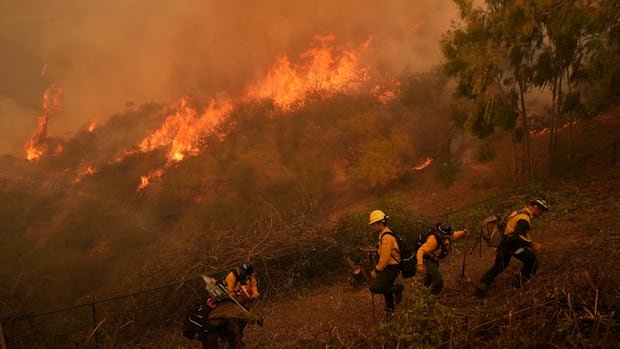

Listen to this article
Estimated 5 minutes
The audio version of this article was generated using artificial intelligence-based technology. Mistakes in pronunciation may occur. We work with our partners to constantly review and improve results.
Climate change exacerbated by human behavior has made 2025 one of the three hottest years on record, scientists say.
It was also the first time the three-year temperature average broke the threshold set by the 2015 Paris Agreement, which limits warming to no more than 1.5C since pre-industrial times. Experts say keeping Earth below that limit could save lives and prevent catastrophic environmental destruction around the world.
The analysis by World Weather Attribution researchers, published on Tuesday in Europe, came after a year in which people around the world were hit by the dangerous extremes brought about by a warming planet.
Temperatures remained high despite the presence of La Niña, an occasional natural cooling of the waters of the Pacific Ocean that affects weather around the world. The researchers cited the continued burning of fossil fuels – oil, gas and coal – which send greenhouse gases into the atmosphere that warm the planet.
“If we don’t stop burning fossil fuels very, very, very soon, it’s going to be very difficult to sustain that” warming goal, Friederike Otto, co-founder of World Weather Attribution (WWA) and a climate scientist at Imperial College London, told The Associated Press.
“The science is getting clearer.”
Heat waves were the deadliest disasters in 2025
Extreme weather events kill thousands of people and cost billions of dollars in damages annually.
WWA scientists identified 157 extreme weather events as the most severe in 2025, meaning they met criteria such as causing more than 100 deaths, affecting more than half of an area’s population or declaring a state of emergency. Of these, they carefully analyzed 22.

These include dangerous heat waves, which the WWA said were the world’s deadliest extreme weather events in 2025. The researchers said some of the heat waves they studied were 10 times more likely in 2025 than they would have been a decade ago because of climate change.
“The heat waves we’ve observed this year are fairly common events in our climate today, but would be nearly impossible to happen without human-induced climate change,” Otto said.
“It makes a big difference.”
Meanwhile, prolonged drought has contributed to forest fires that have engulfed Greece and Turkey. Torrential rains and floods in Mexico have killed dozens of people, and many are missing. Super typhoon Fung-wong hit the Philippines, forcing more than a million people to evacuate. Monsoon rains hit India with floods and landslides.
WWA said that more frequent and more severe extremes threaten the ability of millions of people around the world to respond and adapt to these events with sufficient warning, time and resources, which scientists call “adaptation limits”.
The report pointed to Hurricane Melissa as an example: the storm grew so quickly that it made forecasting and planning difficult, and hit Jamaica, Cuba and Haiti so hard that it left small island nations unable to respond to and cope with its extreme loss and damage.
Not a good year for global climate diplomacy
This year’s United Nations climate talks in Brazil in November ended without any explicit plan to transition off fossil fuels, and while more money has been promised to help countries adapt to climate change, it will take longer for them to do so.

Brazil’s COP30 presidency pushed through a compromise climate deal on Saturday that would boost finance for poor nations grappling with global warming, but omitted any mention of the fossil fuels that drive it. The deal drew objections from Colombia, Panama and Uruguay, before COP30 president Andre Correa do Lago suspended the plenary session for further consultations.
Officials, scientists and analysts have acknowledged that global warming will exceed 1.5C, although some say a reversal of that trend is still possible.
However, different nations are recording different levels of progress.
China is rapidly using renewable energy sources, including solar and wind power, but also continues to invest in coal.
While the increasing frequency of extreme weather has fueled calls for climate action across Europe, some countries say it is limiting economic growth. Meanwhile, in the US, the Trump administration has turned the nation away from clean energy policies in favor of measures that support coal, oil and gas.
“The geopolitical weather is very cloudy this year, and many policymakers are very clearly making policies in the interests of the fossil fuel industry, not in the interests of the people of their countries,” Otto said.
“We have a huge amount of misinformation and misinformation that people have to deal with.”
Andrew Kruczkiewicz, a senior researcher at Columbia University’s School of Climate Change who was not involved in WWA’s work, said places are facing disasters they are not used to, while extreme events are intensifying faster and becoming more complex.
That requires earlier warnings and new approaches to response and recovery, according to Kruczkiewicz.
“Globally, progress has been made,” he said. “But we have to do more.”