itstargetnews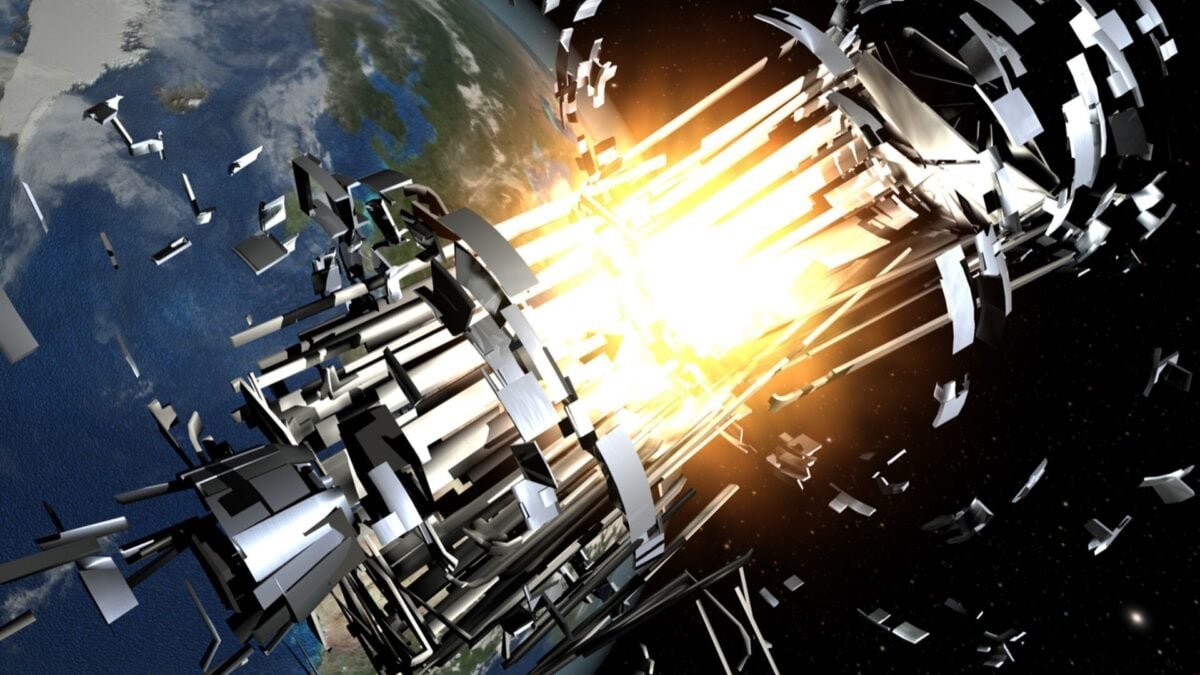

Last week, a Chinese spacecraft passed within 655 feet (200 meters) of a Starlink satellite, narrowly avoiding a collision. According to a new study, such near misses are now occurring all the time in low Earth orbit, and the risk of disaster is extremely high.
the findingswhich has not yet been peer-reviewed, paints a frightening picture. Based on the number of LEO objects in June, a sudden loss of collision avoidance capability could lead to a catastrophic crash in just 2.8 days.
Such a collision can cause a large-scale debris-generating event that can cause multiple collisions and can initiate the first stage of Kessler syndrome. In this theoretical scenario, LEO is so littered with orbiters and debris that collisions between objects set off a chain reaction, creating even more debris. This will weaken the satellite networks we rely on and make some orbits useless for new satellites and missions.
Kessler syndrome takes decades to fully develop, but we don’t want to delay this process if we can avoid it. Some experts BELIEVE it’s too late.
Counting the crash
Before you hyperfixate on this worst-case scenario and stare blankly, let’s talk about the immediate risks. That’s what the authors of this study aimed to quantify with their new metric: the Collision Realization and Significant Harm (CRASH) Clock.
The CRASH clock measures stress in the orbital environment by calculating how long it would take for a catastrophic collision to occur if satellite operators lose the ability to perform evasive maneuvers or suffer a significant loss of situational awareness.
The researchers’ calculations show that the CRASH clock is currently at 2.8 days, a surprising difference from 2018, when it was at 121 days. But that was the time before the megaconstellation. The number of objects in LEO has grown in recent years, jump from about 13,700 in 2019 to almost 24,200 in 2025.
According to the study, the satellites of all megaconstellations in low-Earth-orbit now pass within 0.6 miles (1 kilometer) of each other about every 22 seconds, providing ample opportunity for a collision.
Starlink on the edge
Starlink is the largest megaconstellation in LEO. the 9,300 Operational satellites consist of MANY of all active Earth-orbiting satellites, according to Harvard University astronomer Jonathan McDowell, who tracks the number of spacecraft in LEO. That number will only grow as SpaceX continues to launch thousands of Starlinks each year.
The study found that Starlinks passes within less than 0.6 miles (1 kilometer) of another object every 11 minutes in the densest part of the constellation. Starlinks currently average 41 collision avoidance maneuvers per satellite per year—that’s one maneuver every 1.8 minutes across the entire megaconstellation.
Historically, the number of collision avoidance maneuvers performed by Starlink has doubled every six months, the researchers said.
A sudden loss of the ability to perform these maneuvers can be unpleasant. It’s very bad. Although this is somewhat unlikely, the researchers quickly outlined two situations that could disrupt this capability: a major solar storm and a catastrophic software issue.
It is important that we take these risks seriously, not just when it comes to Starlink, but the entire population of maneuverable spacecraft in LEO. The researchers hope that the CRASH clock and the “high collision risk” it calculates will encourage decision makers to change the current approach to satellite deployment and operation “immediately.”