itstargetnews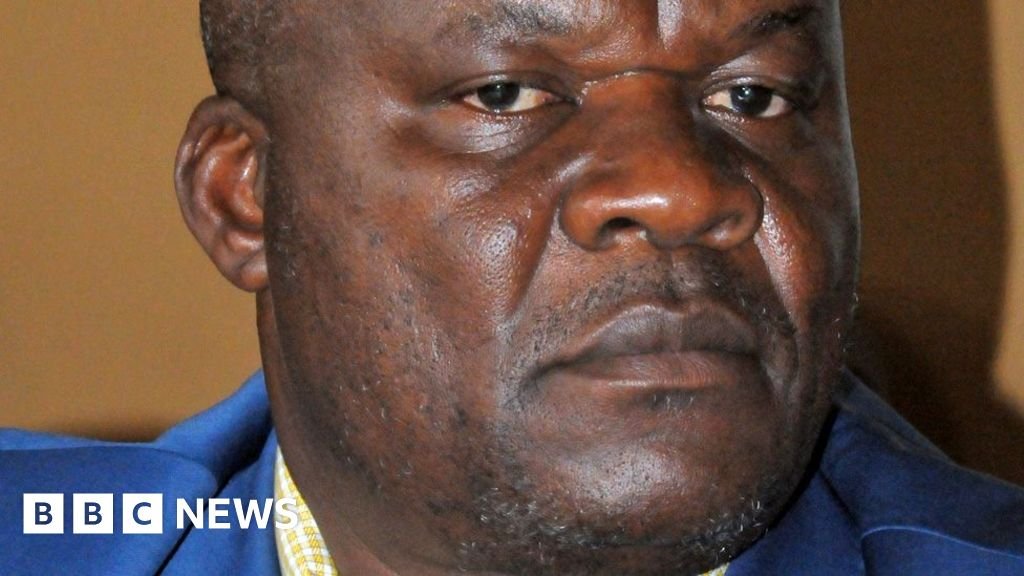
A French court has sentenced a former rebel leader and politician in the Democratic Republic of Congo to 30 years in prison after finding him guilty of crimes against humanity more than two decades ago.
Roger Lumbala led a rebel movement backed by neighboring Uganda that was accused of committing atrocities during the Second Congo War.
The judge said the 67-year-old man was found guilty of ordering or aiding and abetting torture and inhumane crimes, summary executions, rape amounting to torture, sexual slavery, forced labor and theft.
Lumbala, who was living in France when he was arrested nearly five years ago, has refused to accept the legitimacy of the Paris court.
He did not attend the trial, which began last month, although he was in the dock on Monday to hear the verdict.
Rumbala also served as a minister in the transitional government of the Democratic Republic of the Congo from 2003 to 2005 and later as a member of parliament.
A few years later, the Congolese government issued an arrest warrant for him on suspicion of supporting the M23 rebel group now active in eastern Democratic Republic of the Congo, prompting him to flee to France.
The Second Congo War raged from 1998 to 2003, involved nine countries and numerous rebel groups, and killed an estimated 2 to 5 million people.
At the time, Lumbala led the Rally of Congolese Democrats and Nationalists (RCD-N), a group that allegedly committed atrocities during a campaign known as “Erasure the Slate” between 2002 and 2003.
The operation targeted members of the Nande and Bambuti ethnic groups in the northeastern provinces of Ituri and North Kivu, who were accused of supporting rival militias.
A United Nations panel investigating the matter said It is characterized by “premeditated actions that use robbery, rape and summary executions as tools of war”.
The Lumbala case was prosecuted under the principle of “universal jurisdiction”, which allows French courts to seek justice for crimes against humanity committed abroad.
Five NGOs, including Trial International and the Clooney Foundation for Justice, pooled their expertise at the trial, helping to support survivors in testifying and requesting expert analysis.
Trial International, a Geneva-based justice movement, said 65 survivors, witnesses and experts testified in court about Operation Erasure Slate.
After the verdict, two survivors, David Karamay Kasereka and Pisco Sirikivuya Paluku, issued a statement.
“We are scared, but we have come all the way here because the truth matters. For years, our voices have not been heard,” they said
“We would much rather have faced Roger Lumbala and looked him in the eyes. But this verdict marks the first step toward reclaiming the pieces of ourselves that were taken from us.”
During the trial, Kasereka, 41, described how his father and neighbors were tortured and killed by Lumbala’s men, the Associated Press reported.
Mr Paruku, 50, told how rebels robbed and injured him, killed his uncle and raped his friend’s wife, AFP reported.
“We hope this will serve as a lesson to those who continue to bring sorrow to the Congolese people, especially the people of Ituri,” he told Reuters.
Lumbala’s legal team has 10 days to appeal, saying the sentence is too harsh, the Associated Press reported. Prosecutors sought a life sentence.
Mineral-rich eastern Democratic Republic of Congo has been ravaged by conflict for more than 30 years since the 1994 Rwandan genocide. Several peace agreements since the 1990s have collapsed.
Over the years, a number of other militia leaders, including Thomas Lubanga, Germain Katanga and Bosco Ntaganda, have been tried and convicted by the International Criminal Court (ICC) for abuses committed in eastern DRC.
Rights groups welcomed Monday’s verdict as a milestone in further accountability for the long-running conflict there.
Daniele Perissi of the International Trial Group said in a statement: “This verdict is historic. For the first time, a national court dares to confront the atrocities of the second Congo war and shows that justice can be done even after decades of impunity.”