itstargetnews

 Getty Images
President-elect Donald Trump has demanded that Panama lower tolls on the Panama Canal or hand it back to the United States, accusing the Central American country of charging “exorbitant prices” for U.S. shipping and naval vessels.
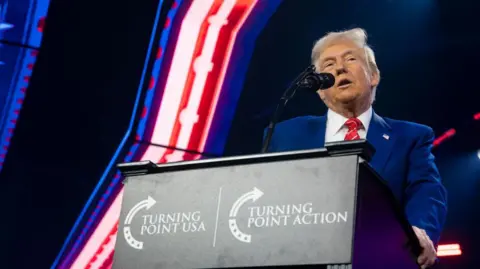
“The fees Panama charges are ridiculous and deeply unfair,” he told a crowd of supporters in Arizona on Sunday.
“This complete plunder of our country will stop immediately,” he said, referring to when he takes office next month.
His comments were immediately rebuked by Panama’s president, who said “every square meter” of the canal and surrounding area belongs to Panama.
President José Raul Mulino added that Panama’s sovereignty and independence are non-negotiable.
Trump made the remarks to supporters of Turning Point America, a conservative activist group that has given significant support to his 2024 campaign.
It’s a rare example of a U.S. leader saying he can push a country to hand over territory – although he didn’t explain how he would do so – and an indication of how U.S. foreign policy and diplomacy may shift once he’s in the White House. Taking office on September 20th.
Trump’s comments came a day after he said the Panama Canal was a “vital national asset” to the United States.
Trump said on Sunday that if freight rates were not reduced, “we will demand that the Panama Canal be returned to us completely, quickly and without question.”
The 51-mile (82-kilometer) Panama Canal traverses Central American countries and is the main channel connecting the Atlantic and Pacific Oceans.
Up to 14,000 ships pass through here every year, including container ships carrying cars, natural gas and other cargo, as well as warships.
It was built in the early 1900s. The United States controlled the Canal Zone until 1977, when it gradually ceded the land to Panama under a treaty. After a period of joint control, Panama gained sole control in 1999.
The United States reserves the right to use military force to defend the canal against any threat to its neutrality—a threat that now appears to come from the United States itself.
Neutrality treaties guarantee fair access and non-discriminatory fees to all nations. Different shipping lines do pay different fees to transit the canal – but this depends on the size of the ship and the load on board, rather than the country of origin.
Canal shipping costs have increased over the past year due to a historic drought, according to analysis by leading shipping industry website Lloyd’s List.
According to the Panama Canal Authority, about 75% of the cargo that passed through the waterway last fiscal year was destined for or originated in the United States.
However, the users of the canal are ship operators and shipowners, not the state itself.
Trump touches on common themes
In addition to Panama, the president-elect also criticized unfair trade practices in Canada and Mexico. He accused them of allowing drugs and immigrants to enter the United States, even as he called Mexican President Claudia Scheinbaum an “amazing woman.”
Trump made the remarks in front of thousands of people at the annual Turning Point conference, one of the largest gatherings of conservative activists in the country.
Turning Point has devoted significant resources to canvassing battleground states aimed at supporting Trump and other Republicans during the campaign.
It was his first speech since Congress this week passed a deal to keep the U.S. government open after several provisions were removed, including one that would have raised the U.S. debt ceiling.
Trump has supported raising the debt ceiling, which limits the amount of money the U.S. government can borrow.
But his speech on Sunday avoided the issue entirely, instead recalling his election victory and touching on themes that were pillars of his campaign, including immigration, crime and foreign trade.
He did mention Elon Musk, though.
“You know, they’re in a new phase,” he said. “All different scams. The new one is that President Trump gave up the presidency to Elon Musk.”
“No, no, that’s not going to happen,” he said. “He’s not going to be president.”
Several speakers at the conference were critical of government spending and politicians from both parties, but the intra-Republican divisions that have played out in Congress in recent days were mostly suppressed.