itstargetnews
Mamoudzou, Mayotte — French President Emmanuel Macron traveled to the Mayotte archipelago in the Indian Ocean on Thursday to investigate the devastation caused by Cyclone Chido across French territory as thousands of people tried to get by without basic necessities such as water or electricity.
“Mayotte is destroyed,” an airport security agent told Macron as soon as he stepped off the plane.
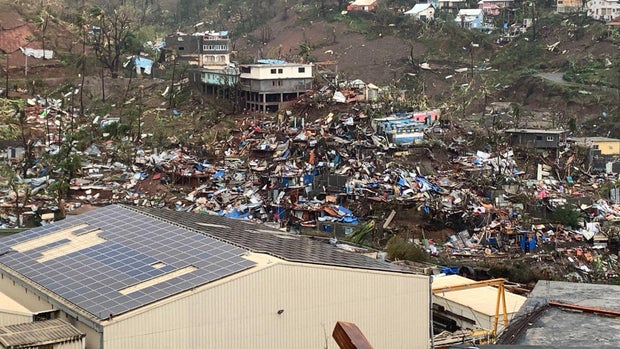
An insurance agent, Assane Haloi, said her family members, including young children, were without water, electricity and nowhere to go after the strongest cyclone in nearly a century hit the French territory of Mayotte off the coast of Africa on Saturday.
KWEZI/AFP/Getty
“There’s no roof, there’s nothing. There’s no water, no food, no electricity. We can’t even take shelter, we’re all wet with our children, we cover ourselves with whatever we have so we can sleep,” she said and asked for emergency help. help.
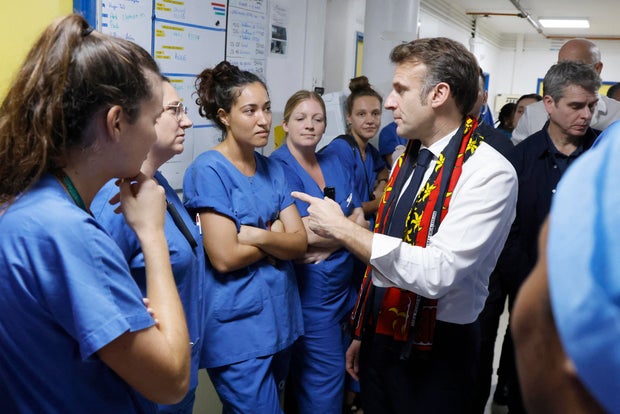
Macron was given a helicopter tour of the damage and was due to spend Thursday night in far-flung French territory. After flying over the devastation, he headed to a hospital in Mamoudzou, the capital of Mayotte, to meet with medical staff and patients.
Wearing a traditional Mayotte scarf over a white shirt and tie, the sleeves rolled up to the elbows, the French president listened to people asking for help. A member of the medical staff told him that some people had not drunk water for 48 hours.
Some residents also expressed agony at not knowing about those who died or were still missing, in part because of the Muslim practice of burying the dead within 24 hours.
LUDOVIC MARIN/POOL/AFP/Getty
“We are dealing with mass graves in the open,” Mayotte MP Estelle Youssouf told reporters. “There are no rescuers, no one came to pull out the buried bodies.”
Some survivors and humanitarian groups described hurried burials and the stench of the bodies.
Macron admitted that many who died were not reported. He said phone services would be restored “in the coming days” so people could report their loved ones missing.
French authorities said at least 31 people were killed and more than 1,500 people were injured, more than 200 in critical condition. But hundreds or even thousands of people are feared to have died in total.
Abdou Houmadou, 27, said the ambulance was needed immediately, not Macron’s presence.
“Mr. President, what I would like to say to you … is that I think that the expenses that you incurred from Paris to Mayotte would be better spent helping people,” he said.
Another resident, Ahamadi Mohammed, said Macron’s visit was “a good thing because he will be able to see the damage for himself.”
“I think then we will get significant help to try to get the island back on its feet,” the 58-year-old said.

LUDOVIC MARIN/POOL/AFP/Getty
Macron’s office said four tons of food and medical aid, as well as additional rescuers, were on the president’s flight. According to the French military, a naval ship was due to arrive in Mayotte on Thursday with another 180 tons of aid and equipment.
The cyclone hit people living in a large slum on the outskirts of Mamoudzou the hardest. Many have lost their homes, some friends.
Nassirou Hamidouni took shelter in his house when the cyclone hit.
His neighbor died when the house collapsed on him and his six children. Hamidouni and others dug through the ruins to get to them.
This 28-year-old father of five is now trying to rebuild his own house, which was also destroyed.
He believes the death toll is much higher than what is officially reported, given the severity of what he went through.
“It was very difficult,” he said.
Mayotte, located in the Indian Ocean between the east coast of mainland Africa and northern Madagascar, is the poorest territory of France.
The cyclone devastated entire neighborhoods and many people ignored the warnings, thinking that the storm would not be that strong.
Mayotte has a population of more than 320,000 according to the French government. The majority are Muslims, and the French authorities estimate that another 100,000 migrants live there.
Mayotte is the only part of the Comoros archipelago that voted to remain part of France in the 1974 referendum.
During the last decade, the French territory experienced a massive influx of migrants from the neighboring islands – the independent state of Comoros, which is one of the poorest countries in the world.